


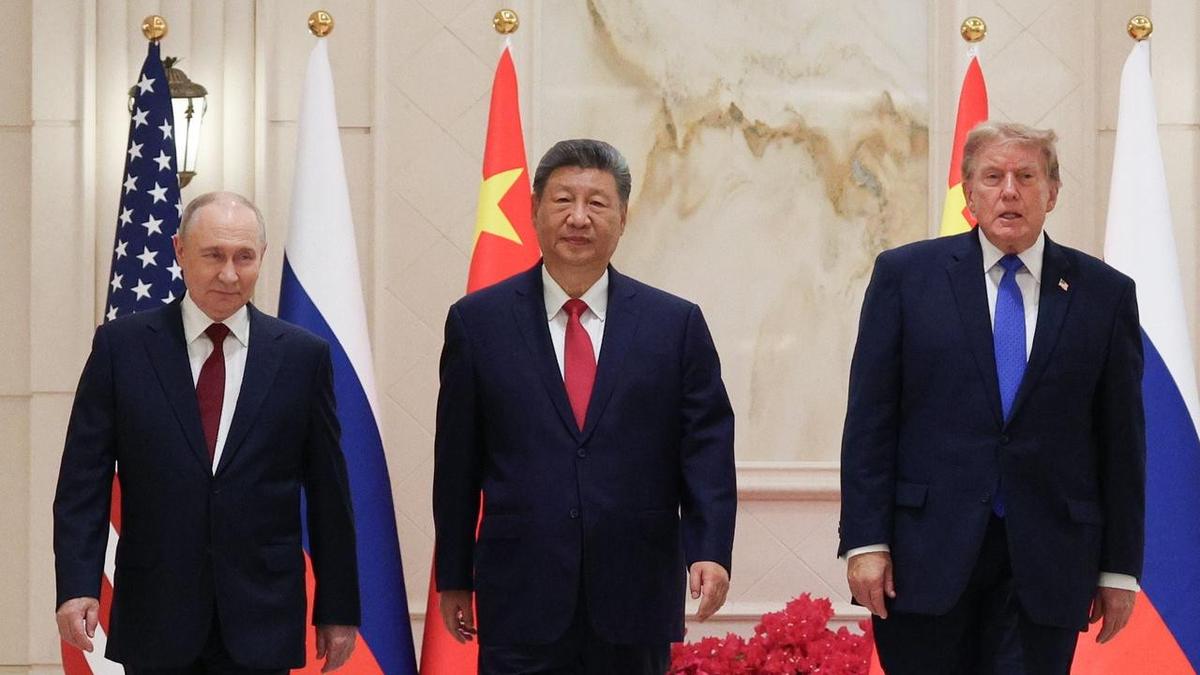
Donald Trump, Xi Jinping and Vladimir Putin have completed an unprecedented trilateral meeting in Shenzhen, where the leaders of the US, China and Russia discussed the war in Ukraine and nuclear arms control.
The talks took place at Kylin Villa, beside a lake among wooded hills, on the sidelines of an Asia-Pacific summit. The three leaders described the encounter as historic but made no immediate statement at its conclusion.
“We are really making history,” Mr Trump said at the start of the meeting. “No peace was ever forged by declining opportunities for engagement.”
Mr Putin said the three countries had “numerous shared interests in the settlement of regional conflicts, including obviously the conflict in Ukraine”. His comments came after a setback in Russia’s war following damage to a key bridge linking Crimea and Russia.
Mr Xi did not refer directly to Ukraine in his opening remarks. Instead, he said: “History tells us that when major powers live in harmony, the world is at peace. When major powers clash, the world falls into turmoil.”
The meeting brought together the world’s biggest nuclear powers despite deep divisions over Ukraine, Iran, nuclear weapons and trade. Its scale has also unsettled smaller countries concerned that their interests could be overlooked by the three major powers.
Chinese state media quoted Mr Xi as telling the other leaders that nuclear weapons should be “prohibited” and “eliminated, with the ultimate goal of establishing a world free of nuclear weapons”. China has made similar calls previously while expanding its nuclear programme.
Mr Xi also urged countries involved in conflicts to pursue negotiations. “China, Russia, and the United States should continue encouraging parties to conflicts to sit down and engage in talks, and resolve disputes through political and diplomatic means,” he said.
Before the trilateral talks, Mr Trump held separate meetings with Mr Xi and Mr Putin, referring to both men as friends. He said he and the Chinese leader shared strong views on the need for oil to continue flowing through the Strait of Hormuz, which has been disrupted by the war in Iran. Mr Xi did not mention Iran directly in his public remarks.
Mr Xi greeted Mr Trump at the airport, the first time he has done so for a visiting leader since becoming China’s president. The gesture reciprocated Mr Trump’s welcome for Mr Xi at Joint Base Andrews in September, and the two men briefly hugged.
Mr Trump praised the ceremony surrounding his arrival, including the soldiers, children and pageantry, contrasting it with the more muted reception given to other leaders. Japan’s Prime Minister Sanae Takaichi arrived without a welcoming ceremony.
Trade and technology also weighed on the wider discussions. Mr Trump and Mr Xi met after extending a trade truce earlier this month, but tensions remain over reports that Nvidia chips have been diverted to China through South-east Asia, raising questions about US export controls and Chinese access to advanced technology.
Craig Singleton of the Foundation for Defense of Democracies said China wanted chip access that it could negotiate directly with the US president, but could instead face restrictions written into law by both American political parties.
The villa has previously hosted sensitive diplomatic encounters, including visits by former North Korean leader Kim Jong-il, Mr Xi’s father Xi Zhongxun and envoys of the Dalai Lama.
