


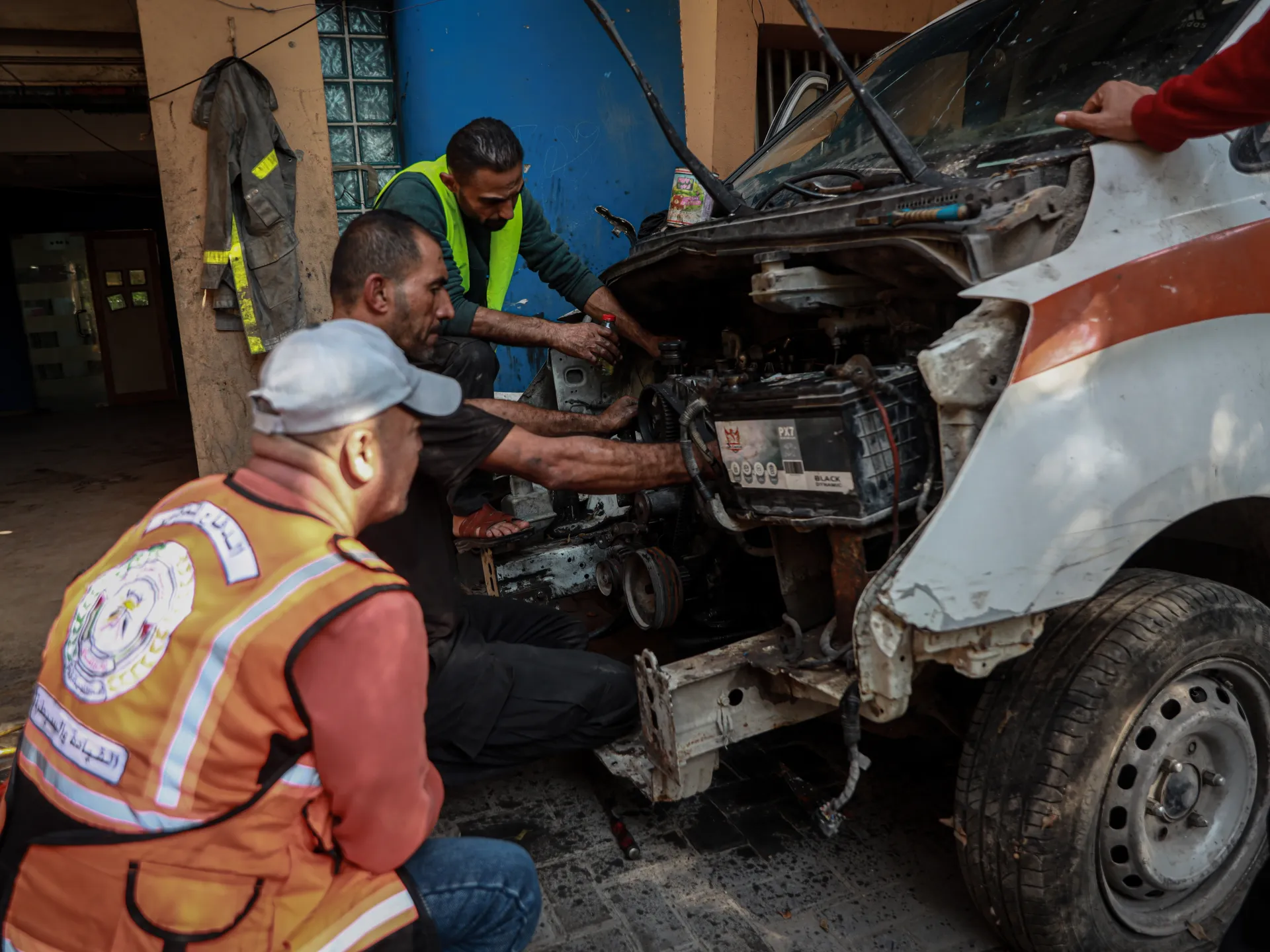
Gaza Civil Defence vehicles are increasingly unable to reach people trapped by Israeli attacks, fires and building collapses, with more than 85 per cent of the department’s fleet out of service, officials have said.
In one recent incident, a crew in Gaza City heard an explosion but had to leave its only available fire engine behind because it would not start. The team ran to the scene carrying its equipment and brought injured people back on foot.
Abdullah al-Majdalawi, a Civil Defence field officer, said the incident happened near the al-Qattan Centre on November 3. It took about 10 minutes to reach the site, where the crew also recovered the body of a person killed in the strike.
In another incident in the Sabra neighbourhood of southern Gaza City last month, the vehicle being used by a Civil Defence team broke down while it was responding to an Israeli air strike. Several people had been killed by the time the crew arrived, while others were critically injured.
Al-Majdalawi said a faster response might have improved the injured people’s chances of survival. During a separate mission in 2024, the team had to use a donkey-drawn cart to carry personnel and equipment.
Gaza Civil Defence vehicles left without spare parts
The only dedicated rescue vehicle serving Gaza governorate is a Toyota Hilux pick-up that has been out of service for weeks. Al-Majdalawi said it is more than 20 years old and has been worn down by years of use and the demands of the war, which began in October 2023.
The crew has tried to keep it operational by improvising repairs, including patching its tyres with flour dough when proper work was not possible. It now needs a power steering pump, tyres and other components, while faults with its turbo system and warning lights make rescue missions more difficult, particularly at night.
“We have exhausted every means and every method to keep this vehicle running,” al-Majdalawi said.
Without the pick-up, crews must rely on larger fire engines, which are more difficult to manoeuvre through streets filled with tents, makeshift shelters and market stalls. When emergencies occur in different areas at the same time, limited vehicles force teams to decide which call to attend first.
Raed al-Dahshan, director of Gaza City’s Civil Defence, said only about 15 per cent of the department’s vehicles were operational across the territory. Many had been in service since 1994 and had completed tens of thousands of missions, while damaged roads and the war had accelerated their deterioration.
The vehicles had exceeded their expected working lives and urgently needed replacing, al-Dahshan said. International fire-service guidance generally recommends replacing frontline fire engines after 15 to 20 years.
The United Nations Office for the Coordination of Humanitarian Affairs warned in a May 1 report that restrictions on the entry of engine oil and spare parts were severely affecting humanitarian operations. It said prolonged shortages were causing vehicles and generators to fail, in some cases beyond repair, while also disrupting ambulance services and the removal of rubble.
Emergency crews struggle to keep equipment working
At a Civil Defence maintenance workshop, officers are attempting to keep the ageing fleet running with whatever materials they can find. Where replacement parts are unavailable or too expensive, mechanics refurbish old components or use substitutes.
Abd al-Fattah al-Nimra, a maintenance officer, said temporary parts did not perform as well as the originals. He said shortages and high prices had worsened since the start of the war, adding that some parts were not replaced because their entry was being prevented.
Even tyres and engine oil have become difficult to obtain within the department’s budget. The Gaza governorate rescue vehicle requires several key components, but some available locally are unaffordable, al-Nimra said.
The shortage comes as Civil Defence teams continue responding to air strikes, fires and buildings at risk of collapse. Heavy rain in early November caused damaged structures to fall and flooded displacement sites, but crews were able to attend only a minority of distress calls.
Many other callers were given instructions by telephone, highlighting the widening gap between the need for emergency assistance and the department’s capacity to provide it.
More than 140 Civil Defence personnel have been killed during the war, al-Dahshan said. Fewer than 1,000 employees remain across Gaza’s five governorates, with many continuing to work despite inadequate resources and irregular salaries.
Al-Dahshan warned that without urgent support the department could reach a point where it was unable to respond to calls at all. Civil Defence personnel and equipment are protected under international humanitarian law, including Article 62 of Additional Protocol I to the Geneva Conventions.
“We are not asking for much,” al-Majdalawi said. “We need tyres, engine oil and fuel. We are ready to dig through the rubble for hours and days to rescue people, but we need the equipment to do that.”
“If the world cannot stop the war on Gaza,” al-Dahshan said, “at the very least it should enable humanitarian services to rescue the injured before they die.”
