


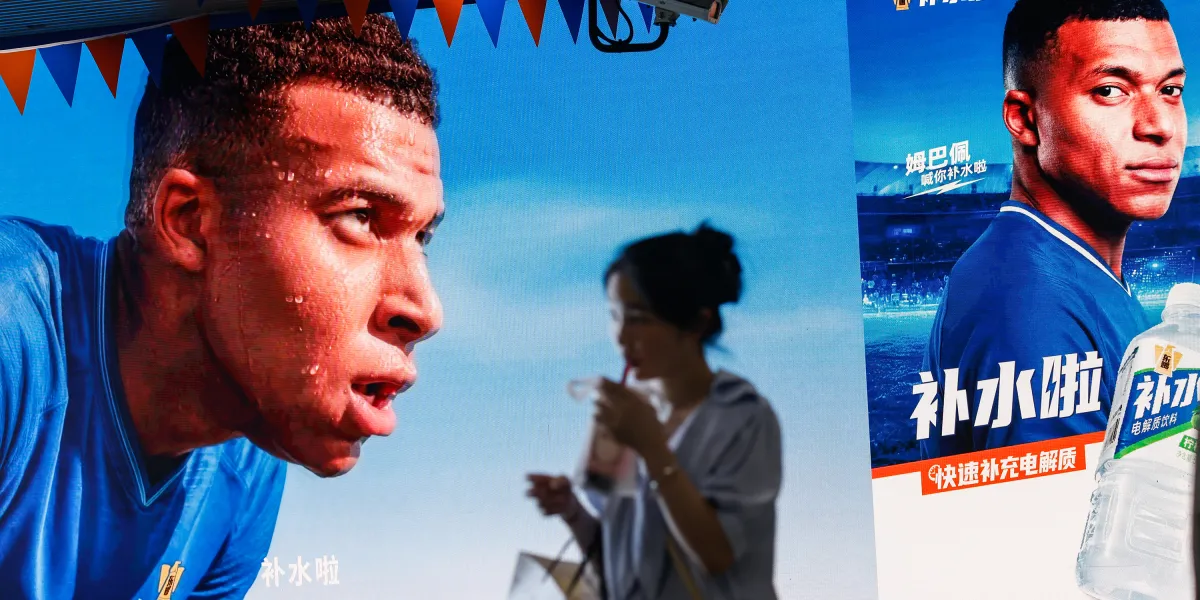
China’s economic coercion has drawn Real Madrid forward Kylian Mbappé, his club and La Liga into a diplomatic row after the footballer referred to a meme depicting him as Mao Zedong as showing “some guy—I think he’s a Chinese dictator”.
The remark, made on the French talk show The Bridge, triggered a swift backlash in China. Within a day, three Chinese sponsors had dropped Mbappé, while his name and image were removed from social media posts, advertisements and shops linked to Dior, Hublot, On and Adidas.
Mbappé’s accounts on the Chinese platforms Xiaohongshu, also known as RedNote, and Weibo were restricted. China’s state broadcaster also stopped showing La Liga matches, involving clubs including Real Madrid and Barcelona.
China’s foreign ministry described the reaction as natural. Mbappé later apologised for what he called an “ill-judged” comment, while Real Madrid said sorry to the Chinese people for any “discomfort” caused by the footballer’s words.
La Liga president Javier Tebas also apologised to Chinese fans. The league is estimated to earn around $100 million a year from Chinese media rights, while Real Madrid reportedly sells about 15% of its shirts in the country and has millions of Chinese supporters.
The episode has renewed calls for governments to provide collective protection for individuals and companies targeted by Beijing, rather than leaving them to withstand economic pressure alone.
Calls for a collective response to China
The proposed solution is a joint economic deterrence agreement, modelled on Nato’s mutual-defence principle, under which economic coercion against one country’s businesses or citizens would prompt a response from others.
Supporters of the idea argue that companies and individuals cannot realistically confront a nation state on their own. The European Union’s Anti-Coercion Instrument, which allows Brussels to impose tariffs and restrictions on trade, investment and public contracts, could be expanded to cover pressure directed at European companies and individuals as well as governments.
The backlash against Mbappé is not without precedent. In 2019, a tweet about the Hong Kong protests by Daryl Morey, then general manager of the Houston Rockets, led to all 11 of the NBA’s official Chinese partners suspending ties. Chinese state media also cancelled broadcasts, reportedly costing the league hundreds of millions of dollars.
Sports organisations remain heavily exposed to the Chinese market. European football clubs regularly tour China and sell merchandise there, while Formula One continues to race in Shanghai and the NFL is introducing flag football in Chinese schools.
Similar pressure has affected the film industry. MGM changed Chinese invaders into North Koreans in its remake of Red Dawn, while Taiwanese and Japanese flags were removed from Tom Cruise’s jacket in the first trailer for Top Gun: Maverick. In 2021, actor John Cena apologised in Mandarin after referring to Taiwan as a country while promoting a film.
These incidents can encourage athletes, filmmakers and companies to avoid comments or creative decisions that might provoke a response from Beijing. The effect, critics argue, extends beyond commercial disputes to issues including human rights, Taiwan and votes at the United Nations.
Research cited in the debate has identified 605 cases of Chinese economic coercion since the 1990s. Of those, 582 involved companies or individuals accused of slighting the legitimacy of the Chinese Communist Party, disputing territory, commemorating Tiananmen or supporting arms sales; 81% of the cases involved the G7 economies, Australia or South Korea.
The countries targeted by such measures may nevertheless possess leverage of their own. Eighteen countries previously punished by Beijing export more than $43 billion of goods to China on which Chinese industries are said to depend, including materials used in solar panels, batteries, construction and plastics.
Other economies affected by Chinese overcapacity supply key industrial inputs, including Brazil’s ferro-niobium for high-strength steel and jet-engine superalloys, and Indonesia’s ferro-nickel for stainless steel and electric vehicle batteries.
The French television programme that broadcast the clip has since deleted it. But the dispute has left Mbappé, Real Madrid and La Liga apologising, while calls continue for governments to ensure that the next individual or company targeted by Chinese economic pressure is not left to respond alone.
