


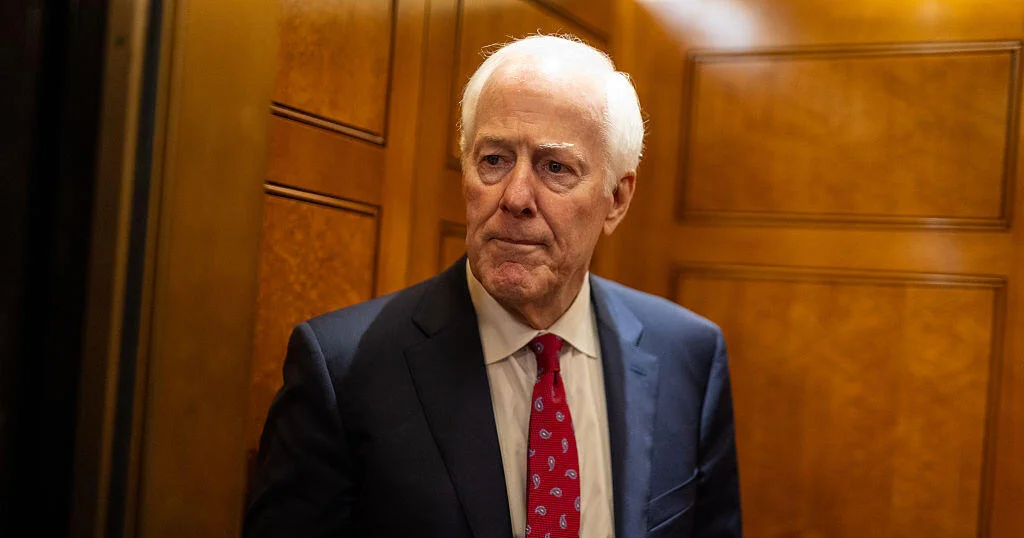
Republican Senator John Cornyn has blocked President Donald Trump’s nomination of Justice Department official T. Elliot Gaiser to a federal district court in the Dallas area, saying the candidate is not from Texas and lacks trial experience.
Cornyn declined to return a so-called blue slip for Gaiser, preventing the nomination from advancing to the Senate Judiciary Committee. “I think his nomination is no longer viable,” he told reporters on Capitol Hill.
Gaiser had been expected to appear before the committee, but was not among the seven judicial nominees who ultimately testified. His nomination was formally sent to the Senate on Monday, after Trump announced him as a candidate for the US District Court for the Northern District of Texas.
Why John Cornyn opposed the Gaiser nomination
Explaining his decision, Cornyn said: “He’s not a Texan, has no trial experience, and the White House tried to jam the Senate and wouldn’t allow us to do our due diligence that we need to do on lifetime appointments.”
He later said Gaiser’s lack of ties to Texas was “a basic problem”, accusing the White House of failing to consult the Senate. “The Constitution provides for advice and consent, but there was no consultation whatsoever, no attempt to try to work with the Senate,” Cornyn said.
The blue-slip process is intended to allow the two senators representing a nominee’s home state to express their views before a district court nomination proceeds. For the Texas vacancy, those senators are Cornyn and Republican Senator Ted Cruz.
A nominee can generally receive a Judiciary Committee hearing only after both home-state senators return positive blue slips. Judiciary Committee chairman Chuck Grassley has retained the practice for district court and US attorney nominations despite Trump’s calls for it to be scrapped.
Gaiser, a native of Ohio and the state’s former solicitor general, appears to have only limited links to Texas. He spent a year clerking in Houston for a judge on the US Court of Appeals for the Fifth Circuit, but lived in Ohio before joining the Trump administration last year as head of the Justice Department’s Office of Legal Counsel.
In a questionnaire submitted to the committee, Gaiser said Cruz’s staff first contacted him about the vacancy on November 4. He said he spoke to Cornyn’s office two days later and was told on the same day that the White House counsel’s office was considering him for the role.
Gaiser has also faced criticism over opinions issued through the Office of Legal Counsel, whose advice on legal questions is considered binding on the executive branch. He authored an opinion providing a justification for US military strikes on alleged drug-smuggling boats in the eastern Pacific Ocean and Caribbean Sea.
Other opinions attributed to Gaiser said the Presidential Records Act was unconstitutional and concluded that private advisers to Trump were generally protected from future congressional and legal investigations by executive privilege.
The Judiciary Committee is seeking to advance remaining judicial nominations during Congress’s lame-duck session before the new Congress begins in January and control of the Senate changes hands. Democrats are expected to hold 56 Senate seats, making confirmation of some of Trump’s nominees to district and appeals courts unlikely.
