


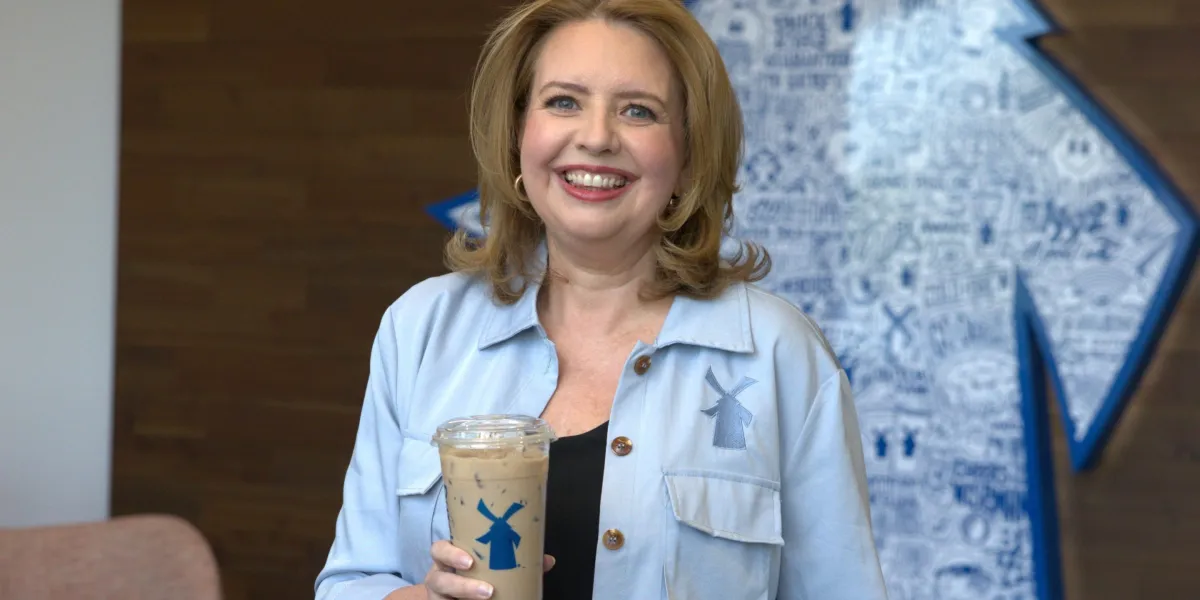
Dutch Bros chief executive Christine Barone has completed a two-week barista bootcamp alongside the coffee chain’s other senior leaders, learning to prepare drinks and work behind the counter as part of the company’s “growth from within” approach.
The training includes six practical shifts in a shop, where executives develop their hospitality skills, practise recipes and learn how the business delivers speed, quality and service. Staff were also willing to correct Barone when she made mistakes, despite knowing she was the company’s CEO.
“As I trained, people knew I was the CEO, and our teams would always point out when I was doing something wrong,” Barone said.
She described that willingness to challenge senior management as a sign of a healthy workplace culture. “When my team cares so much about the customer that they’re going to tell the CEO that they were doing something wrong, I love that,” she said.
The course is designed to give leaders a direct understanding of the work carried out by Dutch Bros’ 25,000 broistas. Participants learn how customer relationships are built, how drinks such as the Golden Eagle coffee are made, and how the chain aims to ensure consistency between shops and shifts.
Leaders must also pass a test known as “Flow”, which covers drink recipes, the company’s history, shop operations and its culture. Those who fail are required to take it again.
Dutch Bros’ growth-from-within model
Barone said the programme reflects the ambitions of Dutch Bros founders Travis Boersma and the late Dane Boersma. The brothers named the business after their grandparents, who immigrated from the Netherlands.
She said the training was intended not only to build technical and hospitality skills, but also to create opportunities for employees to progress through the business. A large number of staff at the company’s headquarters began their careers as broistas, she added.
Marketing employees and teams involved in creating new drinks have also been put through the training. Barone said this helped them understand how decisions made at headquarters would affect the experience in a shop.
“How do we ensure that everyone who is designing programs for our teams, or designing marketing programs, or designing new beverages, really understands what the shop environment feels like?” she said.
Dutch Bros began in 1992 with a pushcart and 100 pounds of coffee beans in Grants Pass, Oregon. The brothers later opened their first drive-through stand in 1994, expanded to six locations two years later and opened their first franchise in 2000.
The company is now the third-largest coffee chain in the US by sales and number of locations, behind Starbucks and Dunkin’ Donuts. It reported revenue of $1.64 billion in 2025, up 27.9 per cent year on year, and has 1,273 locations across 27 states.
Dutch Bros employs 37,000 people across its system and aims to reach 2,029 shops by 2029. Barone said requiring operators to begin on the coffee line helped them understand the challenges faced by frontline workers before progressing to manage shops and regions.
“When you have lived it yourself, your ability to understand where others on your team are starting from, you understand what that customer service feels like,” she said.
Barone said that experience encouraged managers to make decisions with greater empathy, whether they continued their careers at Dutch Bros or moved elsewhere.
“When we’re great at hospitality, the definition for me is almost the ability to think through how someone else will experience something, more so than ourselves,” she said.
