


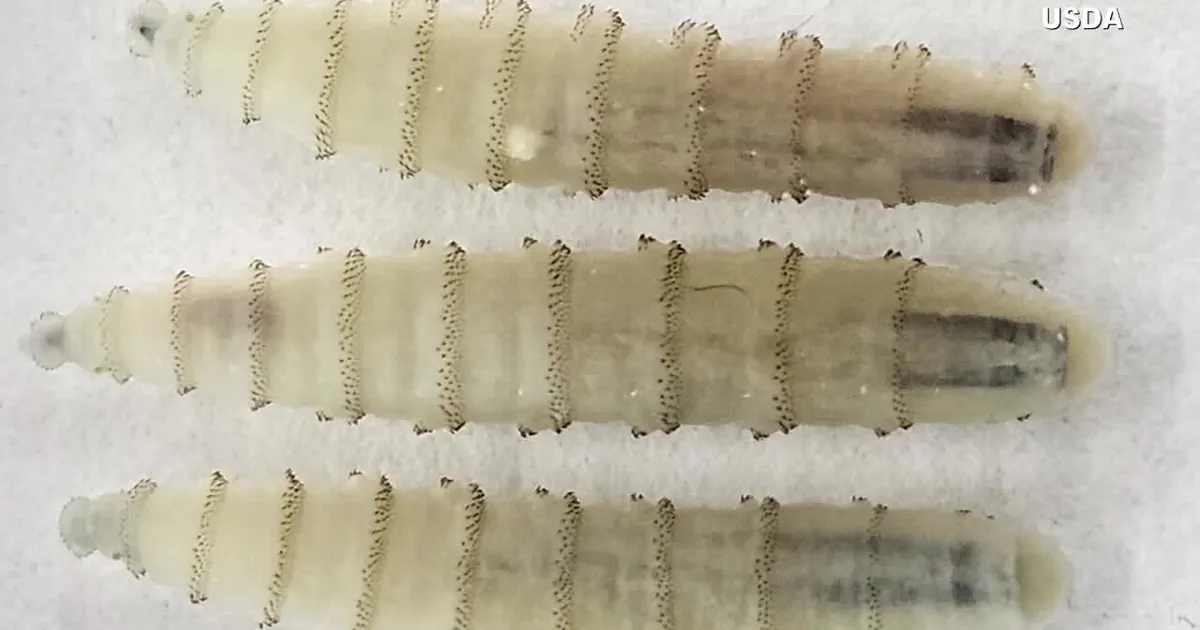
Florida wildlife officials have urged hunters to report any suspected signs of New World screwworm after the invasive blowfly expanded northwards into Texas, New Mexico and Arizona.
The Florida Fish and Wildlife Conservation Commission has asked hunters to inspect recently harvested animals and review remote-camera footage for signs of infestation. Officials have not confirmed that the parasite has reached Florida.
New World screwworm larvae feed on the living flesh of warm-blooded animals, including deer, birds, domestic animals and people. Unlike native blowflies, whose maggots consume decaying tissue, the larvae burrow into fresh wounds.
Female flies lay clusters of hundreds of white eggs around open wounds, including tick bites, and around the navels of newborn animals. Animals that have recently given birth are therefore considered particularly vulnerable.
Infestations can cause thickened, draining wounds with a foul smell and bloody discharge. The larvae eventually fall into the soil to pupate, and affected animals can die if the condition is not detected.
How hunters can identify New World screwworm
Wildlife showing signs of possible infestation may appear lethargic, shake their heads, isolate themselves or develop large draining wounds. Hunters are being asked to look for those symptoms on trail-camera footage as well as in live animals.
In harvested game, officials said hunters should examine wounds and the genital area for maggots burrowing into living tissue. The larvae should not be confused with nasal bots, which are common fly larvae found in the nasal sinuses of healthy deer when the head is removed.
The United States eradicated New World screwworm in the 1960s, after the parasite had severely reduced Florida’s deer population between the 1930s and 1950s. A serious local outbreak later affected Key deer in the Florida Keys in 2016.
The fly is currently found in South and Central America and parts of the Caribbean. It has been moving north through Central America and Mexico since 2022, raising concern that it could reach Florida either through natural spread or the movement of infested animals and people.
Officials said Florida’s subtropical climate could allow the parasite to reproduce and persist across much of the state, potentially making eradication a years-long effort. An established outbreak could reduce fawn survival, kill adult wildlife and pose risks to domestic animals and human health.
Hunters who suspect an infestation in a harvested animal have been told not to move, field-dress or eat the carcass. They should wear gloves, wash thoroughly afterwards, photograph the wounds or larvae and record the precise GPS location.
Suspected cases involving wildlife can be reported through the Florida Fish and Wildlife Conservation Commission. Cases involving domestic animals or wildlife can also be reported to the Florida Department of Agriculture and Consumer Services by email at RAD@FDACS.gov, by calling 850-410-0900 during office hours or 1-800-342-5869 outside those hours.
