


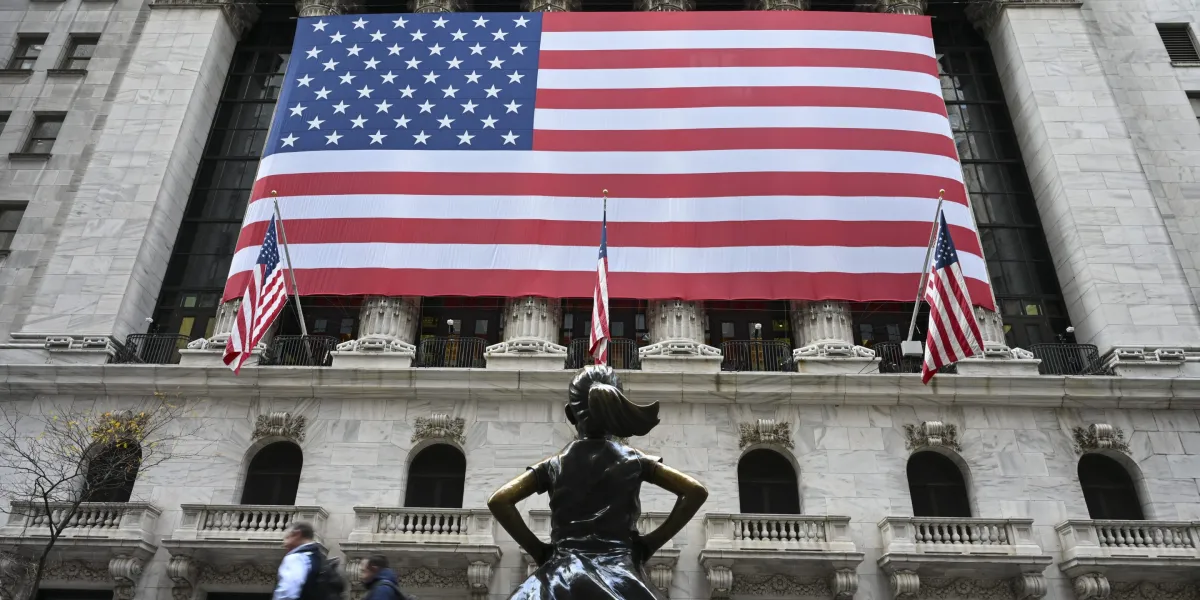
US stock market futures rebounded sharply ahead of a shortened holiday trading week, with investors seeking relief after Wall Street suffered its worst weekly losses in more than six years.
Dow Jones Industrial Average futures rose 684 points, or 1.41 per cent, while S&P 500 futures gained 2.1 per cent. Nasdaq futures climbed 2.89 per cent.
The gains followed the Dow and Nasdaq recording their steepest weekly falls since the early days of the pandemic. The S&P 500 suffered its sharpest such decline since April 2025, when Donald Trump’s “Liberation Day” tariffs unsettled markets.
The Dow and S&P 500 have now joined the Nasdaq in correction territory, with technology stocks bearing the brunt of a sell-off driven by fears that the artificial intelligence boom may be losing momentum.
Those concerns intensified after the midterm elections, which gave victories to Democrats viewed on Wall Street as more sceptical of data-centre expansion. A reported Nvidia scandal involving Jensen Huang’s removal as chief executive added to anxiety over financing arrangements linked to the company’s ecosystem.
Investors are also concerned that so-called circular financing deals could unravel, leaving neocloud companies without the capital needed to build data centres or buy AI chips.
Revelations that China had backdoor access to high-end US chips used in AI development have further prompted calls for tighter export controls. Mr Trump has also vowed to stop US companies building data centres overseas.
Stock market futures rebound as investors assess economic risks
Mark Zandi, chief economist at Moody’s Analytics, warned that falling share prices could weigh on economic growth by reducing household wealth and, in turn, consumer spending.
He estimated that spending rises or falls by about two cents for every dollar change in net worth over roughly a year. If share prices remain at their current levels, he said the wealth effect would cut almost 0.3 percentage points from real GDP growth a year from now, after contributing 0.7 percentage points in the current quarter.
“We’ve seen AI stocks selloff before, only for them to rebound quickly. Investors have been conditioned to buy on the dip,” Mr Zandi wrote.
“But while there are sure to be lots of ups and downs in stock prices in the days ahead, it feels increasingly like the easy money in the AI trade has been made. If so, the economy won’t be able to count on AI to be the sole engine of growth.”
Markets will be closed on Thursday for Thanksgiving and will open for only half a day on Friday. The reduced trading week and thinner volumes could amplify any rebound in share prices, before the traditional Santa Claus rally later in the year.
Despite the correction, several Wall Street forecasters remain optimistic about 2027. Morgan Stanley and Goldman Sachs expect the S&P 500 to finish next year at 8,700, while UBS Global Wealth Management and Wells Fargo have forecast 8,200.
Steve Chiavarone, chief investment officer for equities at Federated Hermes, has set a year-end target of 10,000, representing a 45 per cent rise from current levels.
He dismissed concerns that the midterm elections would derail the AI infrastructure build-out, arguing that the risks had been overstated. A modest slowdown, he said, could allow company cash flows to catch up, ease inflationary pressures and make the investment boom more sustainable.
