


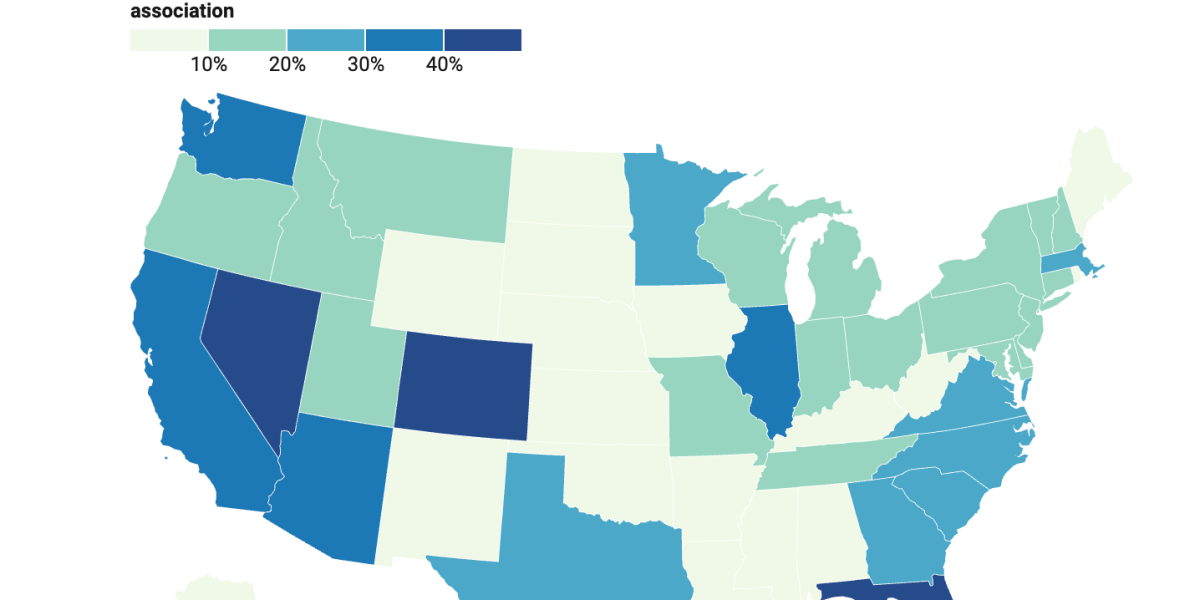
Florida homeowners associations are leaving some Black and Latino residents feeling excluded from their own communities while rising property prices make moving increasingly difficult, according to interviews with residents in central Florida.
Sociologist Stephanie A. Dhuman interviewed 47 Latino, Caribbean and Black residents between 2017 and 2020 to examine their experiences of living under homeowners associations, commonly known as HOAs.
Several residents said they believed HOA officials were sending a clear message that they did not belong, but that they could not afford to leave. Nearly half of Florida residents live in HOA-governed communities, the highest proportion of any US state.
Coretta, a pseudonym used to protect her identity, is a Black mother of three who has lived in her largely Hispanic community for more than 20 years. With a background in real estate, she said her anger had gradually been replaced by apathy.
“I don’t think [the community developers] intended for it to be a heavily Hispanic population,” she said. “They were expecting a certain economic class to come here. I think they were trying to push out the ones that they felt didn’t belong. I think they’re doing that and have done that.”
How Florida homeowners associations exercise control
HOAs are private governing bodies led by elected volunteer boards. They can regulate matters including paint colours, fencing and the appearance of homes, while also imposing restrictions, fines and other sanctions.
In some circumstances, associations can foreclose on properties when homeowners fail to pay fees or assessments. Their influence can also extend to community events, cultural celebrations, parades, festivals and holiday parties.
Dhuman said the organisations could function as what sociologists call “racialised organisations”: bodies that may appear neutral but can create or preserve racial inequality through their rules, practices and distribution of power.
She said the formal rules of an HOA and the way those rules were applied could differ, with residents perceived as white often enjoying greater influence and advantages.
HOA charges can also create a financial barrier. The median monthly fee in Florida is $230, while some homeowners pay more than $500. The additional cost can limit who is able to buy into a community and, in practice, contribute to racial and economic segregation.
Across the United States, about 373,000 HOAs affect the housing of more than 78 million people. The source material states that 80% of new single-family homes in subdivisions, and 60% of new single-family homes overall, are governed by such associations.
Residents say HOA voting rules limit their voice
Residents interviewed by Dhuman also described feeling unable to influence decisions. None was attending HOA meetings at the time, while those who had previously taken part said they had stopped because they believed it made little difference.
In the Florida community studied, homeowners were not allowed to vote by proxy. Votes had to be cast in person on a Tuesday at a time set by the board, which residents said made participation difficult.
Only the homeowner listed in the association’s records could vote. Renters were barred from voting and, under the bylaws, were not permitted to attend meetings because attendance was treated as a privilege for homeowners.
The rules also affected people living in multigenerational households. Elena, another pseudonym, said she paid the mortgage but could not vote because her son was the named homeowner.
“I’m not allowed to vote. You’re not allowed to vote with a proxy. My son, [who is listed as the homeowner], works crazy hours. He gets up at 3 in the morning to work, he comes home, has dinner and goes straight to bed … he never makes it. They should have that on the weekends,” she said.
The association’s bylaws did not require voting information to be made available outside its physical office, which was at one end of the community.
HOA decisions have previously prompted controversy in Florida. In 2019, one association told a veteran to remove her Puerto Rican flag.
Housing access and the American Dream
Dhuman’s research places the experiences of HOA residents within a wider pattern of unequal access to homeownership. The Black homeownership rate is 45%, compared with 73% among non-Hispanic white Americans, according to census data cited in the source material.
Black and Latino residents are also more likely to rent than own as the racial wealth gap widens. At the same time, the number of HOAs in the US continues to increase.
A 2024 survey cited in the research found that fewer than half of Americans living under an HOA believed their neighbourhood was better off because of it. One in 10 had considered selling their home because of HOA-related concerns.
Dhuman said homeownership traditionally carried expectations of autonomy, participation and fair treatment. Where HOAs restrict residents’ involvement or cultural expression, she argued, they can reduce the value and security that homeownership is supposed to provide.
