


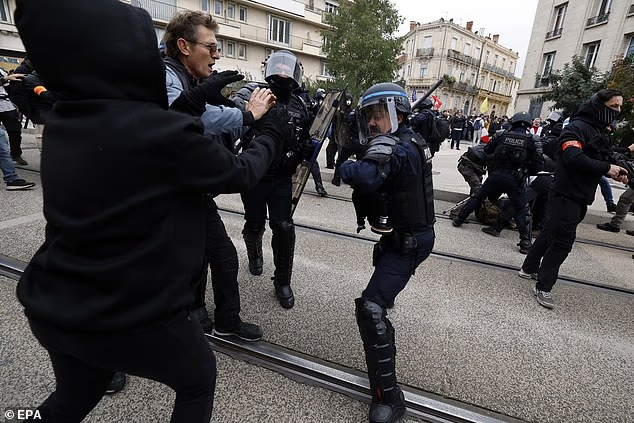
Police fired tear gas and charged at demonstrators during nationwide anti-government protests in France, as tens of thousands took part in the fifth consecutive Saturday of unrest.
The French Interior Ministry said 106,000 people attended rallies across the country, including 24,000 in Paris. Student unions put the national figure at 200,000, with almost 100,000 protesters in the capital.
At least 121 people had been arrested by 6pm, according to a ministry spokesman, after disturbances were reported in numerous cities and towns.
Demonstrations in Paris, Bordeaux, Nantes, Marseille, Lyon, Montpellier and Strasbourg were largely peaceful, but clashes broke out in several locations. Riot police used tear gas to disperse crowds, while officers were seen detaining protesters and pursuing demonstrators through the streets.
Footage from Paris showed riot-control units confronting young people near Place de la Nation towards the end of a march. In Lyon, a barricade was set alight, while protesters in other cities were pictured walking through clouds of tear gas.
Trade union activist Remi Durand accused police of using excessive force, saying: “The police were ridiculously heavy handed – they were attacking anyone they could find with their weapons.”
The movement began with anger over failings in France’s education system and a campaign by high school students for the equivalent of around £9 billion in additional funding. It has since expanded into a broader challenge to President Emmanuel Macron’s government and its economic policies, bringing together students, trade unions, Yellow Vest activists and Black Bloc anarchists.
Protesters called for Mr Macron’s resignation, while chants included “No justice, no peace” and “Everybody hates the police”. A giant puppet carried by demonstrators wore a hat bearing the words “Lord Macron”.
The demonstrations also focused on a proposed law that would give police officers who use their weapons a presumption of legitimate self-defence.
Adrien, a 20-year-old cellist performing with a volunteer orchestra at the Paris rally, said: “We’re scared when we come to a protest, and this will only make us even more afraid if their impunity is strengthened.” He said tear gas had fallen on protesting musicians during a demonstration the previous month.
Supporters of the bill, including Marine Le Pen’s hard-Right party, argue that officers should not automatically be suspected of using disproportionate force. Activists oppose the measure, describing it as a potential “licence to kill” and warning that it could make security forces harder to hold accountable.
Lawyers said last week that police violence during recent protests had caused serious injuries, including damage to hands, feet and eyes. Left-wing politician Jean-Luc Melenchon also claimed that too many tear gas canisters had been fired at peaceful demonstrators.
Mr Melenchon said: “It seems that confrontation is the very goal of this public-order strategy. It’s pathetic.”
France’s Interior Minister Laurent Nunez said about 70,000 police officers and gendarmes had been deployed for each Saturday of protests. He warned of social media posts calling for violence against police and public buildings, promising “an extremely firm response” to any such acts.
The arrest total adds to at least 4,000 people taken into custody during disturbances over the past month, with hundreds reported wounded. Authorities have also raised concerns about arson after attacks on public buildings, including a 19th-century town hall in Limoges and a historic tourist office in Lyon.
In Bordeaux, 72-year-old Josette joined protesters despite opposition from her children. “They’re giving us hope at a time when it feels like we’re heading straight for disaster, with a planet that keeps getting hotter and far-right movements that are increasingly unapologetic,” she said.
In Toulouse, asylum law specialist Kenza, 28, said: “The repression of protesters is unacceptable – even more so when they are children.”
Saturday’s turnout was lower than in recent weeks, although the unrest comes as France prepares for a presidential election in April. Mr Macron’s popularity has fallen to its lowest level since he became president in 2017, while his government is also attempting to reduce the country’s debt.
Marine Le Pen and Mr Melenchon are both suggested by opinion polls as possible contenders in the election’s second round. Ms Le Pen is appealing against a conviction for embezzling European Parliament funds.
Unions have called for another day of strikes on Tuesday after rejecting a government promise to raise the minimum wage by 0.6 per cent as “crumbs”. More than half a million people joined the largest protests of recent weeks during a union-led strike the previous Thursday, according to official figures.
