


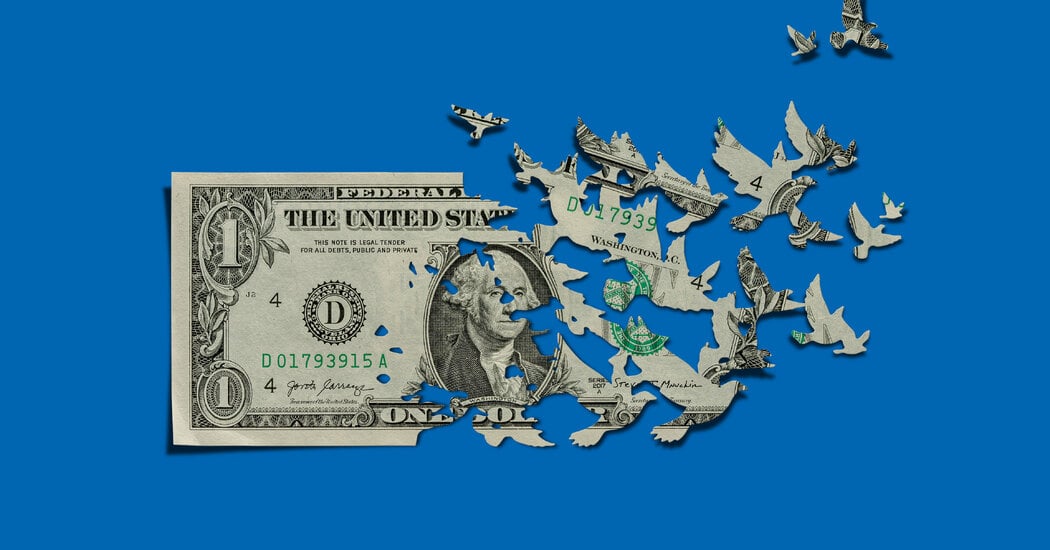
Global investors are beginning to move away from US assets as concerns over America’s $40 trillion debt burden, sanctions policy and President Trump’s approach to the rule of law weaken the country’s reputation as a safe haven.
The United States remains the dominant force in global finance. Private investors continue to buy American shares and bonds, while investment in artificial intelligence infrastructure is expanding. No rival currency is close to displacing the dollar.
But officials and investors are increasingly looking for ways to reduce their exposure to the US financial system. Foreign governments are diversifying their reserves, some are moving gold out of American vaults and others are developing payment systems designed to bypass Western institutions.
“Geopolitical factors and U.S. weaponization of the dollar through financial sanctions are causing central banks and other official investors to attempt to diversify away from dollar assets,” said Eswar Prasad, the former head of the China division at the International Monetary Fund.
US Treasury market under pressure
The clearest signs of unease have appeared in the bond market, where yields have risen as investors demand greater returns to hold US government debt. The yield on the 10-year Treasury bond passed 5 per cent this week, its highest level since 2007.
The increase came shortly after the Treasury bought $5.2 billion of its own debt due to mature in between 10 and 20 years. The purchase formed part of an effort to bolster demand, raise bond prices and bring yields down.
Treasury Secretary Scott Bessent told Congress on Tuesday that the American financial system remained credible. He said bond auctions were continuing to operate successfully and argued that the dollar was still thriving when measured by its share of global transactions.
“The U.S. is in fact the leader, and the leader does not fear competition,” Mr Bessent said. “Competition makes us better.”
Norway’s sovereign wealth fund, the world’s largest, said this month that it planned to reduce its holdings of US Treasuries while seeking stronger returns elsewhere.
The dollar still accounts for nearly 90 per cent of global foreign exchange transactions. However, its share of central bank reserves fell to 56 per cent at the end of 2025, from 64 per cent in 2015.
Christine Lagarde, president of the European Central Bank, said last year that unpredictable US policymaking was creating the conditions for a “global euro moment”.
Sanctions drive search for alternatives
Washington’s use of the dollar as a foreign policy weapon has intensified the debate over its future as the world’s reserve currency. Sanctions against countries including Iran and Russia can restrict access to the cross-border financial system because so many international transactions are conducted in dollars.
The US attempted to reduce its sanctions programme this year amid concerns that excessive use of financial pressure was encouraging countries to find alternatives. But Mr Bessent reversed course in August by announcing Operation Economic Outcast, an initiative intended to put pressure on Iran’s economy and threaten secondary sanctions against countries continuing to trade with Tehran.
Mr Bessent acknowledged that enforcing those threats could “blow up the global financial system”.
Alternative systems are now being developed using digital currencies. China is leading a cross-border platform with Hong Kong, Thailand, the United Arab Emirates and Saudi Arabia, known as mBridge, while Russia and India said last week that they were working on a plan to settle trade using central bank digital currencies.
“Countries have thought about working around the dollar, and technology is making it a little cheaper and easier to do it than before,” said Josh Lipsky, chair of international economics at the Atlantic Council.
Gold moves closer to home
Other countries are turning to gold as they reassess the stability of the US-led financial system. International reserves held in gold overtook foreign official holdings of US Treasury securities in 2025, while the price of gold passed $5,000 per troy ounce for the first time as central banks increased their purchases.
The Netherlands’ central bank said this month that it had moved a large part of its 95 tonnes of North American gold reserves out of the US, citing “increasing geopolitical unrest” and the need to prepare for a crisis. In March, the Bank of France said it had withdrawn 129 tonnes from the Federal Reserve Bank of New York and transferred it to Paris.
The Trump administration has not threatened to seize foreign-owned gold stored in the US. However, the President has questioned aspects of international law by raising the prospect of colonising Greenland and Canada.
“It’s like the countries don’t trust the U.S.,” said Daniel Tannebaum, a former Treasury Department official. “I do think that there is a fear factor.”
That uncertainty is also affecting American companies seeking to sell technology overseas. European governments and businesses have become wary of relying on US infrastructure for sensitive industries such as artificial intelligence, fearing that tariffs, export controls or future restrictions could leave them exposed.
“Governments and companies now have to ask what would happen if the United States turned its economic leverage against them,” Mr Tannebaum said.
