


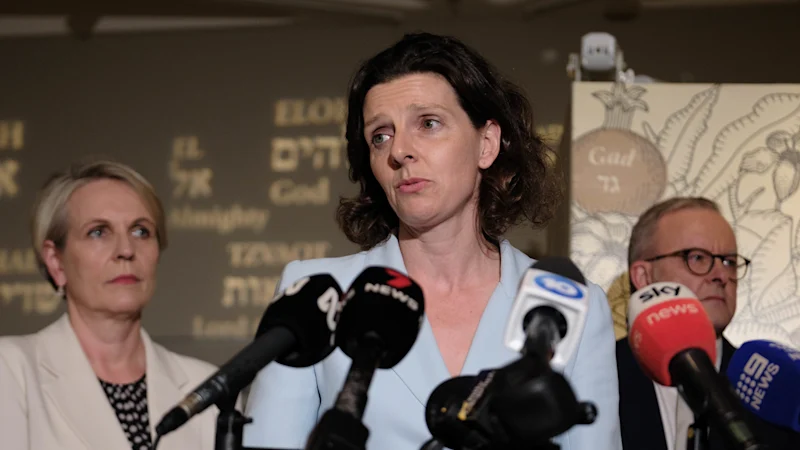
Australian politicians from Labor, One Nation and the independent “teal” crossbench have joined Jewish community leaders in calling for stronger hate speech laws after Melbourne preacher Abu Ahmad urged followers to “take up arms” against Christians and Jews.
Allegra Spender, the independent MP for Wentworth, said the remarks demonstrated the need for nationally consistent laws. Her electorate includes Bondi Beach, where Australia’s worst terror attack took place.
“I hope the royal commission will make recommendations relating to this, but regardless, I will continue the push and urge all politicians who express sincere concern about hate preachers to back stronger protections,” Ms Spender said.
Abu Ahmad has been described as an ally of Sydney cleric Wissam Haddad, whose network has established a Melbourne “outpost”. Mr Haddad has been linked to the Bondi shooters.
Calls for action against extremist networks
Pauline Hanson also called for tougher federal intervention, saying extremist and fundamentalist mosques and Islamic prayer centres should be subject to stronger scrutiny where terrorist recruitment or advocacy was alleged to be taking place.
“We need stronger federal powers to shut down the extremist and fundamentalist mosques and Islamic prayer centres,” Senator Hanson said. “Give ASIO and the AFP the resources and targeted powers to dismantle these networks.”
She added: “Bondi should have ended the excuses. Australians must never pay for this government’s political cowardice with their lives. Christians aren’t calling for jihad. Hindus aren’t calling for jihad.”
Senator Hanson, who was widely condemned earlier this year after suggesting there were no good Muslims, spoke about terrorist advocacy but stopped short of endorsing broad anti-vilification laws covering religious, racial, gender or sexuality-based hatred.
Labor proposed such laws after the Bondi massacre, but the Coalition and Greens opposed the push and Prime Minister Anthony Albanese shelved it.
Jewish leaders urge changes to hate speech laws
Peter Wertheim, co-chief executive of the Executive Council of Australian Jewry, said the existing offence of inciting violence was so difficult to prove that authorities were often forced to pursue other offences when dealing with religious extremists.
“There has been an air of unreality about the way the hate speech debate has been conducted to date,” Mr Wertheim said. “People who have deliberately and calculatedly promoted hate speech against targeted communities have successfully played well-meaning civil libertarians for suckers. It’s not a left-right political issue.”
His position was supported by Federal Court Justice Ian Jackman, who recently called for a reassessment of the judiciary’s approach to free speech, arguing that it was not equipped to deal with modern forms of extremism.
Anthony Fisher, the Catholic Archbishop of Sydney, said freedom of speech and protest were central to liberal democracy, but Australia had not found the correct balance between those rights and the freedom to worship safely.
“Freedom of speech and freedom of religion are fundamental rights, but neither provides a licence to incite violence against other Australians,” said Jeremy Leibler, president of the Zionist Federation of Australia.
Federal Labor MP Josh Burns has also been pressing the government to enact broad anti-vilification laws. In a submission to the royal commission, he said his office had received 10,000 emails, 1,000 phone calls and numerous social media messages since the October 7 Hamas attacks on Israel.
Mr Burns said most messages expressed strongly held political views respectfully, but some contained prejudice. He argued that references to Zionism were sometimes being used as a substitute for the word “Jew”, alongside antisemitic abuse.
“That is not political criticism. It is hate, dressed in political language,” he wrote.
A spokesman for Attorney-General Michelle Rowland said the government wanted to introduce laws against vilification after the Bondi massacre, but claimed the Coalition had prevented the legislation from passing.
