


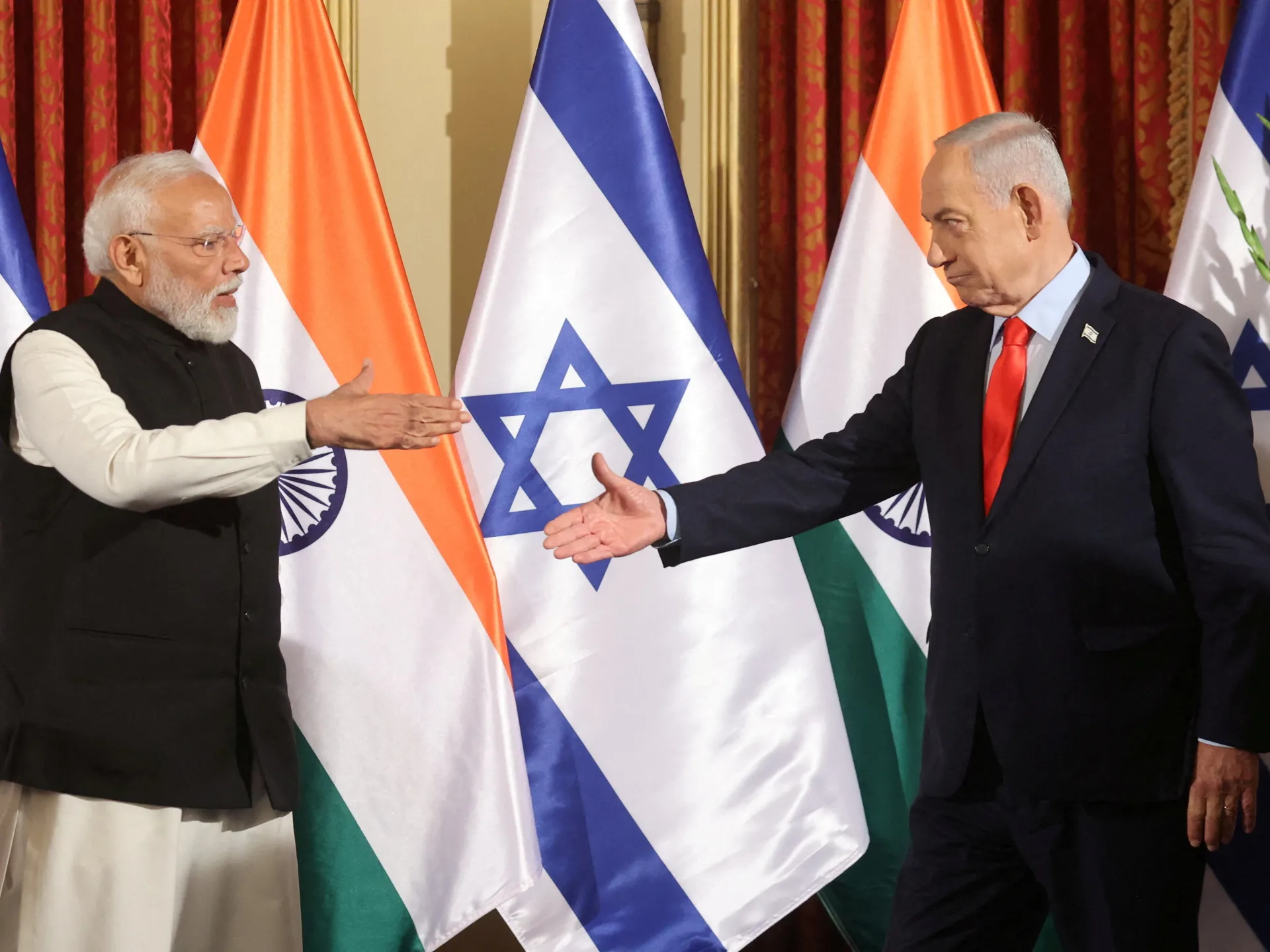
India’s strategic relationship with Israel is likely to survive any change of government in New Delhi, with opposition leader Rahul Gandhi acknowledging that his party supports close ties despite condemning Israel’s war in Gaza.
Mr Gandhi said he backed “a strong relationship with Israel” because India had strategic interests, including acquiring advanced weapons for its armed forces. His comments prompted criticism from some Congress allies, including left-wing parties, but analysts said they reflected a partnership that extends well beyond Prime Minister Narendra Modi and his Bharatiya Janata Party (BJP).
The relationship now encompasses missiles, drones, intelligence, surveillance technology, policing and industrial production. India has increasingly relied on Israel for weapons and expertise, creating links that would be difficult for a future government to dismantle.
“I support a strong relationship with Israel. We have strategic interests, including buying the best weapons for our armed forces,” Mr Gandhi said in an interview last week.
Surveillance and security cooperation
New concerns about the partnership emerged this month when the Internet Freedom Foundation said Home Minister Amit Shah had waived India’s own rules to permit the purchase of phone-hacking technology from Israel.
The allegations recalled the 2019 disclosure by WhatsApp that Pegasus spyware, developed by Israel’s NSO Group, had been used to target Indian journalists and human rights defenders. Amnesty International later confirmed infections on the phones of journalists Siddharth Varadarajan and Anand Mangnale. The Indian government denied unauthorised surveillance.
Researcher and author Azad Essa said India’s co-operation with Israel had long involved studying Israeli methods of intelligence gathering, border management and controlling dissent. He said it was “only a matter of time” before Israeli products or methods were used against Indians, including farmers.
In Haryana, neighbouring Delhi, the state government spent six years attempting to replicate Israeli police and military tactics. In February 2024, police used drones to fire tear gas at farmers marching towards the capital.
The military relationship is even more extensive. Since 2014, India has become Israel’s most dependable arms customer, accounting for about 37 per cent of Israeli exports.
Why India turns to Israeli weapons
The Adani Group, led by billionaire Gautam Adani, has become a prominent commercial link between the two countries. In 2016, it formed a joint venture with Israel’s Elbit Systems to manufacture Hermes 900 drones in Hyderabad, the first facility of its kind outside Israel.
Since 2020, Adani has held a 51 per cent stake in BLR Systems, which produces parts for Negev machine guns with Israel Weapon Industries. In January 2023, Adani and Israel’s Gadot completed the 1.15 billion dollar purchase of Haifa port, with Israeli Prime Minister Benjamin Netanyahu attending the handover.
Mr Essa said India was becoming “a manufacturing and supply base for Israeli companies”. Another researcher, Ashutosh Singh, described Hyderabad as an example of Indian capital becoming embedded in Israel’s military infrastructure under the government’s Make in India programme.
There are limits to the extent of that industrial integration. Nicolas Blarel, an associate professor of international relations at Leiden University, said production in Hyderabad was “mostly late assembly” of Israeli-designed drones and that it was unclear how much technology had been fully transferred.
He noted, however, that deliveries were made to Israel in late 2023 and early 2024, when some of those drone models were being used in Gaza.
An Amnesty International report published on July 30 recorded 2,596 shipments of weapons, ammunition and military components from Indian companies to Israel between October 7 2023 and November 30 2025. It identified nine companies, including three wholly owned by India’s Ministry of Defence, and said the Indian state was responsible for transfers when those firms exported goods.
India’s external affairs ministry said it had a “robust” legal framework governing strategic trade, but did not address the specific allegations.
Analysts say India’s attraction to Israel is not simply the quality of its equipment, but the relatively few conditions attached to its use. Kabir Taneja, of the Observer Research Foundation, said Israel was prepared to adapt systems for Indian requirements, including fitting early-warning radars to a Russian Il-76 aircraft.
He described Israel as “that Walmart of defence technologies that you can just go and purchase without any terms and conditions that stop you from using these technologies in whatever manner is required”.
Israel’s equipment can also be integrated with India’s largely Russian-origin arsenal. Its willingness to share technology and work with Indian companies has become increasingly important as New Delhi seeks to manufacture more of its own military hardware.
Mr Blarel traced the confidence between the countries to the 1999 Kargil war with Pakistan, when other suppliers imposed restrictions after India’s nuclear tests while Israel continued sending spare parts and ammunition.
A partnership older than Narendra Modi
Although Mr Modi has made the relationship far more visible, military and intelligence links predate his premiership and have been maintained by governments led by both the BJP and Congress.
India recognised Israel in 1950 but kept diplomatic relations at arm’s length for more than four decades. Israel nevertheless supplied India secretly during conflicts, including the 1962 war with China, the 1965 war with Pakistan and the 1971 war that led to the creation of Bangladesh.
India also maintained a strong public commitment to the Palestinian cause. It was the first non-Arab state to recognise the Palestine Liberation Organization in 1974 and recognised the State of Palestine in 1988. Full diplomatic relations with Israel were established in 1992 under a Congress-led government.
The BJP government of Atal Behari Vajpayee continued purchasing Israeli missiles and early-warning aircraft and began discussions about joint production. When Congress returned to office in 2004, it took the relationship further with a 350 million dollar agreement to develop the Barak-8 missile defence system.
Mr Essa said the ideological links that developed under Mr Modi were built on relationships established by earlier Congress governments.
After Mr Modi became prime minister in 2014, India’s position became more openly aligned with Israel. His government refused to allow the upper house of parliament to adopt a resolution condemning Israel’s 2014 offensive in Gaza, while India abstained at the UN Human Rights Council in 2015 and 2016 on resolutions seeking accountability for that operation.
Mr Modi became the first Indian prime minister to visit Israel in 2017 and returned in February 2026. India also did not join the case against Israel at the International Court of Justice, endorse an arms embargo or prevent arms exports during the latest war in Gaza, while pro-Palestinian protests in India faced restrictions.
Nicolas Blarel said India’s position on Palestine, once clear since the 1970s, had become more unpredictable. Kabir Taneja argued that the underlying policy had not fundamentally changed, pointing to India’s continued support for a two-state solution.
Experts are divided over whether ideology or practical security needs are the main force behind the alliance. Mr Essa said the relationship was both strategic and ideological, linking the Hindu-majoritarian Hindutva movement in India with Zionism and the two countries’ self-image as civilisational states facing existential threats.
Mr Taneja described the ties as primarily transactional, saying India would work with any country offering comparable security assistance. Mr Blarel took a middle position, noting that early leaders of the Rashtriya Swayamsevak Sangh had cited Israel as a model, while also saying Mr Modi’s personal affinity with Mr Netanyahu was clear.
For Congress, the issue has exposed a difficult balance. Salman Khurshid, a senior party figure and former external affairs minister, said relying on Israel for defence was understandable but argued that proper safeguards were missing from India’s dealings with the country.
He also did not dispute reports that some Congress-controlled states had bought Israeli phone-extraction tools. “We have to make concessions,” Mr Khurshid said, while acknowledging that it was “not a perfect world”.
Critics say those concessions have made India complicit in alleged war crimes in Gaza. Mr Essa said India could not claim ignorance of the consequences of supplying military equipment, while Mr Singh said any country materially providing Israel with tools used in the conflict shared responsibility.
The debate has therefore moved beyond Mr Modi’s personal alliance with Mr Netanyahu. The extent of the defence, commercial and security infrastructure linking the two countries means that even a change in India’s governing party is unlikely to end the partnership.
