


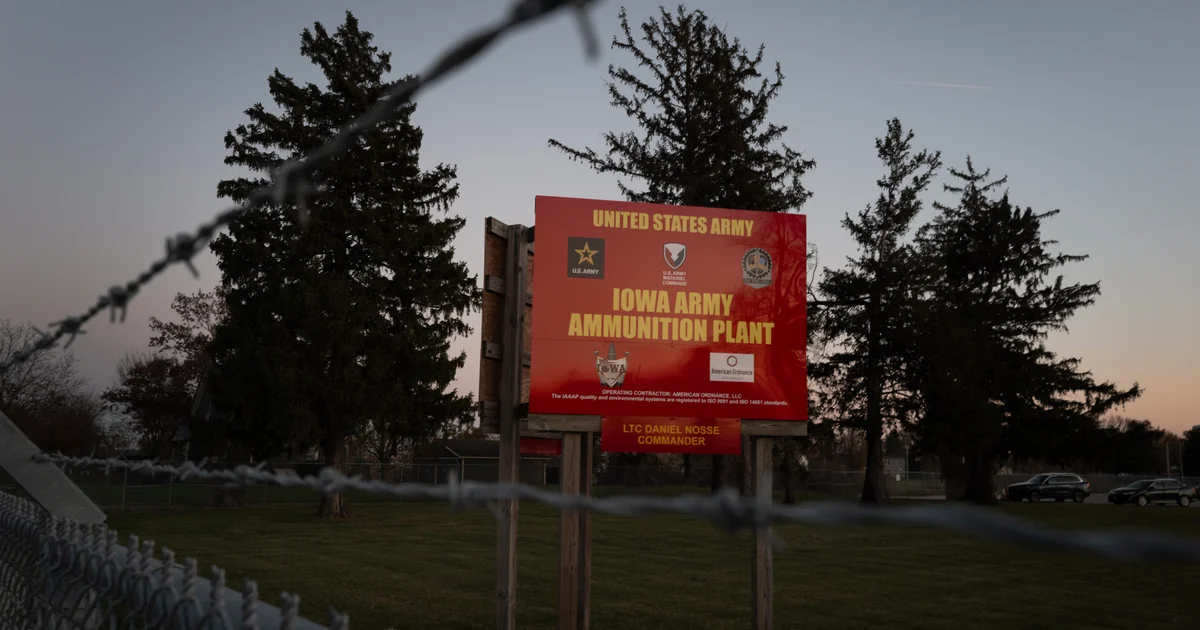
A federal appeals court has put an indefinite hold on the planned detonation of five tons of unstable lead azide at the Iowa Army Ammunition Plant in Middletown, after environmental groups challenged an emergency permit issued by the US Environmental Protection Agency.
The Eighth US Circuit Court of Appeals granted an emergency motion filed by the Iowa Environmental Council and the Sierra Club’s Iowa chapter. Its single-sentence order imposed an administrative stay on the EPA permit “until the emergency motion for stay is ruled upon by this court”.
The Iowa lead azide detonation had been scheduled for noon on Friday, before being delayed until Monday. The court’s order sets no replacement date, meaning the plan will remain paused while the wider legal challenge is considered.
The groups argue that people living in the area were given too little notice to prepare and take safety precautions. They also say the evidence used by the EPA to decide that detonation was the safest option had not been made public, preventing it from being properly assessed.
Concerns over toxic lead dust
The Iowa Army Ammunition Plant has stored 68 barrels of lead azide, totalling about five tons, for more than 20 years. The highly sensitive explosive, which has been used in munitions since the First World War, was kept in earthen-covered containers in a mixture of ethanol and water to help stabilise it.
Justine Barati, a public affairs specialist with Army Sustainment Command, said a routine inspection earlier this year found that some of the water had evaporated. The EPA said the material had deteriorated, allowing it to recrystallise and become more sensitive to friction and shock.
Army officials determined that a controlled detonation was the safest way to dispose of the explosives. However, the operation could produce a cloud of dust containing toxic lead particles.
Preliminary maps based on Friday’s weather forecast showed a potential plume moving north across eastern Iowa, over the Mississippi River and possibly into north-western Illinois. The area includes homes, farms, water sources and playgrounds, raising concerns that lead particles could settle on agricultural land and outdoor surfaces.
Residents of Middletown, a community of about 360 people, had been asked to leave their homes temporarily between 8am and 2pm under the original plan. The Army also warned that nearby buildings could be damaged, including through shattered windows.
Lawmakers call for safer alternatives
A bipartisan group of elected officials from Iowa and Illinois had urged the Pentagon and the EPA to delay the operation and examine alternatives.
“While we understand the urgent need to address these volatile materials, their detonation has the potential to spread lead contamination in and around the region,” they wrote in a letter to Acting Army Secretary Adam Telle and EPA Administrator Lee Zeldin.
“We call on you to consider delaying this detonation until there is an opportunity to explore safer alternatives,” the officials added, saying residents were concerned about the potential health impacts.
The signatories included Illinois senators Dick Durbin and Tammy Duckworth, representatives Darin LaHood, Mary Miller and Eric Sorensen, Illinois Governor JB Pritzker, and senators-elect Juliana Stratton of Illinois and Josh Turek of Iowa.
