


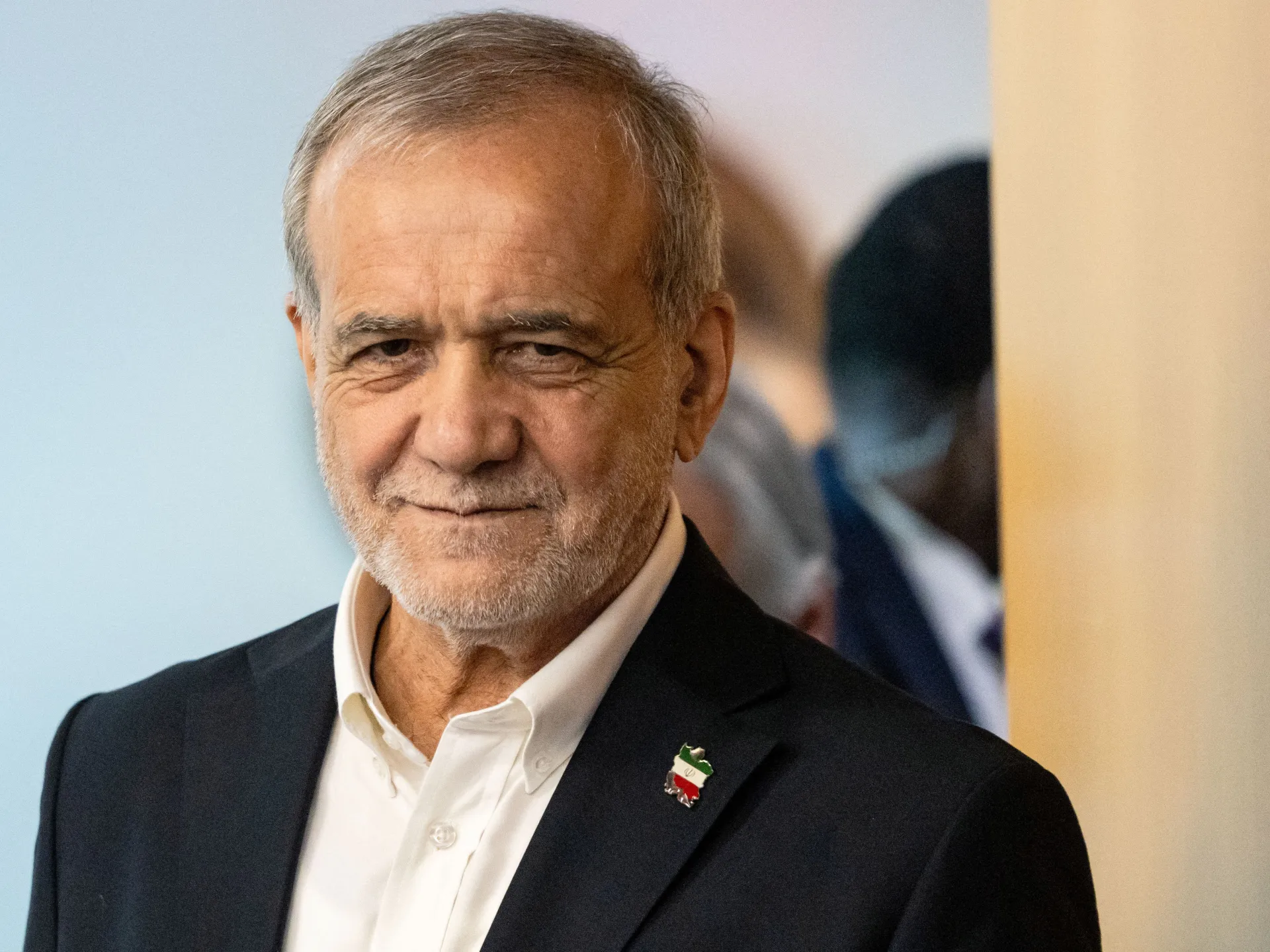
Iranian President Masoud Pezeshkian has said Iran no longer trusts talks with Washington, as Tehran awaits a response to its proposal for ending the war and reopening the Strait of Hormuz.
“We have no trust in the American side and do not know on what basis an understanding can be reached with it,” Mr Pezeshkian said in an interview aired on Saturday.
He said previous negotiations had been followed by attacks and sanctions, while mediators from Qatar and Pakistan were now carrying Iran’s messages to the United States.
The proposal, put forward during Mr Pezeshkian and Foreign Minister Abbas Araghchi’s visit to the United States for a United Nations gathering, would end fighting in the US-Israel war on Iran and unblock the strategic waterway within seven days.
Under the plan, Washington would lift its naval blockade of Iranian ports, waive sanctions on Iranian oil sales, release an estimated $12 billion in frozen Iranian assets and observe a regional ceasefire, including in Lebanon and Yemen.
Iran would, in return, reopen the Strait of Hormuz, through which a fifth of the world’s traded oil and gas passed before the war. Mr Araghchi said initial steps would take four to five days, with the waterway reopening on the sixth and discussions on a final agreement beginning on the seventh.
Mr Pezeshkian said the proposed negotiations were based on a memorandum of understanding reached by the two sides in June. He said the United States needed to clarify its position on the agreement, which lapsed last month.
Iran says reopening Hormuz depends on negotiations
Mr Pezeshkian rejected claims that Iran was responsible for closing the Strait of Hormuz, saying the United States had “closed the routes before us”. He described the closure as “a natural response when routes are cut off to Iran”.
He said the waterway would reopen to commercial shipping if negotiations succeeded in ending the war, arguing that the crisis could be resolved through diplomacy rather than force.
The Iranian president described the United States as the aggressor and said Iran “has not attacked any country in 200 years”. He claimed Washington and Israel had drawn regional countries into the conflict believing that Iran’s political system would collapse within days.
“We withstood the American and Israeli attacks, and we will continue to stand firm,” he said, adding that the killing of an Iranian commander and economic pressure had not caused Iranians to retreat.
Mr Pezeshkian also said Iran’s regional security should be organised through co-operation between countries in the region, rather than under the authority of an outside power. “We do not need a regional policeman,” he said.
He accused the United States and Israel of trying to set Islamic countries against one another in order to control the region’s resources, and said Saudi Arabia could help unite the Islamic world.
On Yemen, he said the actions of the Iran-aligned Houthi rebels were not connected to Tehran. He urged the Houthis and Saudi Arabia to settle their differences through dialogue, saying Iran would not be a warmonger and was willing to help end the dispute.
The war began in late February when the United States and Israel launched attacks on Iran that killed Supreme Leader Ayatollah Ali Khamenei. Mr Pezeshkian said Iran was now experiencing “unprecedented unity and cohesion”, despite what he described as efforts by its enemies to create divisions among officials.
