


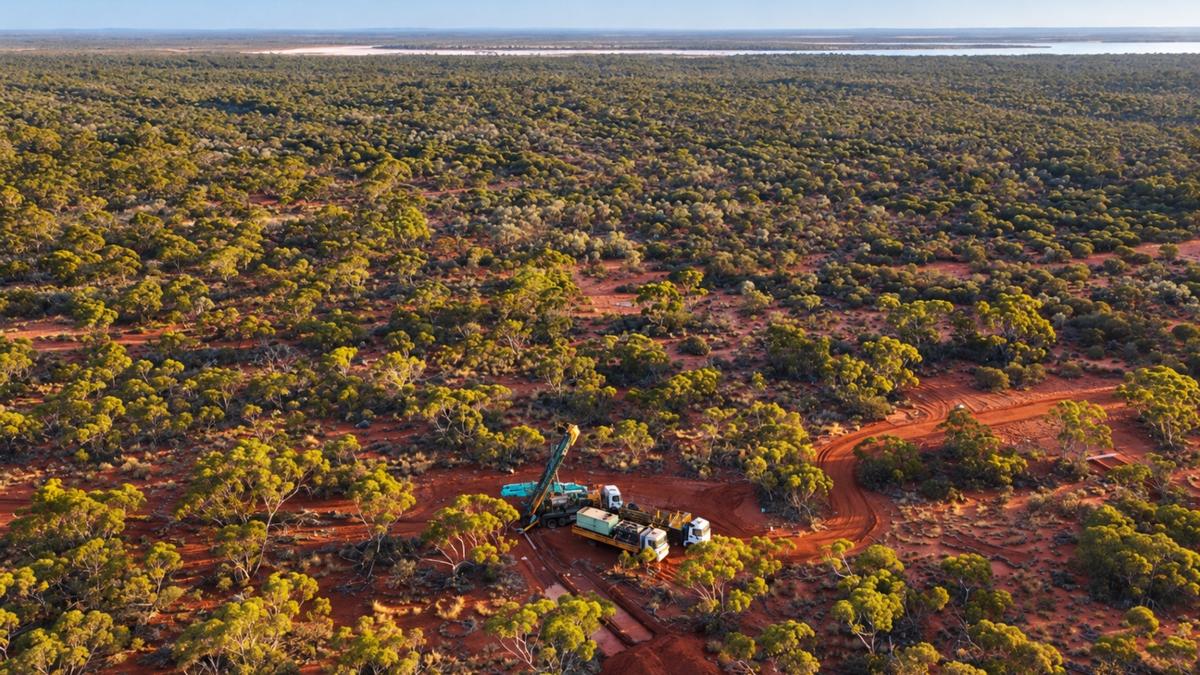
Kalgoorlie Gold Mining has identified multiple gold anomalies, including a trend extending for up to 2km, through first-pass aircore drilling at its Pinjin project in Western Australia’s Eastern Goldfields.
The programme targeted concealed mineralisation along the Laverton Tectonic Zone (LTZ), a major geological structure that has provided a pathway for mineralising fluids linked to significant gold deposits across the region.
Pinjin is about 140km north-east of Kalgoorlie-Boulder, in the southern section of the LTZ. KalGold drilled 225 aircore holes covering 7,212 metres, with lines spaced between 320m and 400m apart and holes averaging 32m in depth.
The drilling was designed to investigate gold beneath transported cover, where bends and faults in the LTZ may have concentrated mineralising fluids. Individual results were modest, as expected from an early-stage regolith programme, including 1m at 0.378 grams per tonne from 41m, 4m at 0.167g/t from 36m and 1m at 0.196g/t from 40m.
Gold anomalies point to follow-up targets at Pinjin
More significant was the broader pattern of results. Using a cumulative down-hole gold threshold of 20 parts per billion, KalGold defined several coherent anomalous zones, including a 2km-long trend through the northern half of the drill grid.
The threshold is about ten times typical background levels in Yilgarn laterite and ferricrete. The company said the gold traces correspond with magnetic rocks, possible faults and other geological features identified in an aeromagnetic survey carried out before drilling.
KalGold believes the alignment supports its exploration model and provides a ranked group of targets for testing in fresh rock beneath the weathered zone. The results have converted a previously untested structural flexure into a pipeline for further exploration.
Deeper reverse-circulation drilling is planned to determine whether the shallow regolith anomalies connect with primary gold mineralisation at depth. The larger RC rig will be able to penetrate fresh rock and test the potential scale of the system.
The RC work is expected to run alongside first-pass aircore drilling at the concealed Rebecca Sequence immediately north of the current grid. Earlier limited drilling in that area returned low-level gold anomalism with a possible antimony association, which differs from the stronger arsenic association seen in the Pinjin Sequence.
Work at Rebecca is scheduled for mid-October, although heavy rainfall in late September has closed roads across the Eastern Goldfields and could affect the start date.
The LTZ Flexure is 3.5km south-east of KalGold’s Kirgella Gift and Providence deposits, which have an inferred resource of 2.34 million tonnes at 1.0g/t gold for 76,400 ounces. Pinjin also contains the Lighthorse discovery, where early 2025 drilling produced a standout intercept of 3m at 9.01g/t from 145m, including 2m at 12.69g/t within a broader 22m interval grading 1.58g/t.
Follow-up drilling has confirmed primary gold beneath a shallow supergene blanket at Lighthorse, with the anomalous footprint extending for about 1.45km. Mineralisation at Kirgella Gift has been traced to roughly 300m vertically.
The wider LTZ hosts the Sunrise Dam, Wallaby and Granny Smith deposits and is associated with more than 30 million ounces of historical production, reserves and resources. KalGold’s next drilling campaigns will test whether the new Pinjin anomalies represent isolated geochemical signals or part of a larger concealed gold system.
