


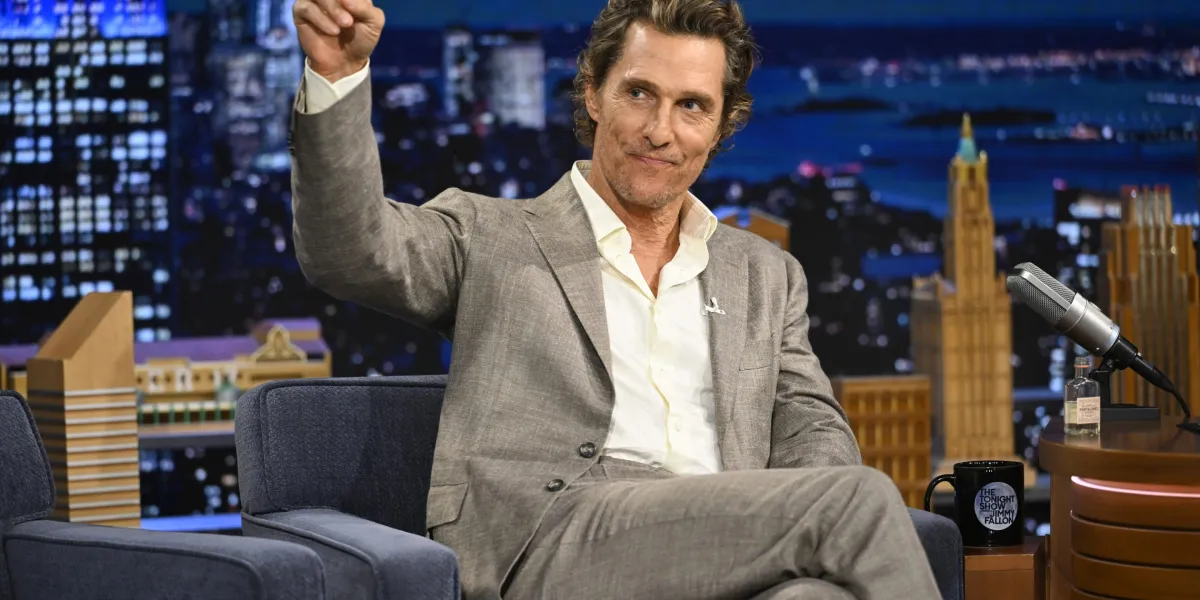
Matthew McConaughey has described how he spent a weekend in the West Texas desert reading two decades of negative reviews of his work, separating personal hostility from criticism he could use to improve.
The Oscar-winning actor, whose net worth is estimated at $200 million, gathered the harshest assessments of his performances into a single volume before taking them with him near Marfa.
“I took them on as a thick book… not all the positive, the negative ones—and I sat with them,” McConaughey said in an interview with Build or Break.
“It’s all I took, and I spent two days looking at them, and it was hard.”
His team said the trip took place around 2018 or 2019, while McConaughey was writing his memoir, Greenlights. By then, he had spent more than 20 years in the film industry, following his breakthrough in Dazed and Confused and major roles in projects including Interstellar and True Detective.
McConaughey said the experience taught him that not all bad reviews deserve equal weight. Some critics, he felt, had decided against him before assessing the work.
“Some of the reviews, what I learned is that, from the very first sentence, this person has it out for me,” he said. “It didn’t matter if they saw the movie or not. They just don’t like me. They were going to write a negative review.”
Other reviews were difficult but offered a more useful challenge. McConaughey said those writers appeared to understand his work and were explaining why a performance had fallen short.
“I was like, ‘This person got a point.’ They’re actually a fan of mine, and they didn’t get from my performance what I was actually hoping they would’ve got. Where did I fail in achievement?”
He described that as constructive criticism, saying the reviewers had assessed the work rather than simply attacking him.
“They were looking at the work and objectively criticizing it. Applauded some things, but also applauded some things that shined a light on where I came up short,” he said.
McConaughey said the important question was what he could learn from criticism, while recognising that some people would remain hostile regardless of what he did.
“Some are going to write bad about you or wish you the worst no matter what, because they just don’t like you from afar, don’t like your success or what have you,” he said. “Some are really good critics or write constructively about what you did wrong—and you can learn from it.”
Why taking criticism seriously matters beyond Hollywood
The actor is not the only prominent figure to argue that feedback remains valuable after reaching the top of a profession. Ozark actor Jason Bateman has said he reads reviews of his films and television programmes because his work is made for public consumption.
In the corporate world, Nvidia chief executive Jensen Huang has said he remains self-critical after more than three decades at the company. He has described himself as “always in a state of anxiety” that Nvidia could fail and said he was “still working on being a good CEO”.
Huang also said he criticises everything his staff show him, arguing that feedback should be immediate and intended to help people improve rather than punish them.
Ralph Lauren chief executive Patrice Louvet has similarly rejected the idea of softening difficult messages, saying weaknesses should be addressed sooner rather than later.
For some employers, the ability to accept criticism is now tested directly. Gagan Biyani, chief executive of education platform Maven and a co-founder of Udemy, gives candidates live feedback during interviews, sometimes before a full panel.
He has called the response the “most telling part” of the process. Candidates who freeze or become offended, he said, are likely to be considered “not a fit”, while those energised by the criticism are more likely to join.
