


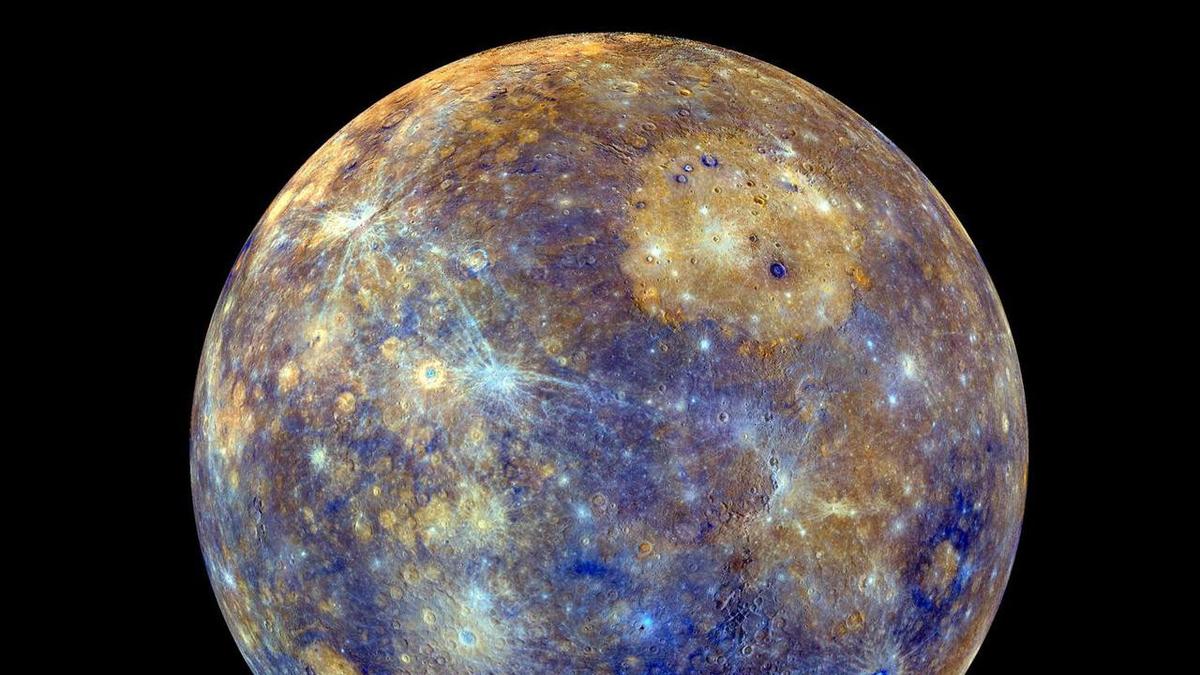
BepiColombo has entered orbit around Mercury after an eight-year journey through the inner Solar System, marking the first arrival at the small, scorched planet in more than a decade.
The mission consists of linked spacecraft operated by the European Space Agency and the Japan Aerospace Exploration Agency. They will separate in December and orbit Mercury at different altitudes to investigate its interior, surface and magnetic environment.
A series of engine firings slowed the spacecraft sufficiently for Mercury’s weak gravity to capture it. Flight controllers in Germany, 152 million kilometres away, then faced several anxious hours before data confirmed that the manoeuvre had succeeded.
BepiColombo is only the third spacecraft to visit Mercury, the closest planet to the Sun and one barely larger than Earth’s Moon. The European Space Agency announced the arrival on social media.
The mission follows NASA’s Mariner 10, which flew past Mercury three times in the mid-1970s, and the Messenger spacecraft, which entered orbit in 2011 before crashing into the planet after running out of fuel in 2015.
Named after the late Italian mathematician Giuseppe “Bepi” Colombo, the latest mission was launched in 2018 and took an unusually indirect route. It passed Earth once, Venus twice and Mercury six times, using gravity assists to guide its progress.
Those manoeuvres added more than 10 billion kilometres to the spacecraft’s journey. The two explorers separated from their mother ship in September for the final stage of the trip.
Once operating independently, the European and Japanese spacecraft will examine Mercury’s dense interior and magnetic field, as well as its impact craters, volcanic plains, mountain ridges and peaks rising as high as 4.5 kilometres.
Lead project scientist Geraint Jones said the team was looking forward to the flow of new data in the northern spring. The mission, he said, would enable “unprecedented measurements taken by two spacecraft at the planet at the same time”.
Temperatures on Mercury can exceed 430C, placing considerable strain on the spacecraft’s electronic and engineering systems. “The spacecraft and its instruments need to be kept as cool as possible, which is a huge technical challenge in itself,” Mr Jones said.
Space agency officials aim to keep the mission operating for at least one Earth year, equivalent to four years on Mercury.
