


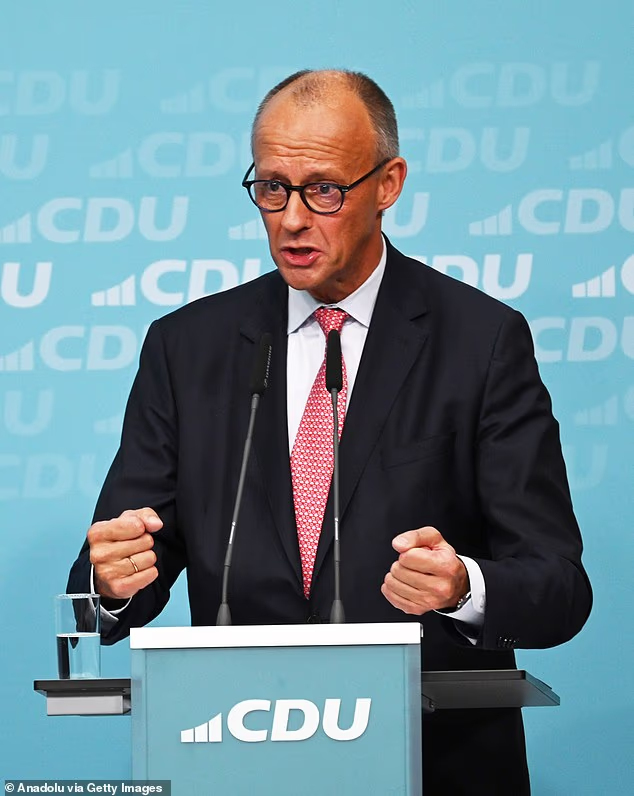
German Chancellor Friedrich Merz has vowed to continue with his reform programme after the CDU suffered a historic setback in two state elections, while the anti-migration Alternative for Germany made major gains.
Exit-poll projections indicated that Merz’s centre-right Christian Democratic Union secured just 5% in Mecklenburg-Western Pomerania – its lowest result in any German state since the Second World War.
The AfD won 37.9% in the north-eastern state, according to projections by public broadcaster ARD based on exit polls and partial counting. In Berlin, the party took 16.2%, while the CDU came second on 19.1%, behind the Left party on 25.3%.
Merz described the result for his party as a “disaster”, but rejected suggestions that his government should retreat from its agenda. He argued that Germany’s economic and political difficulties made difficult reforms more urgent.
“What needs to be done now requires backbone, steadfastness, and patience,” Mr Merz said in a statement issued shortly after the projections were announced.
“I will demonstrate these qualities as chairman of the CDU and, above all, as chancellor of our country.”
AfD gains increase pressure on Friedrich Merz
The result adds to the pressure on Mr Merz after the CDU was defeated by the AfD in Saxony-Anhalt on September 6. That outcome shocked many Germans who had believed the country had developed strong resistance to nationalism and claims of racial superiority after confronting the crimes of its Nazi past.
The AfD was not close to being able to form a regional government in either of Sunday’s elections. But its performance has further weakened the Chancellor’s position, after he became leader 16 months ago promising to revive an economy that has barely grown for years.
Tino Chrupalla, the AfD’s national co-leader, criticised Mr Merz’s response. “The chancellor’s statement today really was more than feeble – he announced that he’d carry on as before, instead of finally drawing the consequences and resigning,” he told ZDF television.
Mr Merz appeared to refer to the hard-right party when he said the government’s reforms would be “the antidote to the poison of authoritarianism, which is penetrating ever deeper into our society as the fascination with authoritarianism grows.”
The plans include income-tax cuts for low and middle-income families, an overhaul of the pension system and measures to reduce Germany’s bureaucracy.
There have been calls in recent weeks, including from within the CDU, for Mr Merz to be replaced as Chancellor. No senior ally has publicly demanded his departure, however, and several figures have warned against allowing the dispute to become a debate about personnel.
Philipp Amthor, a prominent CDU figure from Mecklenburg-Western Pomerania who manages relations between the federal and state governments at the chancellery, said the campaign had been affected by “the difficult personnel discussions” of recent weeks.
“It is good and right for these personnel discussions not to be continued now,” he said.
