


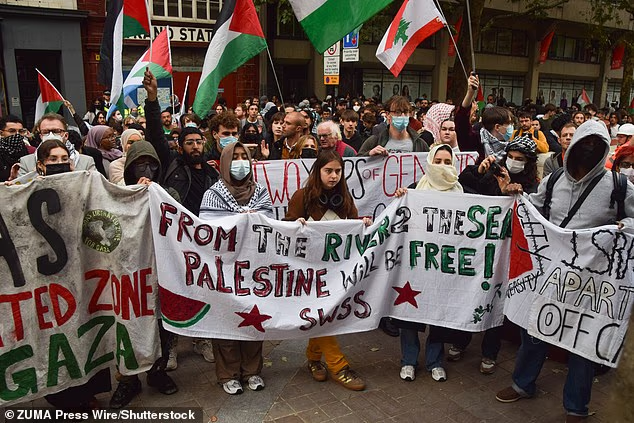
Police have urged organisers to cancel a pro-Palestinian student protest planned in central London on the third anniversary of the October 7 attacks, warning that officers will take a “robust” approach if the march goes ahead.
The Metropolitan Police said Wednesday should be “a day of mourning and a day of reflection”, and warned that the event could cause distress to Jewish students and staff.
About 300 students are expected to take part in the demonstration, which has been promoted on social media by activists calling for an end to what they describe as the “Palestinian genocide”.
James Harman, the Met’s deputy assistant commissioner for operations, said the force had tried to contact those behind the event and ask them to choose another date.
“Serious concerns have been expressed about the impact of this march on students and staff, particularly those who are Jewish, the route, and of course the very specific day on which it is being held,” he said.
“Finding the organisers, frankly, has so far proved difficult. So I use this opportunity today to urge them to reconsider and to make contact with us urgently, so they can plan their events on a different date.”
The force said it had identified people planning to attend but that none had been willing to take responsibility for organising the march. It has been attempting to identify those behind the University of London Coalition, which advertised the protest.
DAC Harman said: “I don’t think it is the right day to be holding that event. If it goes ahead, it is not because the Met have permitted it. We will have to police it.”
The planned route begins at King’s College London and continues to the London School of Economics, the School of Oriental and African Studies and University College London.
The demonstration is one of several events the Met believes could heighten tensions in the capital. A further pro-Palestinian protest is planned for Saturday, October 10, while the force is also preparing for possible disorder ahead of the Holborn and St Pancras by-election next week.
DAC Harman said policing was not seeking to become involved in political disputes, but would act against serious disorder, violence and hate crime.
“We have absolutely no desire to get involved in politics. We have absolutely no desire to take sides in culture wars or wars of words between opposing groups,” he said.
“But the Met absolutely has a role – and policing has a role – when it comes to preventing serious disorder, violence, and hate crime, and we will be robust in doing so.”
The protest plans have been condemned by Jewish organisations and politicians. Karen Pollock, chief executive of the Holocaust Educational Trust, said those demonstrating on October 7 knew what the date represented.
“They know of the savagery, the sexual violence, the murder and kidnapping committed by Hamas, yet they still choose this date,” she said. “This is a disgusting attack on the memory of the victims of Hamas and those still grieving, carrying the pain and trauma this anniversary brings.”
Raphi Leon, president of the Union of Jewish Students, described holding a protest on the day of mourning for Israeli families as “outrageous”, adding: “There are 365 days of the year. The decision to protest on this day is provocative, deliberate and must be condemned to the fullest extent.”
Education Secretary Lucy Powell said October 7 should be marked with “deep mourning” for those killed and those affected by the Hamas attack.
Hamas militants killed more than 1,200 civilians and took 251 hostages during the attack. Israel has subsequently faced accusations of genocide over the thousands killed in its retaliatory bombing campaign in Gaza.
A similar student march held on the second anniversary was described by then-prime minister Sir Keir Starmer as “un-British”. The students went ahead despite his call for the action to be cancelled.
