


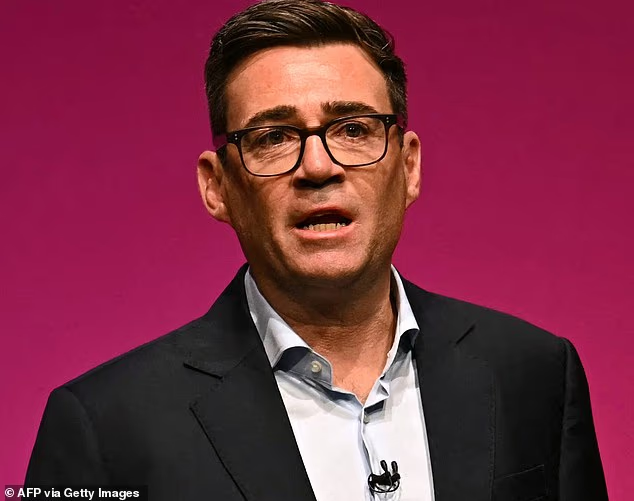
Andy Burnham’s Labour conference speech in Liverpool set out a programme of expanded state control over housing, water, energy, transport and social care, alongside plans to roll back parts of Margaret Thatcher’s market reforms.
The Prime Minister told delegates he wanted “good growth in every postcode, hope in every heart”, with greater public involvement in essential services and a transfer of powers from Westminster to lower-level politicians and officials.
One of the central announcements was a council-house building programme, to be fronted by Angela Rayner, described as the biggest since the post-war era. The proposals would remove the right to buy and give the state “democratic control over our housing stock”.
Burnham also said councils would receive new powers to seize private property judged to be unused or poorly maintained by landlords. He argued that housing should not be treated as a market but as “an essential that everyone needs”.
The speech included a commitment to repeal Thatcher’s prohibition on public ownership of water companies. It also proposed greater state control across other parts of the economy, including energy, transport and social care.
Andy Burnham Labour conference speech sets out state-control agenda
Burnham presented the measures as part of a broader “theory of growth”, based on control of essential services followed by the devolution of responsibility. The proposals were warmly received by Labour delegates, who repeatedly applauded the address.
He linked his approach to his family’s experience of home ownership, recalling how his grandparents buying their home had helped create opportunities for the next generation. However, the speech also marked a decisive break with the policy of expanding home ownership through the right to buy.
The address invoked the political divide over Thatcherism and the legacy of nationalised industries. It portrayed the former Conservative prime minister’s reforms as an obstacle to the greater public ownership and regulation now being proposed.
It also included a significant change to pensions policy. From April 2030, the state pension triple lock would be replaced by a double lock, with annual increases determined by whichever was higher between inflation and 2.5 per cent.
The speech said the change would break the link between pensions and earnings, a policy associated with the triple lock. It was presented alongside a programme otherwise focused on expanding the role of government.
Burnham further announced a commission on electoral reform. The proposal could lead to consideration of alternatives to the first-past-the-post system, which has helped Labour win a large parliamentary majority despite a weak share of the vote in 2024.
A more proportional system would benefit parties including Reform, the Liberal Democrats and the Greens, while making it more difficult for Labour to form a majority government without support from smaller parties.
Taken together, the Liverpool speech outlined a Labour programme centred on public ownership, tighter state control of housing and essential services, and the devolution of political power away from Westminster.
