


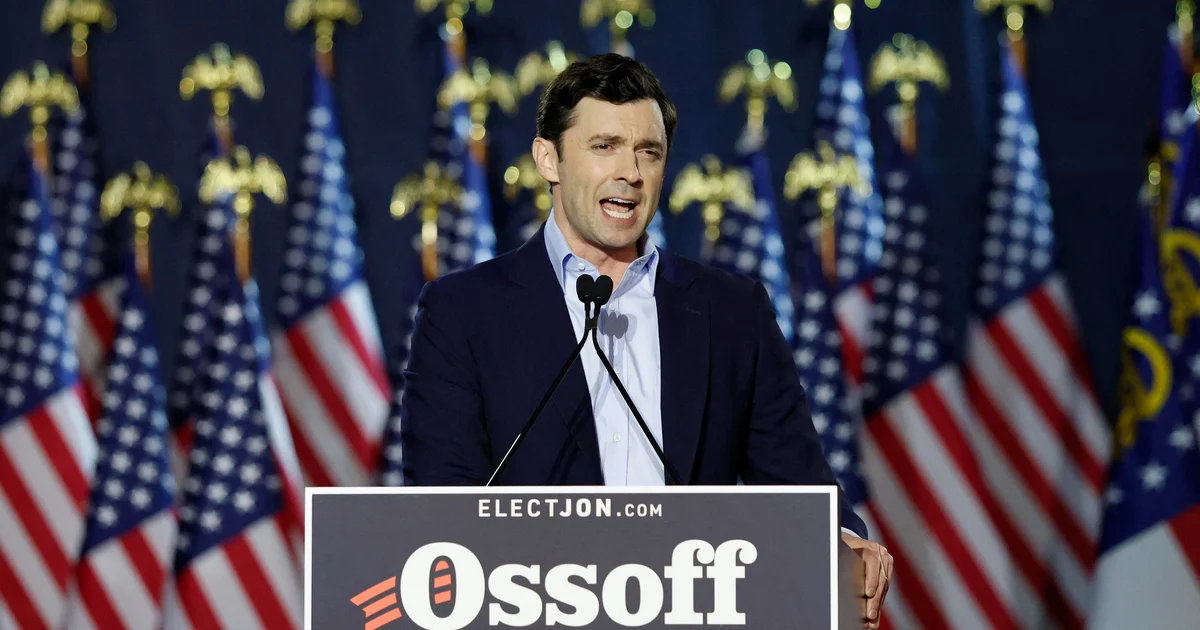
Jon Ossoff’s decisive Senate re-election victory in Georgia has intensified speculation that he could seek the Democratic nomination for president in 2028, although the 39-year-old senator continues to reject the idea publicly.
Ossoff defeated Republican challenger Mike Collins by about 18 points, a marked improvement on his previous Senate victory, which he won by just over one percentage point. The result came two years after Donald Trump carried Georgia against Kamala Harris by roughly two points.
“I have zero interest in running for president” in 2028, Ossoff said during a debate in October. Nevertheless, early polling has placed him at the head of a hypothetical Democratic field.
A post-election survey gave Ossoff 17 per cent support among Democratic voters, narrowly ahead of Harris and New York congresswoman Alexandria Ocasio-Cortez. Former transport secretary Pete Buttigieg and California governor Gavin Newsom were also among the leading contenders.
Ossoff has also performed strongly among progressive activists. At a Washington gathering held after the midterm elections, he received 38 per cent of first-choice votes in a straw poll, ahead of Ocasio-Cortez and Buttigieg.
His appeal reflects a balance that could prove valuable in a national contest: he has attracted interest from both the party’s centre and its left while winning decisively in a closely divided presidential battleground state.
“I think he would make an attractive presidential contender on the Democratic side,” said Jerry Gonzalez, chief executive of the Georgia-based GALEO Impact Fund PAC, which backed Ossoff’s re-election campaign.
“He is not afraid, he won’t shy away from holding the Trump administration accountable, but in a way that works towards actually building coalitions to get something done,” Mr Gonzalez said.
Ossoff’s coalition in Georgia
Election data suggests Ossoff assembled a broader coalition than Democrats have managed in Georgia in recent contests. He retained overwhelming support among Black voters, winning 93 per cent of the group, which accounts for almost a third of the state’s eligible electorate.
He also made gains among white voters, winning 40 per cent compared with 28 per cent for Harris two years earlier. Among white voters without university degrees, his support rose to 29 per cent, against 18 per cent for Harris, while he won 19 per cent of white evangelical or born-again Christian voters, compared with less than 10 per cent for her.
Ossoff won men by nine points, after Harris lost that group by 13 points. He also secured 85 per cent of voters aged 29 and under and roughly split the vote among those aged 45 and over, a group Harris lost by 15 points.
His performance among Hispanic voters was another significant shift. Ossoff won about two-thirds of Latino voters, seven points more than Harris had won in 2024.
In 19 Georgia precincts where at least 30 per cent of active registered voters identify as Hispanic or Latino, Ossoff won by a combined 49 points. Harris had held an eight-point advantage in those areas in 2024, while fellow Democratic senator Raphael Warnock had won them by 18 points in 2022.
The change was particularly pronounced in areas that had backed Mr Trump two years earlier. Six heavily Latino precincts in Whitfield County moved from a 12-point advantage for Mr Trump in 2024 to a 37-point victory for Ossoff, while three similar precincts in Hall County shifted from an 11-point Republican lead to a 33-point Democratic win.
The figures concern whole precincts rather than individual Latino voters, and presidential and midterm electorates are not directly comparable. Mr Gonzalez attributed the shift partly to concerns about affordability and immigration enforcement.
“Things are really expensive,” he said. “The price and affordability were a big driving issue.” He also pointed to the Trump administration’s immigration crackdown and Ossoff’s Senate investigations into alleged abuses in federal immigration detention facilities.
Charles Bullock, a political science professor at the University of Georgia, said Ossoff presented himself as a moderate whose emphasis on mainstream issues could appeal beyond the Democratic base.
But he cautioned that success in a Georgia general election might not translate easily into the party’s presidential primary, where voters can place greater weight on ideological positions.
“Obviously, he’s successful here in Georgia,” Mr Bullock said. “How would he play elsewhere?”
“I think what we will be seeing is preparation, maybe for a later run,” he added.
Potential challenges in a 2028 primary
Ossoff’s record could leave him open to attacks from both sides of the Democratic Party. Progressives have criticised his vote for the Republican-backed Laken Riley Act and his reluctance to support Medicare for All.
Meanwhile, his votes to restrict certain weapons sales to Israel and criticism of Israel’s military conduct in Gaza have drawn objections from some pro-Israel Democratic voters and donors.
Healthcare is already emerging as a potential dividing line among possible 2028 candidates. Ro Khanna, another potential contender, recently renewed the argument for universal healthcare, writing that “Medicare for All who want it” was “pablum”.
The Democratic Party’s revised primary calendar could also give Ossoff an early advantage if he changes his mind. South Carolina, where Black Democratic voters have long played an influential role in selecting the party’s nominee, will lead the calendar, followed by Nevada, New Hampshire, New Mexico, Michigan and Virginia.
Those six early-voting states are home to about 4.2 million Latinos. Ossoff’s support among both Black and Latino voters could therefore be relevant in the nominating process, as well as in a general election campaign.
Mr Gonzalez said Ossoff’s focus had been on securing re-election, a goal he had now achieved.
“He has mentioned that he was focused on winning reelection, which he has done, so I think that gives him a little bit of latitude to think about it a little more seriously,” he said.
