


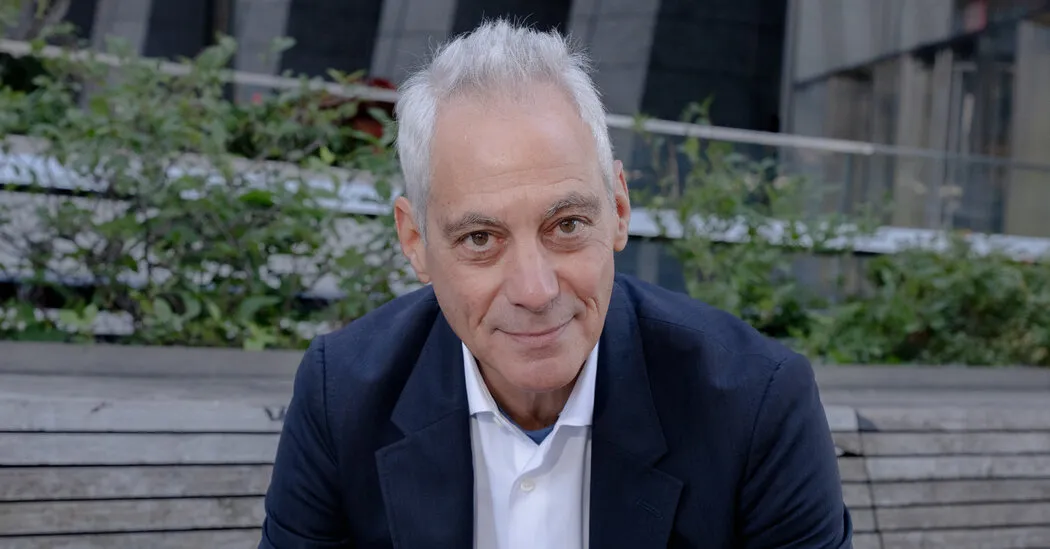
Rahm Emanuel has become a key behind-the-scenes figure in the Democratic campaign to retake the US House, advising candidates, raising money and developing messages as he considers a possible run for president in 2028.
The former Chicago mayor and White House chief of staff has been recruiting candidates, appearing at events in competitive districts and speaking regularly with Hakeem Jeffries, the House minority leader.
Mr Jeffries said the pair were in contact at least every other week, with Mr Emanuel sometimes providing updates on how candidates were performing on the campaign trail.
“Rahm’s perspective is always thoughtful, frank, insightful and helpful,” Mr Jeffries said.
Mr Emanuel, 66, has drawn on a career spanning the Clinton White House, House Democratic leadership, Barack Obama’s administration and Chicago City Hall. He also served as ambassador to Japan under President Joseph R Biden Jr before returning in early 2025 and offering to help Democrats win back the House.
“We win the House and it’s the first day of the end of the Trump presidency, and it is the most important thing to do,” he said.
Rahm Emanuel predicts Democratic gains
At a private dinner in Washington this month, Mr Emanuel told a group of leading Democratic House recruits that the political climate looked “eerily similar” to 2006, when his party made substantial gains in Republican-leaning parts of the country.
He cited an unpopular war, an unpopular president, corruption and rising energy prices as parallels with that period.
Mr Emanuel predicted that Democrats could gain between 10 and 12 seats at the lower end of his estimate, and between 15 and 17 at the higher end. He said independent voters were moving towards the party and Republican turnout was low.
“That’s a chemistry for a wave,” he said. “That is the law of physics.”
He has also been using his extensive political contacts to support candidates. On Tuesday, he is due to host a Chicago fundraiser for five women taking part in the Democratic Congressional Campaign Committee’s “Red to Blue” programme, with a target of raising between 60,000 and 75,000 dollars for each during the election cycle.
Denise Powell, a Democrat seeking to win a House seat in Nebraska, said Mr Emanuel’s support had been valuable after he visited her on a picket line.
“Having the support of experienced Democratic leaders like Rahm — people who know how to win tough fights — has been invaluable,” she said.
Mr Emanuel has campaigned in several swing districts, including alongside Sean McCann in Michigan and Rebecca Bennett in New Jersey. He acknowledged that the relationships he is building could help him if he enters the 2028 presidential race, but insisted that was not the main reason for his work.
“I’m not saying it’s zero. But it is not a hundred percent. It’s not even 50 percent,” he said.
Message-building and tensions on the left
His approach has not won universal approval within the Democratic Party. Maurice Mitchell, national director of the progressive Working Families Party, questioned whether a veteran political operator associated with Wall Street could offer useful advice to candidates fighting competitive races in 2026.
“He’s like the political equivalent of Windows 95 — an operating system without an application in the modern era,” Mr Mitchell said.
Mr Emanuel has promoted a series of slogans and policy ideas as he seeks to help Democrats appeal to voters. He has urged the party to focus on “greed, grievance and grandeur” when attacking President Trump, and has proposed measures including a ban on social media for under-16s and restrictions on stock and prediction-market trading by politicians.
He has also called for mandatory retirement at 75 and developed education proposals focused on early reading and higher education.
Mr Emanuel has been openly critical of the party’s left wing, saying Democratic socialists should not be part of the party until they change their positions on key issues. He contrasted rallies led by Bernie Sanders and Alexandria Ocasio-Cortez with his own focus on winning a congressional majority.
“Some people want to do oligarchy tours,” he said. “I want to do majority tours. That’s what I’m doing with my time.”
For now, his attention remains on House races. He said he spoke or exchanged messages with about 70 people on an average day, sometimes reaching three figures, and described his continued involvement in congressional campaigns as a form of advanced study.
“Maybe this is my postdoctoral work,” he said. “Maybe I did my B.A. and I’m working on my postdoctorate?”
