


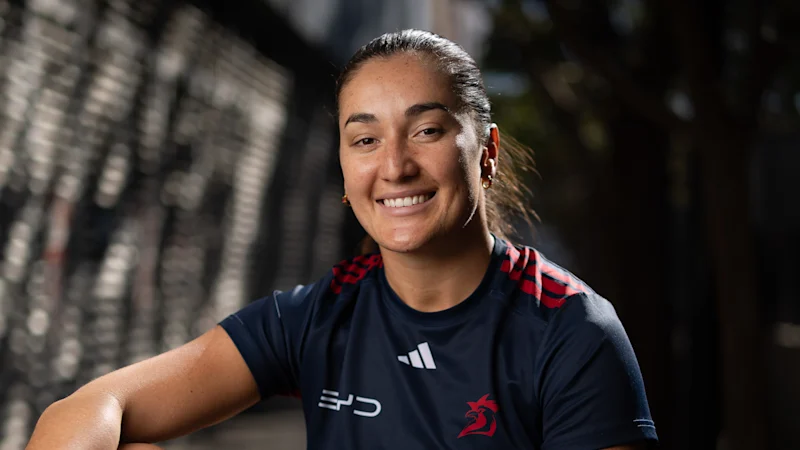
The Roosters NRLW team have remained unbeaten this season after trailing for just 70 minutes of play, building the kind of understanding that lock Olivia Kernick describes as a “sixth sense” ahead of Sunday’s grand final against Brisbane.
Across 840 minutes, the Roosters have been behind for only 70. Their 770 minutes in front have helped deliver a perfect record, but the side has not dismissed the brief periods when matches have gone against them.
The clearest example came in round three, when Canberra led for 32 minutes and 56 seconds before the Roosters recovered to win 22-18. Kernick still regards the performance as a failure to meet the team’s standards.
“That was sort of a loss in our eyes,” she said. “We didn’t play anywhere near our potential … we just weren’t at the standard that we had been training at – defensively or in our attack.”
The match prompted the Roosters to reconsider how quickly they responded when their original plans stopped working. Hooker Keeley Nizza said they had taken too long to adapt to Canberra’s approach.
“We probably went into the game, playing the same way as the week before, and it took us too long to change it up and adapt,” Nizza said.
“The Raiders really played the opposite game to what we thought we were going to. [With] Our game plan, we didn’t change quick enough on the run, and we didn’t adapt as players on the field. We did, eventually, but it probably took us longer than we would have liked.”
Roosters NRLW attack reaches new level
The adjustments have coincided with a record-breaking attacking season. The Roosters are averaging 37.8 points a game, the highest total in the NRLW, and their points differential of plus 328 is the best in the competition’s history.
Halfback Tarryn Aiken declined to reveal the detail of the changes, but five-eighth Jocelyn Kelleher said the Canberra match forced the team to examine how its halves combination operated.
“We all speak about [how] that Canberra game was the loss that we needed to have [even though they still won], and we needed to go back and look at ourselves and how we could be better,” Kelleher said.
“We did change our attack a little bit and worked a few things out – without giving away too much – we just changed pretty much how Taz [Aiken] and I operated, and I think it works really well now.”
Aiken was unavailable for last year’s grand final after suffering an anterior cruciate ligament injury the week before the finals, when the Roosters were also unbeaten before losing the decider to Brisbane.
Captain Isabelle Kelly believes the team’s cohesion depends on its players responding to the voices of its key organisers, particularly when the side is fully focused.
“I feel like we just have this connection on the field where … I don’t even know how to explain it,” Kernick said. “I guess it’s just a feeling, almost like a sixth sense, where you can all almost predict what each other are going to do on the field.”
Kelly highlighted the influence of the halves and fullback, with Kelleher’s kicking able to alter momentum and Aiken’s reading of matches providing direction.
“So, it’s listening to your halves, it’s listening to your fullback, and I think that for us is when we’re switched on 100 per cent, and we’re really dominating,” Kelly said.
