


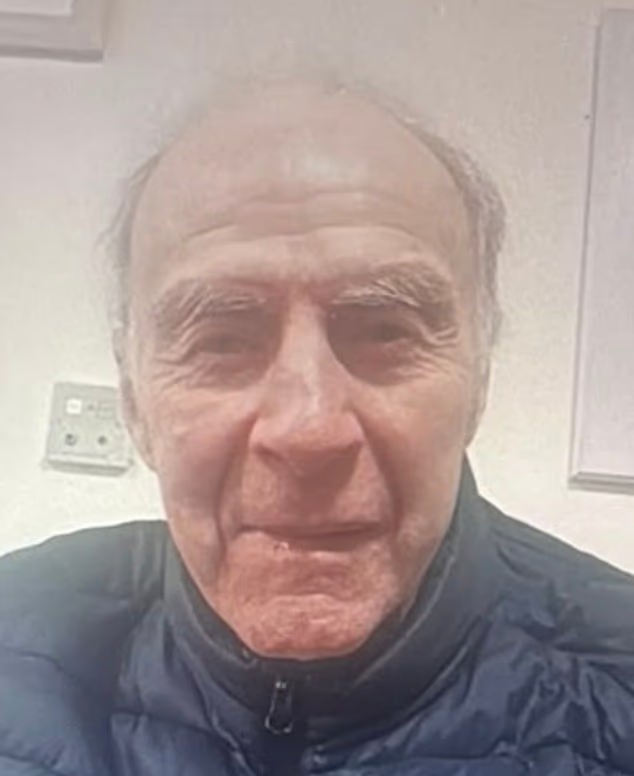
Sir Ranulph Fiennes is believed to be back at his isolated farmhouse in Shropshire, amid continuing concern over the welfare of the 82-year-old explorer, who has Parkinson’s disease and has not been seen in public for two years.
The property is screened by a 6ft-high security gate. Two modular homes, one intended for Sir Ranulph and the other for his carer, were assembled near the main house last week.
The development follows a period in which Sir Ranulph has reportedly been moved between four care facilities and a hotel. He was most recently staying at a care home in Crewe, Cheshire.
Cheshire Police said that “no immediate safeguarding concerns have been identified at this time” and that any new information would be assessed through “the appropriate multi-agency arrangements”.
However, the explorer’s return to his farmhouse has prompted renewed concern among friends and supporters, who fear there will now be fewer opportunities for people outside his household to see him.
Concerns over Sir Ranulph Fiennes’ care
Sir Ranulph’s whereabouts were disclosed by his friend of more than 30 years, Michael Kobold, after a source noticed the new accommodation being installed at the Shropshire property.
Mr Kobold said Lady Fiennes had told the source that her husband had been involved in a car accident, which was why he was using a wheelchair. He added that the carer had been introduced as “the blacksmith for the horses”.
Sir Ranulph’s wife, Louise Millington-Cotes, became Lady Fiennes after their marriage in 2005. She is 23 years younger than the explorer and was previously a horse trainer in Cheshire.
Concerns have centred on the secrecy surrounding Sir Ranulph’s care and the restrictions reportedly placed on contact with him. At one London establishment, visitors were said to have been required to sign non-disclosure agreements.
At a care home in Wales, the owner said instructions had been given for Sir Ranulph not to socialise with other residents and to wear a disguise when leaving his room.
“I wouldn’t do that to an animal. Never mind Sir Ranulph Fiennes,” the owner said.
There is no suggestion that Lady Fiennes has done anything wrong. But the Care Inspectorate of Wales found that Sir Ranulph had been unlawfully “deprived of his liberty” because the authorisation covering his residence was not in place.
The manager of the Welsh home said he had contacted police and the Office of the Public Guardian in March to raise concerns, but Sir Ranulph was moved before action could be taken.
Friends call for investigation
The situation has led to an outcry among some of Sir Ranulph’s well-known friends, including fellow adventurers Bear Grylls and Ben Fogle, who called for the police to investigate.
Mr Kobold, who climbed Mount Everest with Sir Ranulph almost 20 years ago, has also criticised the way the explorer has been treated. He posted footage showing Sir Ranulph, appearing frail, walking with a frame in what looked like a stable or barn.
Lady Fiennes can be heard directing him: “Stand up straight, that’s it, walk between the wheels, nice and straight.” She then sings “heigh ho, heigh ho, it’s off to work we go” from Disney’s Snow White And The Seven Dwarfs.
As the footage ends, she says: “That’s it, stand up straight, back up. There we go. Do not hit anything.” The recording is believed to have been made at the couple’s Cheshire home.
Mr Kobold also posted an image of Sir Ranulph sitting in an armchair, wearing a woolly hat and covered with a blanket, while holding what appeared to be a bed pan.
He described the explorer as “broken and frail, after two years of strict isolation” and asked how “even a national treasure like Ran Fiennes” could experience such treatment.
It has also emerged that King Charles has taken an interest in the case because he is a close personal friend of Sir Ranulph. The King’s equerry was reportedly told to “back off” when he contacted Lady Fiennes.
Sir Ranulph’s stepson, Alex Millington-Cotes, 31, has called for Lady Fiennes to lose her lasting power of attorney over the explorer’s property, finances, health and welfare.
The Office of the Public Guardian, which is responsible for protecting elderly and vulnerable people from exploitation by those holding power of attorney, has reportedly rejected nine complaints to intervene, saying the case was beyond its remit.
Mr Millington-Cotes last saw Sir Ranulph at the Shropshire farmhouse in September 2024. He said he had been forced to climb over the gate because he no longer had a key, having become estranged from his mother.
He recalled walking about 100 metres before encountering Sir Ranulph, who took him by the arm, turned him around and walked back towards the drive.
“I told him how difficult things had been and he said: ‘Every family has its problems.’ Then he pulled me into a hug and told me how proud he was of me,” Mr Millington-Cotes said.
He began walking back with Sir Ranulph but stopped after seeing his mother.
