


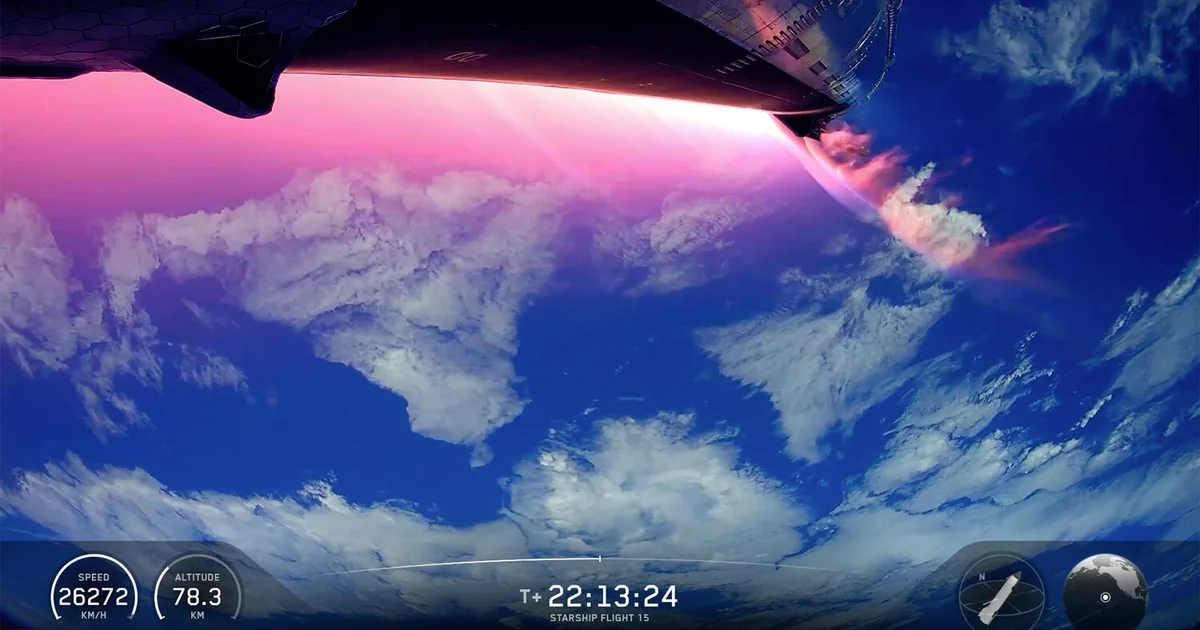
SpaceX has caught a Starship rocket in mid-air at its Texas launch site after the spacecraft spent 22 hours in space, marking the first recovery of a Starship from orbit.
The vehicle survived the intense heat of re-entry before turning upright above the Gulf Coast and slowing to an almost complete hover. Two large mechanical arms on the launch gantry then closed around it moments before its engines shut down.
Employees gathered at SpaceX’s Starbase facility cheered as the upper stage restarted three of its six methane-fuelled Raptor engines to complete the manoeuvre.
“This is so incredible to see!” SpaceX commentator Jessie Anderson said. “One of the most incredible and historic engineering feats of all time has just happened right in front of our eyes.”
Previous Starship test flights had ended with planned splashdowns at sea. The successful capture is a significant step in SpaceX’s effort to create an orbit-class rocket that can be flown repeatedly, with the company saying reusability could reduce the cost of sending payloads into orbit, to the Moon and eventually to Mars.
The 407ft rocket launched from the Texas coast on top of its Super Heavy booster. The two-stage vehicle is described as the most powerful launcher ever built, producing about 16 million pounds of thrust from 33 engines at lift-off.
The booster was also intended to return to the launch site for capture, but a guidance problem forced it towards an offshore splashdown instead. It ran out of fuel and exploded shortly before reaching the water.
Elon Musk said the failure was caused by a “slight underperformance of engines”, adding that the early ships and boosters were already outdated by improved designs being built or tested.
“This booster loss does not change our timeline to reach high volume, fully reusable Starship flights,” he said.
The Starship upper stage sent back clear views as it crossed the Baja Peninsula and northern Mexico on its descent. Its heat-shield tiles glowed red as the spacecraft passed through the atmosphere, before it banked over the launch site, restarted its engines and positioned itself for capture.
Dan Huot, another SpaceX commentator, said the recovery was “the missing link” in the company’s plans. “We caught a Starship, and now everything changes,” he said.
SpaceX will still need to launch and recover many more Super Heavy boosters and Starships to establish the reliability required for crewed missions. It must also show that Starships can be refuelled autonomously in orbit and that their propellant can be preserved in space.
NASA wants to use a version of Starship to carry astronauts to the lunar surface in 2028. Several tanker flights would be required to refuel the lunar lander in orbit before its journey to the Moon.
SpaceX plans to begin orbital fuelling tests during its next Starship flights. However, the programme has taken longer than initially expected, and NASA has said it could also use Blue Origin’s Blue Moon Mark 2 lander, depending on which spacecraft is ready first.
