


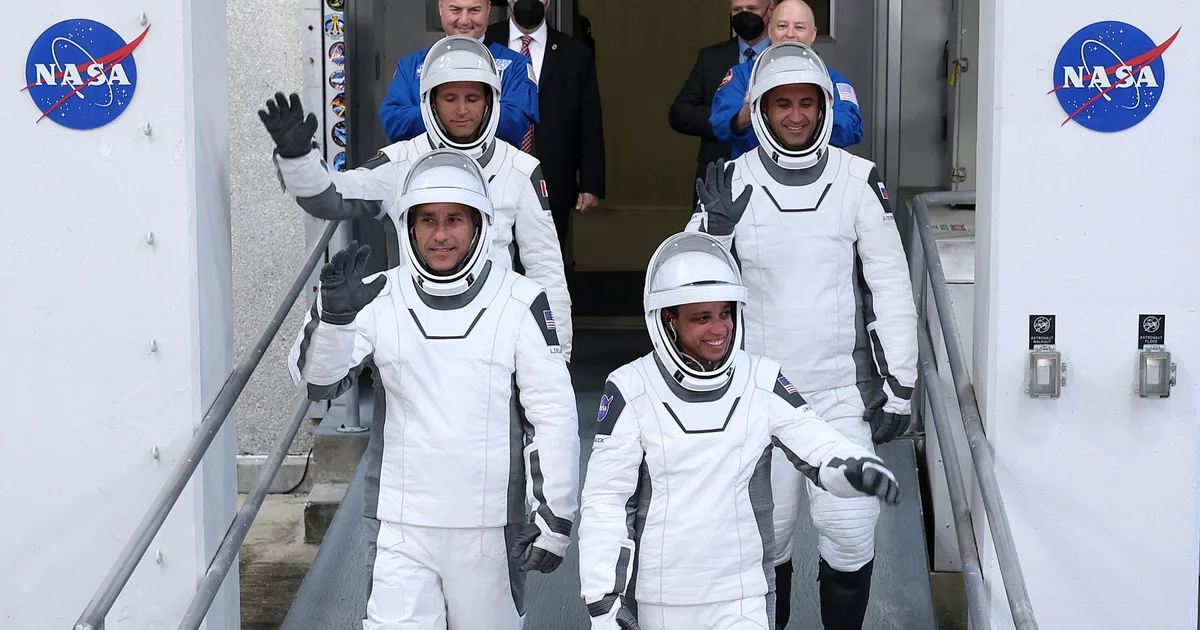
The SpaceX Crew 13 launch has sent two NASA astronauts, a Russian cosmonaut and a Canadian astronaut towards the International Space Station, with one crew member facing a major family milestone while in orbit.
Jessica Watkins, Luke Delaney, Sergey Teteryatnikov and Joshua Kutryk lifted off aboard a Falcon 9 rocket from Cape Canaveral Space Force Station in Florida at 11.10am local time on Thursday.
The mission had been scheduled for mid-September but was postponed so a valve in the Crew Dragon’s propulsion system could be replaced. Watkins, who is the mission commander, previously flew to the space station in 2022, while Delaney, Teteryatnikov and Kutryk are making their first journeys into orbit.
Mr Kutryk’s wife, Heather, is expecting the couple’s third child around Thanksgiving, approximately two months into the mission. Their children are aged five and seven.
The birth will make the couple the fourth in the history of space travel to have a child while one parent is off the planet.
“Leaving these three (plus one on the way) is the hardest thing I’ve ever done,” Mr Kutryk wrote before the launch.
He added: “But that has always been the nature of exploration.” He also quoted the Norwegian explorer Fridtjof Nansen, writing of a departure for the North Pole: “Behind me lay all I held dear in life. And what lay before me? Happy child, little do you know what life is – how strangely mingled and how full of change… and now, a farewell to home. It was the darkest hour of the whole journey.”
Crew 13 set for record station rendezvous
After separating from the Falcon 9, the rocket’s first stage was programmed to return to a landing at the Space Force station, while the upper stage continued towards orbit.
The Crew Dragon was expected to reach the International Space Station in eight hours, which would be a record for a crewed flight, before docking automatically with the forward port of the station’s Harmony module.
The crew is due to take over from Crew 12, whose members are completing a 237-day mission. They are expected to return to Earth aboard their own Crew Dragon, with undocking planned for October 5 and splashdown in the Pacific Ocean off southern California shortly after noon local time on October 6.
European Space Agency astronaut Sophie Adenot, NASA astronauts Jessica Meir and Jack Hathaway, and cosmonaut Andrey Fedyaev are among those preparing to leave the station. Three further crew members launched aboard a Russian Soyuz spacecraft in July and are expected to remain in orbit until early April 2027.
Mr Kutryk, the 17th Canadian to fly in space, said he hoped the station would be seen not only as a feat of engineering but also as evidence of what countries can achieve by working together.
“When I think about the space station, I hope the legacy is that people see this beacon in the sky going around Earth, one of the most complex things humans have ever, ever created,” he said.
“But (I hope) they also see it as sort of this beacon for what we can do when we make good decisions, when we work together and we collaborate and we prioritize things.”
The Crew 13 astronauts will carry out maintenance inside and outside the station, conduct spacewalks and support the capture and stowage of visiting spacecraft. Their programme will also include scientific experiments and public outreach.
Research planned during the mission includes studies of stem-cell-derived tissues linked to heart disease and Parkinson’s disease, crop production for longer-duration missions, blood-flow abnormalities in space and new equipment for monitoring crew health.
Two further solar-array panels are also due to arrive aboard a cargo Dragon spacecraft later in October. They are the final sets in a major upgrade to the station’s original solar-power system and are expected to be installed during spacewalks later in the month and in early November.
“For me, between the science, the spacewalks and everything else that the expedition is going to have, it’s looking to be a great time,” Mr Delaney said. “Excited to launch with this crew, join the expedition, and integrate as an extension of NASA and all the ISS team members.”
