


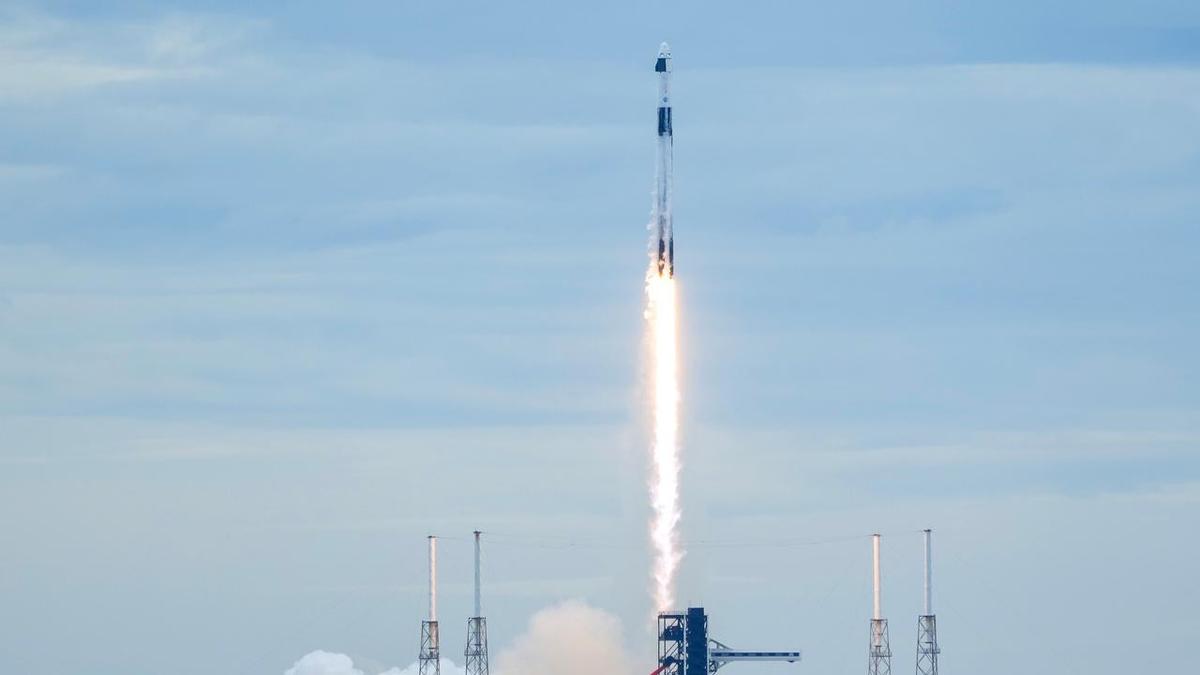
A SpaceX rocket has launched from Florida carrying two US astronauts, a Canadian astronaut and a Russian cosmonaut on a six-month mission to the International Space Station.
The Falcon 9 lifted off from Cape Canaveral Space Force Station with the autonomously operated Crew Dragon capsule on top. The crew is due to reach the orbiting laboratory, about 400km above Earth, after an eight-hour journey.
NASA astronauts Jessica Watkins and Luke Delaney are travelling with Canadian astronaut Joshua Kutryk and Russian cosmonaut Sergey Teteryatnikov. After the capsule entered orbit, SpaceX mission control told them: “Dragon separation confirmed. Jessica, Luke, Josh, Sergey, welcome to orbit.”
Live footage showed the 25-storey rocket rising from the launch pad as its nine Merlin engines produced bright plumes of vapour. Within three minutes, the Falcon 9’s reusable lower-stage booster separated and returned to Earth for a landing.
The upper stage continued its ascent before releasing the Crew Dragon into orbit. The capsule then began its own journey towards the space station.
Watkins, a 38-year-old geologist-turned-astronaut, is making her second spaceflight and is the first NASA astronaut to fly twice aboard a Crew Dragon. Delaney, 47, is a former test and fighter pilot and is making his first trip into space.
Kutryk, 44, is also a former test and fighter pilot, while Teteryatnikov, 37, is an engineer who specialised in submarine operations. Both are making their spaceflight debuts.
The four astronauts and cosmonaut are expected to be welcomed by the seven current occupants of the International Space Station, including the four members of Crew 12. That crew is due to return to Earth soon after a mission lasting more than seven months.
The new arrivals will conduct biomedical and human-performance research, including studies into how microgravity affects blood circulation and clotting. They will also collect health data intended to inform future space missions.
The flight is the 13th long-duration space station crew NASA has launched aboard a SpaceX vehicle since the company began sending US astronauts into orbit in May 2020.
The International Space Station, which is about the length of a football field, has been continuously operated by a US-Russian-led partnership involving Canada, Japan and 11 European countries. NASA has said it is committed to keeping the station operating through 2030.
