


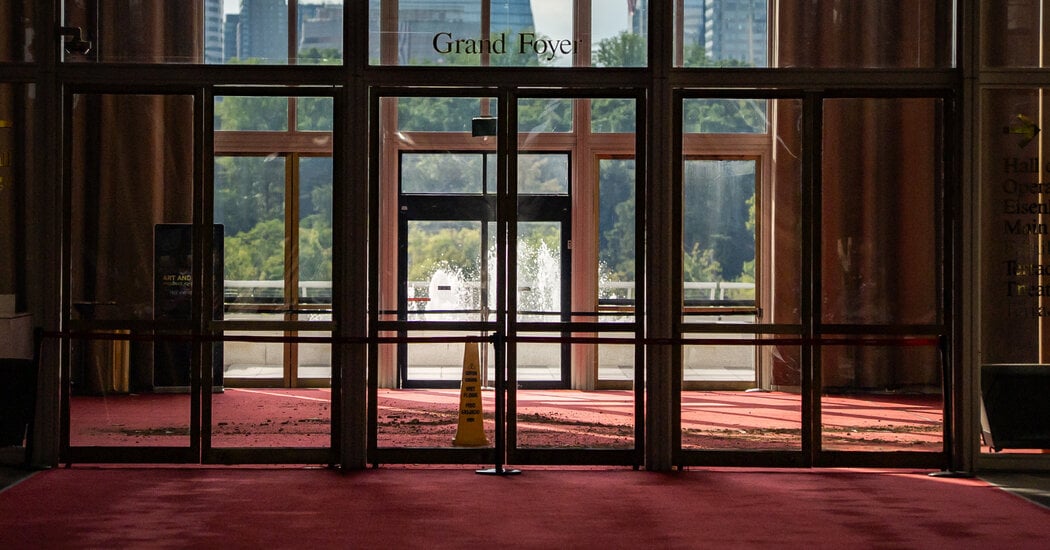
The Kennedy Center in Washington has been shut temporarily after a piece of ceiling plaster fell in the building, but President Donald Trump’s recent threats suggest the closure is also tied to his battle to put his name on the arts venue.
Around five feet of ceiling plaster came down during a storm earlier this month. No one was hurt, yet the debris was left on the carpet for almost two weeks while staff photographed and measured it for a 55-page briefing on the building’s condition.
Trump later claimed online that a security guard had narrowly avoided “certain death”. Less than two hours afterwards, his allies on the Kennedy Center board voted to close the institution, citing safety concerns. Workers in hard hats eventually removed the debris late last week.
The president, who is chairman of the centre, had announced in February that it would close for two years of renovation. Democratic members of the board said the plan was instead intended to disguise falling ticket sales and the departure of artists.
Trump has since made clear that work will not begin until legal challenges over his name are resolved. After a judge rejected his latest attempt to rename the memorial to the assassinated president John F Kennedy, he ordered the closure to take effect immediately, while leaving the renovation dependent on possible further court action.
As construction fencing was erected around the building, Trump argued that adding his name would help rescue it from financial and physical decline. “Because frankly if we don’t do that it’s going to close, it’ll end up being ripped down,” he said.
On Friday night, demonstrators formed a human chain around the Kennedy Center to protest against the closure and fears that the building could ultimately be demolished.
Political takeover of the Kennedy Center
The shutdown follows less than two years of upheaval since Trump took control of an institution designed as a bipartisan national centre for the arts. At the beginning of his second term, he removed Biden-era board members, installed allies and became the first sitting president to serve as the centre’s chairman.
Internal emails and documents indicate that the change has affected the centre’s management, programming and art collection. Audiences and donors have reportedly withdrawn, while the organisation’s finances have deteriorated.
Richard Grenell, Trump’s first director of the Kennedy Center, installed political allies in senior roles and pursued a plan to replace artworks, including pieces donated by foreign governments in tribute to Kennedy.
One proposal stated that works could be returned to their countries of origin, transferred or exchanged, sold publicly or destroyed. A proposed donors’ group would have charged members up to 100,000 dollars and described its purpose as removing “outdated or inappropriate artworks” and replacing them with pieces reflecting “shared American values”.
Grenell said his instruction was to contact donors and tell them: “Thank you very much, we’re returning the art.” He later said he was chiefly concerned with works requiring repairs or restoration that the centre could not afford.
More than 20 works were identified in the plan, including “Blue”, a large outdoor sculpture by Joel Shapiro. The piece was removed without public notice and later sold to David Rubenstein, a former Kennedy Center chairman who was ousted by Trump.
Inside the building, artworks and textiles were removed from the African Lounge, including a carved wooden sculpture from Ghana representing African grief over Kennedy’s death. The centre said the works remained safeguarded and that there were no planned or imminent changes to the collection, adding that the lounge pieces were being preserved on site.
The centre has also hosted events for conservative groups and Trump allies, including gatherings offered free or at heavily reduced prices. Trump’s theatre boxes were refurbished with gold plumbing fixtures, while a newly installed tiled floor was removed after its colour displeased the White House.
Unsigned gold-plated reliefs depicting Trump, Elon Musk and Health Secretary Robert F Kennedy Jr have appeared at the Reach, an annex expected to remain open during the main building’s closure. The artist is believed to be major Trump donor Trish Duggan, who did not respond to requests for comment.
The fight over the building’s name
Congress approved 257 million dollars for a Kennedy Center renovation in July 2025. Five months later, the board voted to put Trump’s name on the front of the building, prompting further departures among performers and patrons.
Representative Joyce Beatty, a Democrat from Ohio and an ex officio board member, sued over the decision. Judge Christopher Cooper ruled that only Congress could change the centre’s name and ordered Trump’s name to be removed.
Workers covered scaffolding with tarpaulins as the letters were taken down during a public gathering in June. Trump’s name has gone, although the coverings remain; centre officials have said they are needed for maintenance.
Sections of the building had already been closed, including the Potomac terrace. The fall of the plaster led to the closure of the Grand Foyer, a vast space nearly two football fields long.
The centre’s spokeswoman, Roma Daravi, said its “nonpartisan approach is evident by the consistent practice of welcoming everyone”. She was dismissed hours after issuing the statement in a round of layoffs.
Democrats have rejected the administration’s explanation for the crisis. Representative Chellie Pingree, the senior Democrat on the House appropriations subcommittee overseeing the building’s funding, said: “The No. 1 problem the Kennedy Center has had is President Trump.”
