


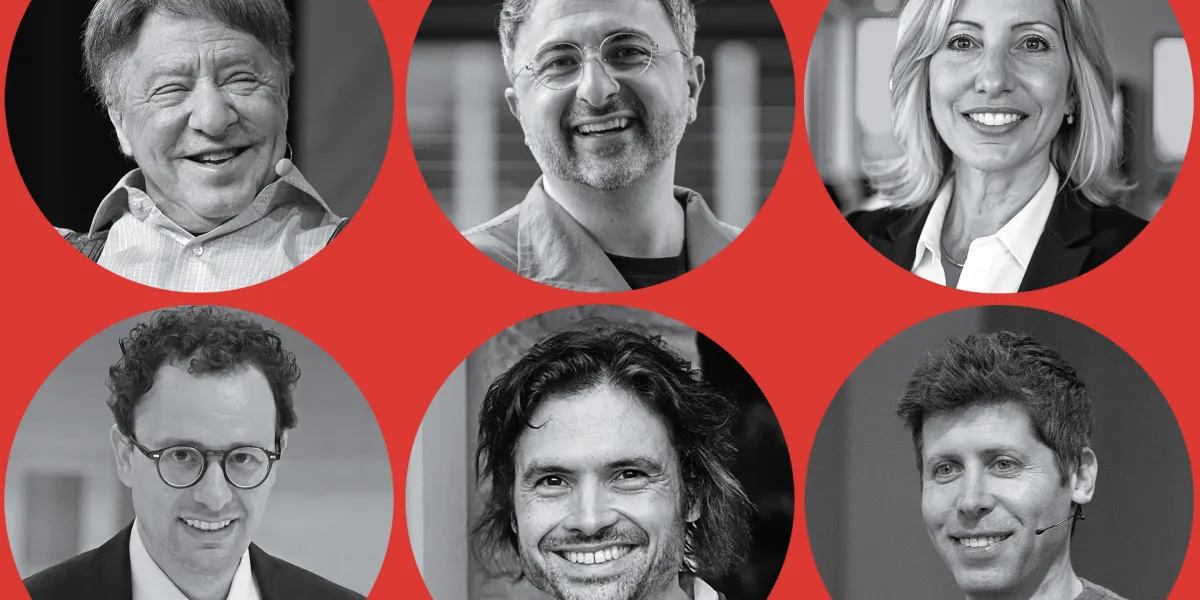
Six leading figures from the artificial intelligence industry and academic world have offered sharply differing views on AI consciousness, human values and the prospect of merging minds with machines.
The perspectives, from executives, researchers, futurists and philosophers, address whether AI can be made morally aligned with people, whether brain-computer interfaces should be used to enhance humans, and whether machines could eventually become conscious.
AI alignment and human values
Dario Amodei, co-founder and chief executive of Anthropic, said his company’s constitution encourages its Claude system to regard itself as “an ethical but balanced and thoughtful person”.
He said the document also encouraged Claude to consider existential questions about its own existence “in a curious but graceful manner”, adding that it had “the vibe of a letter from a deceased parent sealed until adulthood”.
Sam Altman, chief executive of OpenAI, offered a warning against claims that the problem of aligning AI with human interests had already been solved.
“I get nervous when I hear rumors that people think they have sufficiently solved alignment, that they can continue training and it’s okay because their model is a nice guy and isn’t going to do anything wrong,” he said in a podcast interview.
Altman said the question ultimately depended on whose values an AI system was aligned with, pointing to the possibility that “different parts of humanity disagree”.
Could humans merge their brains with AI?
Ray Kurzweil, a futurist and researcher who advises brain-computer interface company Subsense, argued that using machines to extend human thought was part of an established pattern of development.
“If you actually think of language and purpose, and put it inside a machine, that’s already been done,” he said. “And we did that. It did not come from Mars. We created that.”
Kurzweil said such technology represented a way for people to expand their capabilities, allowing them to consider ideas that would previously have been beyond human reach.
Susan Schneider, a philosopher and director of the Center for the Future of AI, Mind & Society, struck a more cautious note over radical enhancement.
She said that even if microchips could replace parts of the brain responsible for consciousness without turning a person into a “zombie”, extensive changes could still threaten personal identity.
“After too many changes, the person who remains may not even be you,” Schneider said. “Each human who enhances may, unbeknownst to them, end their life in the process.”
Debate over AI consciousness
Henry Shevlin, an in-house philosopher at Google DeepMind and a Cambridge University professor, said evidence of sophisticated cognition and possible consciousness in AI systems was increasing rapidly.
He predicted that a significant proportion, and potentially a majority, of researchers in cognitive science and philosophy of mind would soon regard AI systems as serious candidates for consciousness.
Mustafa Suleyman, chief executive of Microsoft AI, rejected that prospect, saying AI systems “are not conscious” and do not feel, experience or suffer.
He said machines did not possess innate preferences or underlying motivations, and argued that they should remain that way if humanity was to flourish during the 21st century.
Suleyman warned that growing acceptance of the idea that AI could already be conscious, or might soon become so, could unsettle existing political and ethical frameworks and alter what it meant to be human.
