


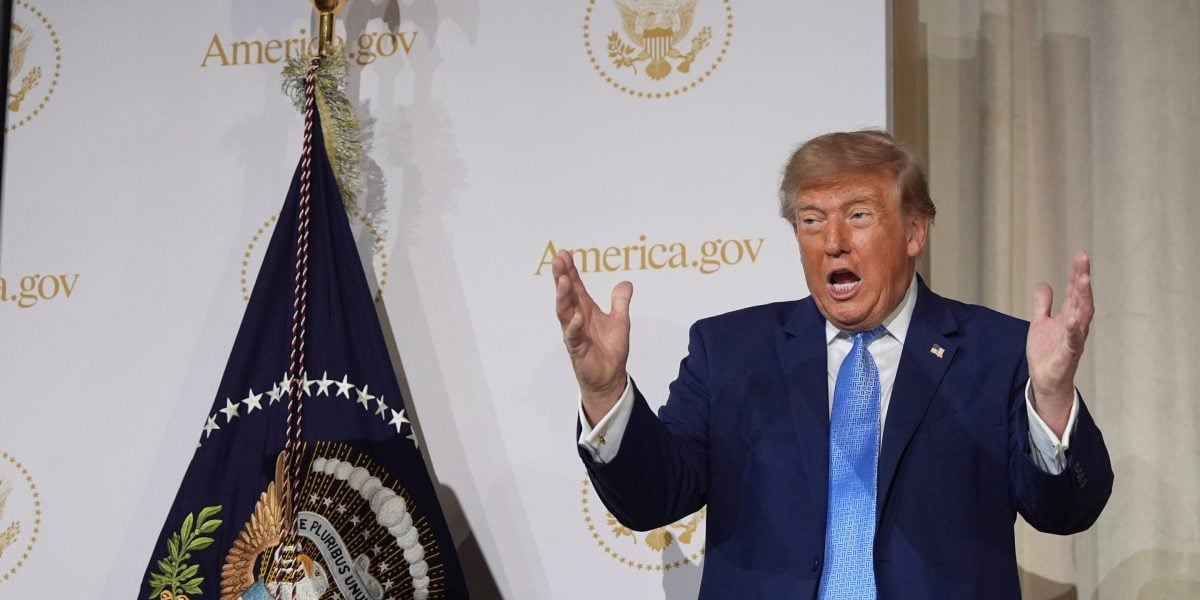
Donald Trump and a group of leading artificial intelligence executives have signed a voluntary AI accord that is expected to include internal and external reviews of the technology, the US president said after a White House meeting.
Details of the agreement were not immediately released, but Mr Trump said the industry had shown a willingness to regulate itself. “I think I’m seeing tremendous self-policing. And they understand that they have to self-police,” he told reporters.
The president also promised that his administration would not restrict the development of AI, despite warnings from some technology leaders that progress should be slowed to allow safety measures to catch up.
“I will never stifle the growth of a technology that will be bigger than the industrial revolution,” Mr Trump said at the unveiling of America.gov, an AI chatbot designed to help people navigate government services. “We can’t stifle it, and we’re leading by a lot.”
Among those attending the White House lunch were Dario Amodei, chief executive of Anthropic; Greg Brockman, president of OpenAI; Amazon founder Jeff Bezos; and Elon Musk, whose X platform has its own AI model, Grok.
Nvidia chief executive Jensen Huang sat to Mr Trump’s right, while Mr Musk was seated on his left. Google chief executive Sundar Pichai, Meta chief executive Mark Zuckerberg and Microsoft chief executive Satya Nadella were also present, alongside Vice President JD Vance, Treasury Secretary Scott Bessent and House Speaker Mike Johnson.
Trump presents AI as US-China race
Mr Trump said the executives had agreed to support “self-regulation”, while suggesting that government agencies would provide a further layer of oversight. “And we automatically have regulation with the Department of Justice, the FBI, all of that,” he said.
He also said the companies had agreed to address opposition to new data centres in local communities by providing more money for schools or helping to reduce energy costs. If resistance continued, he said, “they’ll be forced to go overseas or other locations”.
The president portrayed the development of AI as a contest between the United States and China, insisting that America was ahead and that there would be a winner and a loser, with no “second place”.
The two countries agreed last week to establish a channel for dealing with AI-related incidents during Chinese President Xi Jinping’s visit to Washington. But Mr Trump said he did not want excessive co-operation with China: “I didn’t want to do anything, because we’re leading. Why would I want to do anything?”
His stance contrasts with recent calls for caution from some executives. Mr Amodei earlier this month urged leading firms to slow development, while Mr Musk and OpenAI chief executive Sam Altman said safety measures needed time to catch up as companies reported more examples of AI agents behaving unpredictably.
Mr Altman said on television that OpenAI was increasingly focused on safety and had paused the rollout of a new model the previous day over safety concerns. “We are pacing our progress, which includes sometimes not training a model,” he said. “We have to do these in a way where we can make very confident safety cases and claims, so that people don’t have a bunch of anxiety.”
At the government event, administration officials described a coming “Golden Age” powered by what Mr Trump calls “super intelligence”. Secretary of State Marco Rubio said America.gov could eventually allow people to apply online for a first passport without visiting a processing centre.
