


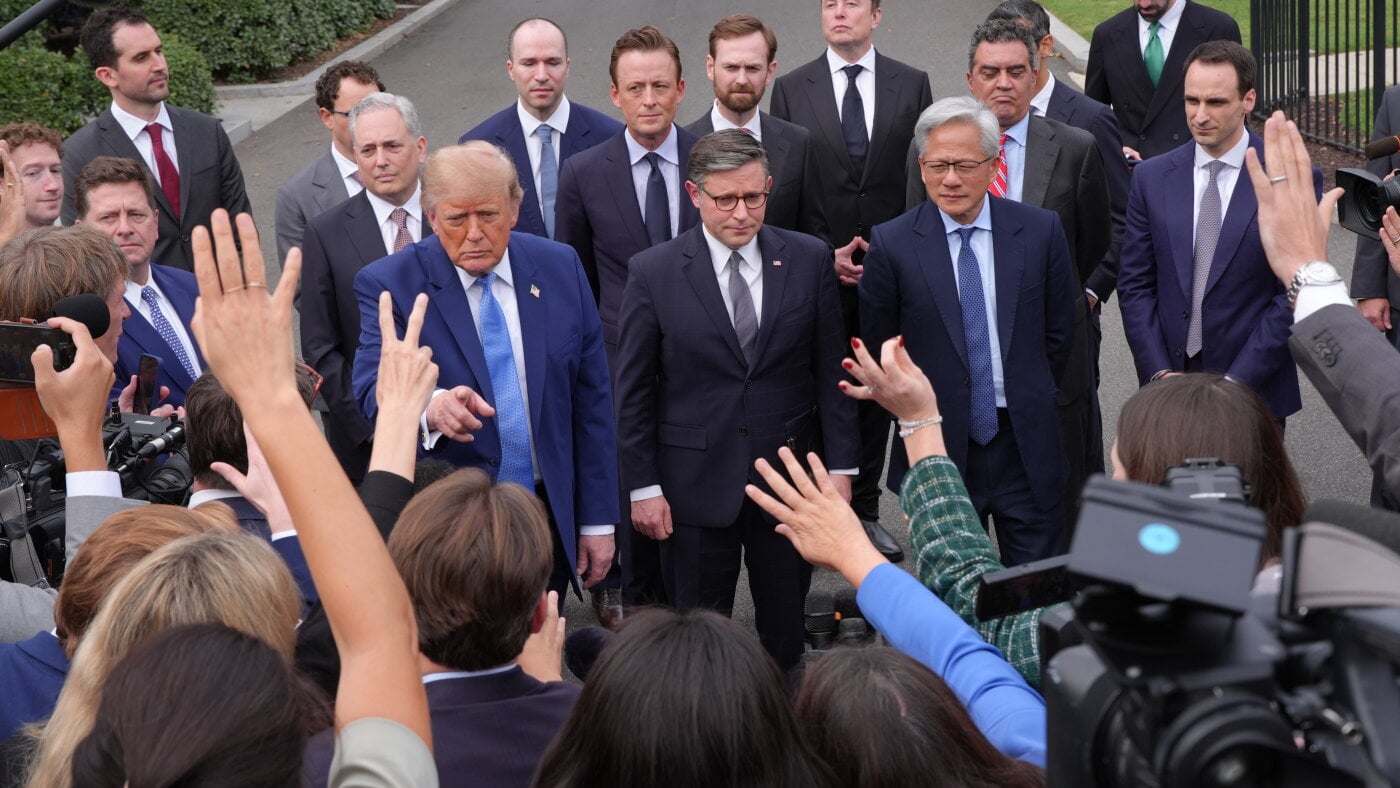
Donald Trump has secured a voluntary accord with leading artificial intelligence companies for internal controls and independent reviews, as he urged the industry to regulate itself rather than face immediate government restrictions.
The agreement was announced after Trump and House Speaker Mike Johnson met technology executives at the White House, including Anthropic chief executive Dario Amodei, Google chief executive Sundar Pichai, Meta founder Mark Zuckerberg, OpenAI president Greg Brockman, Nvidia chief executive Jensen Huang and Elon Musk, the founder of xAI.
“I think I’m seeing tremendous self-policing. And they understand that they have to self-police,” Mr Trump told reporters outside the West Wing.
The accord, which Mr Trump later published on Truth Social, says companies will introduce “robust internal controls” and work with an independent external auditor to assess whether those safeguards are effective.
Each company is also expected to create a board committee to review reports from its internal and external auditors. The agreement leaves open the possibility that the measures could eventually become legally enforceable.
“Over time, it may make sense to codify these steps into laws and regulations,” the document says.
Criticism of voluntary AI oversight
Mr Trump said about 10 people would be appointed to a committee overseeing the initiative and described the agreement as “morally binding”. He said he would consult the industry before naming someone to supervise it.
Several of the measures appear to reflect practices that the companies already use or have previously promised to adopt. Supporters say the approach could protect room for innovation while encouraging work on the safety and security of AI models.
But critics questioned whether companies should be trusted to police themselves, particularly as the most powerful AI developers compete to build increasingly capable systems.
Robin Jia, an assistant professor of computer science at the University of Southern California, said it was important that the leading laboratories’ intentions were aligned with the wider public interest. He referred to recent hacking disclosures and warned that the consequences could become more serious as the models improve.
Alex Pascal, executive director of the Berkman Klein Center for Internet and Society, said reducing the risks and harms of AI would require legal liability and regulation, as well as changes to the competitive pressures driving developers.
Mr Amodei, who has called for a slowdown in AI development, also struck a cautious note during the White House meeting. “The technology has very real risks,” he said, adding that how those risks should be addressed was still under discussion.
Trump rejects calls for restrictions
Earlier in the day, Mr Trump said the US government would not limit the development of AI or support demands for “guardrails” and other restrictions.
At the unveiling of an AI chatbot intended to help Americans navigate government services, he said: “I will never stifle the growth of a technology that will be bigger than the industrial revolution. We can’t stifle it, and we’re leading by a lot.”
Mr Trump has presented the development race as a contest between the United States and China, saying there would be a winner and a loser rather than a second-place finish.
He also praised the industry’s contribution to economic growth, while executives agreed to offer more support to local schools or help reduce energy costs amid bipartisan opposition to data centres being built in communities across the country.
