


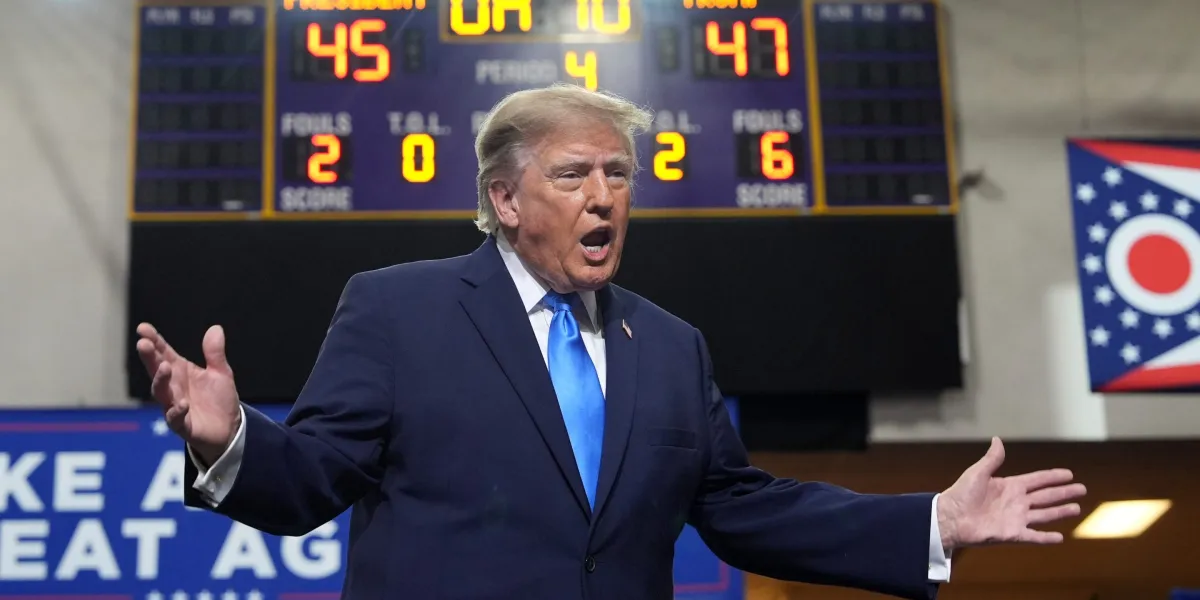
Donald Trump defended data centres at a rally in Ohio after the facilities became a political liability for Republicans, arguing that shutting them down would allow China to overtake the United States in artificial intelligence.
The president’s remarks in south-western Ohio were met with a noticeably quieter response than his attacks on other issues. He spent several minutes promoting his administration’s efforts to ensure data centres benefit local communities and praised Republican Senator Jon Husted’s unsuccessful attempt to advance legislation on the issue.
“Look, there’s so much money to be made for Ohio. You can’t just turn them off. They’ll go to China,” Mr Trump said.
Large warehouse campuses built to support artificial intelligence projects have faced opposition from voters concerned about electricity prices, farmland and water supplies. The issue has attracted criticism from both Republicans and Democrats in races across the country.
Data centres become a flashpoint in Ohio Senate race
In Ohio, the controversy has focused particularly on Mr Husted, who was appointed to the Senate seat vacated by JD Vance when he became vice-president. Mr Husted is now seeking election to the seat against former three-term senator Sherrod Brown.
Mr Brown and allied groups have attacked Mr Husted over his role in attracting data centres to Ohio while serving as lieutenant governor. Mr Brown said on Friday that Mr Husted had given “billions in tax breaks to Big Tech” before making Ohio residents pay the cost.
Republicans have sought to argue that Mr Husted supports safeguards for communities rather than unrestricted development. Senator Tim Scott, chairman of the National Republican Senatorial Committee, said Mr Brown had also supported data centres and that Mr Husted wanted them to operate responsibly.
“If a community doesn’t want them, he doesn’t want them either,” Mr Scott said.
The Republican-controlled Senate had attempted to advance legislation sponsored by Mr Husted that would effectively charge large power users more, as households face high energy bills. Nearly all Democrats blocked the measure.
Mr Trump’s visit formed part of what he described as a 32-day campaign blitz before the November 3 elections. After visits to Republican strongholds including Texas, Oklahoma and Alabama, he turned to Ohio, a battleground state seen as central to the contest for control of the Senate.
There is unlikely to be a route for Democrats to win a Senate majority without taking Ohio. Mr Scott said the race was now effectively level, describing it as “as tight as ticks”.
Mr Trump also told the rally that Ohio’s economy was thriving, despite concerns over living costs and the recent loss of almost 1,400 jobs at a truck factory near Springfield.
“Your state is booming. Every — I hate to say it — every state is booming,” he said.
More than 100 protesters gathered outside the school where the rally was held, carrying anti-Trump and anti-Husted signs. Some displayed references to Jeffrey Epstein, after Mr Brown’s campaign criticised donations Mr Husted had received from retail magnate Les Wexner; Mr Husted has given his remaining Wexner contributions to an anti-human trafficking charity.
Inside, supporters wearing “Make America Great Again” hats and “Trump 47” jerseys greeted Republican candidates enthusiastically. Mr Husted said Ohio had endured difficult periods, but claimed Republican leadership had helped deliver the state’s highest number of jobs and lowest unemployment rate on record.
The rally also featured Republican governor candidate Vivek Ramaswamy, who is facing Democrat Dr Amy Acton. Despite a substantial fundraising advantage and more than 12 million dollars spent on advertising, Mr Ramaswamy is in a close contest with the former state health director weeks before election day.
