


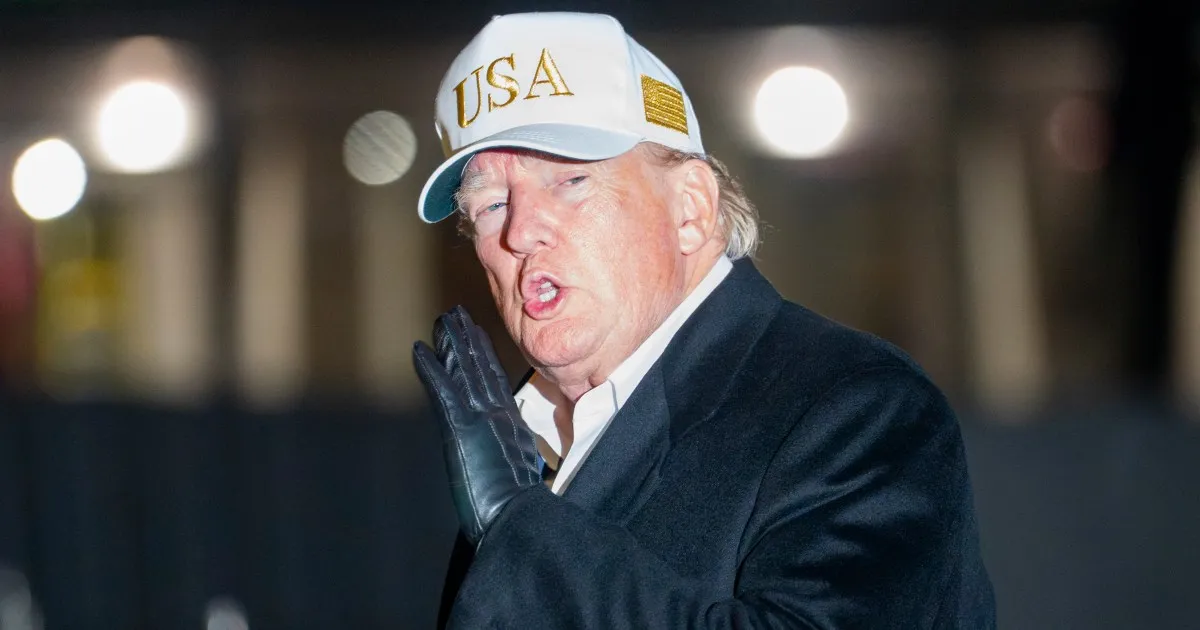
Donald Trump has claimed Iran is exploring chemical and biological weapons, reviving allegations that Tehran could be considering a “dirty bomb” attack, despite providing no evidence for the assertion.
Speaking to Fox News on Thursday, the US president said Iran was “looking at gases, looking at bio”. He also claimed Tehran had moved away from developing nuclear capabilities because “we’ve shut them out”.
Trump added: “We’ll see what happens after January 1,” before referring to Iranians as “nasty people”.
His remarks followed a report that US intelligence believes Iran may be developing plans to target senior officials in the Trump administration with a chemical weapon in Washington DC.
But US Secretary of State Marco Rubio said on Wednesday that America did not face an “imminent threat”. Homeland Security Secretary Markwayne Mullin agreed, saying there was no indication of an impending attack.
Trump did not rule out the possibility when asked whether people in Washington should be concerned. He said he did not believe an attack was likely, but warned: “If it does happen, we wipe them out.”
What evidence is there of Iran’s bioweapons capability?
Iran is a signatory to the Biological Weapons Convention and ratified the Chemical Weapons Convention in 1997. The country signed the biological weapons treaty six years before the 1979 revolution that established the Islamic Republic.
Western intelligence agencies have nevertheless long alleged that Iran has pursued unconventional weapons capabilities. A report by the Royal United Services Institute said Iran’s biological weapons programme was believed to have accelerated after the Iran-Iraq War, which ended in 1988.
RUSI concluded that Iraq’s extensive use of chemical weapons during the conflict prompted Tehran to ensure it would not again face a similar disadvantage, with biological agents allegedly developed under the cover of civilian research.
Hamish de Bretton-Gordon, an analyst and former British Army officer, said it would not be surprising if Iran was considering chemical weapons after US strikes on its nuclear facilities set back its nuclear programme.
“It is also possible they are looking at biological weapons,” he said, adding that AI-enabled biological weapons could be “as devastating as nuclear weapons at a fraction of the cost and time”. Such weapons, he said, could replace a nuclear programme and be more difficult to detect.
Dan Kaszeta, an associate fellow at RUSI specialising in defence against chemical, biological and radiological weapons, said the issue remained highly uncertain.
“Any country with the industry, science and laboratory infrastructure that Iran has could, in theory, make chemical and biological hazards in sufficient quantity for a singular incident like a localised terrorist attack,” he said. “The underlying technology is not highly sophisticated.”
However, Kaszeta said claims about an Iranian chemical or biological weapons programme had been debated for decades without a firm conclusion.
Jacek Siewiera, a senior fellow at the Atlantic Council’s Europe Center, said scientific expertise should not be confused with the ability to carry out an operation overseas, or with the political decision to launch one.
“A research programme does not, by itself, establish the ability to carry out a particular operation abroad,” he said. “A credible assessment would require corroborated information about capability, operational reach and intent.”
Warnings over echoes of Iraq’s weapons claims
The latest allegations have also drawn comparisons with claims made before the US-led invasion of Iraq in 2003. Washington said at the time that Saddam Hussein’s government posed an imminent threat because of alleged chemical, biological and nuclear programmes.
Glen Rangwala, an associate professor at the University of Cambridge, said successive US administrations had a “fairly extensive history” of making unfounded claims that Middle Eastern countries possessed weapons of mass destruction.
Such allegations, he said, could raise the international stakes and put domestic critics on the defensive.
No stockpiles of banned weapons, or evidence of a programme to develop them, were found in Iraq after the invasion. A Senate committee later found that the CIA and others in George W Bush’s administration had manipulated evidence to justify the occupation, describing the operation as a “whitewash for the White House”.
Rangwala said concern about proliferation was justified, but argued that accusations should not be directed at only one side in the Middle East.
