


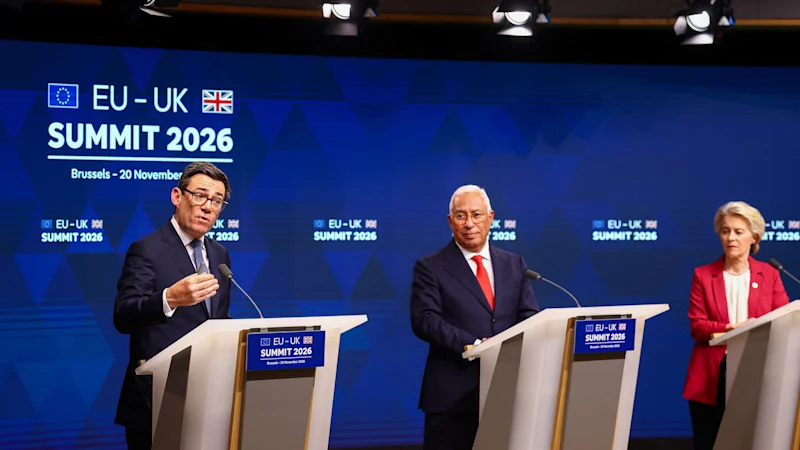
Britain and the European Union have agreed a package of deals on trade, carbon emissions and youth mobility at a summit in Brussels, as both sides pledged to rebuild their post-Brexit relationship.
The agreements will remove checks on plant and animal products, link the UK and EU emissions trading schemes, and allow up to 100,000 young adults from each side to live and work in the other’s countries for as long as three years.
European Commission president Ursula von der Leyen described the package as “a turning point” in relations, while Prime Minister Andy Burnham called it a “landmark”.
“This is a good day for Britain. This is a good day for Europe,” Mr Burnham said after the meeting.
The summit was only the second formal meeting between the UK and the EU since Britain left the bloc. Both sides said they wanted an “ambitious and dynamic” partnership, while acknowledging that further negotiations would be needed.
UK and EU deals leave tuition fees unresolved
The package is dependent on progress over university tuition fees, with negotiators given six months to reach an agreement on what students from each side should pay.
EU negotiators want European students studying in the UK to have access to domestic fee rates rather than the higher charges applied to international students. Britain has resisted the proposal, although an EU official said there was goodwill to resolve the issue.
Talks are also continuing over Britain’s request to take part in the EU’s “made in Europe” rules for manufacturing.
Mr Burnham has presented closer ties with the EU as a way to reduce costs and expand opportunities, saying the agreements could add 0.5 per cent to the British economy. He said the partnership would help “cut costs, keep prices down in the supermarkets and create opportunities for young people”.
The agreements will require the UK to accept some EU rules and standards without having a role in setting them. Supporters of Brexit have criticised that as a threat to Britain’s independence.
Reform UK leader Nigel Farage told the BBC: “I’m afraid that the great Brexit debate has just started again. It’s perfectly clear that this very, very soon becomes a debate about: do we rejoin or do we stay out?”
Mr Burnham has said all options should remain open for Britain’s future relationship with the bloc, including rejoining the EU, but has stressed that such a move is not imminent and would require the backing of British voters and all 27 EU member states.
The war in Ukraine and cooperation over security, defence and irregular migration have also helped draw Britain and the EU closer. European Council president Antonio Costa said their security and prosperity were “closely intertwined”.
However, EU officials remain cautious about the prospect of Britain seeking to rejoin. Ireland’s ambassador to London, Sonja Hyland, said the UK would need to make “a clear decision as to what it wants” if it sought to reopen negotiations.
