


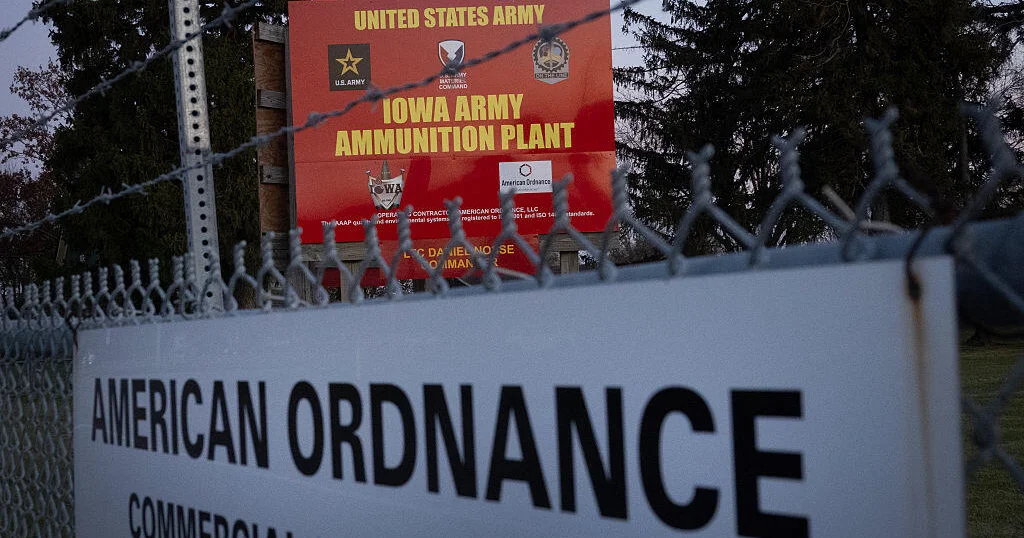
The US Army plans to detonate several tons of unstable explosives at a munitions plant in Middletown, Iowa, by Tuesday despite a court order suspending the operation.
In a filing made late on Saturday, the Department of the Army said it would rely on an emergency exclusion from the Environmental Protection Agency’s permit. It argued that a controlled blast posed a smaller risk to the public than allowing the explosives to detonate without warning.
The explosives contain lead azide and are stored at the Iowa Army Ammunition Plant. The proposed operation has prompted concern that toxic lead particles could spread in a dust plume across parts of Iowa and Illinois.
A federal court halted the Army’s plans on Friday after environmental groups brought a legal challenge. The 8th US Circuit Court of Appeals granted an emergency motion to pause the detonation, which had initially been scheduled for Friday and then delayed until Monday.
Army warns of deteriorating lead azide
The Army said it needed to act by Tuesday because temperatures are expected to fall below 30 degrees in the coming days. It said the lead azide had deteriorated and that crystals in the waste could break apart as temperatures drop.
“A controlled detonation allows the Army to implement measures to minimize the risk to the public, including the risk from the ejection of partial unexploded ordnances that can explode later from the Facility,” the court filing said.
The Army added that it intended to follow the emergency permit’s safety measures even if the permit was not in effect, including steps to reduce the dispersal of lead dust. It said a controlled detonation was “by far safer than an uncontrolled explosion”.
The Iowa Environmental Council and the Sierra Club responded on Sunday by asking to add evidence to their emergency request to block the operation. Their filing included statements from three experts and local government representatives challenging the Army’s assessment of the risks of delay, as well as raising concerns about public notice and possible health and environmental effects.
The groups, together with Earthjustice, said the Army had not properly considered alternatives. Earthjustice lawyer Thien Chau accused the military of focusing on “finding a way to sidestep the judicial process” rather than providing greater transparency and stronger protections for residents, property and the environment.
Josh Turek, Iowa’s new Democratic senator-elect, said he was concerned about the potential health risks and what he called a lack of clear communication from the Army. He said he was seeking details about when the detonation would take place.
Mr Turek also called for an investigation into why the stockpile had been allowed to deteriorate, why safer disposal methods had not been pursued, and what other potentially dangerous materials were being stored at the plant.
The Army said in March that 68 drums of lead azide at the facility had begun “recrystallization”. The Iowa Army Ammunition Plant, built in 1941, produces medium- and large-calibre munitions.
