


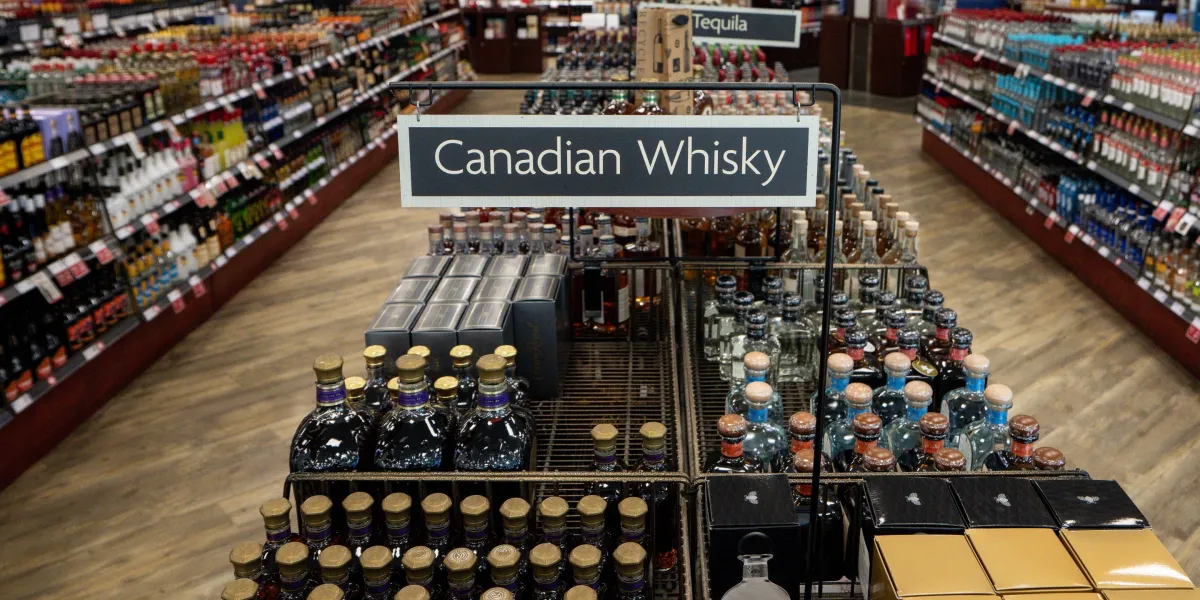
The United States has imposed a ban on almost $1 billion (£740 million) of Canadian imports, including alcoholic drinks, dairy products and motorcycles, escalating an already tense trade dispute between the two countries.
The measures took effect at 12.01am Eastern time on Tuesday after President Donald Trump ordered the restrictions in response to Canada’s retaliatory tariffs on US goods.
The banned products represent a small share of the roughly $880 billion in annual two-way trade between the neighbours. But the move adds to uncertainty over the future of North America’s main trade agreement and risks further retaliation from Ottawa.
Alcohol accounts for most of the Canadian imports affected
Jacob Jensen, director of trade policy at the American Action Forum think tank, estimated that the ban covers $967 million of Canadian imports based on 2025 figures. Alcoholic beverages account for 87 per cent of that total.
Several Canadian provinces had removed US alcohol from their shop shelves after Washington imposed tariffs, prompting the latest action from the Trump administration. Some dairy products, including whey, and motorcycles are also affected.
Canadian manufacturer Bombardier Recreational Products said its three-wheel Can-Am Spyder and Canyon motorcycles would be excluded from the US market. The company said the impact was unlikely to be felt until next year because most production and shipments for the current season had already been completed.
Trade lawyer Patrick Childress, a former US trade official, said the economic consequences were likely to be limited because many of the products were already subject to 50 per cent tariffs.
“For a lot of these goods, the 50% was already acting as a de facto ban by making importation from Canada into the United States uneconomical,” he said.
The United States imposed the tariffs over claims that Canada discriminates against American dairy, car and alcohol producers. Canada responded with tariffs of 15 per cent, 25 per cent or 50 per cent on equivalent US imports.
Canada seeks to reduce reliance on the US market
Canadian Prime Minister Mark Carney has pledged to respond to the tariffs while reducing his country’s dependence on the United States, which accounted for more than 70 per cent of Canadian exports last year.
“There is now a price to be paid for access to the United States market,” Mr Carney said earlier this month. He has set a goal of doubling Canada’s trade with countries other than the US over the next decade.
Canada is exploring closer economic ties with other partners, including the prospect of becoming the European Union’s first associate member. Mr Carney has also said trade negotiations with India are making “good progress”, with the two countries aiming to conclude talks by the G20 summit in mid-December.
Earlier this year, Canada reached an agreement with China allowing a limited number of Chinese electric vehicles into the country at a reduced tariff, in return for lower Chinese tariffs on Canadian canola.
Gabriel Brunet, a spokesman for Canada’s trade minister Dominic LeBlanc, said Ottawa’s priority was protecting Canadian workers, farmers, families and businesses from what it called unjustified measures.
“Our core focus is on what we can control: building strength at home, diversifying our partnerships abroad, and building Canada strong for all Canadians,” he said.
Mr Trump has said he expects Canada to return to negotiations. “They’re gonna come in and they’re gonna say, ‘Sir, we are sorry,’” he told reporters on Monday, adding that he believed a fair deal would eventually be reached.
Mr Jensen said the import ban represented another escalation in the trade war and could prompt further Canadian measures. Mr Childress warned that the dispute was likely to continue for months, since the tariffs and bans might not cause enough economic disruption to force either side back to the negotiating table.
