


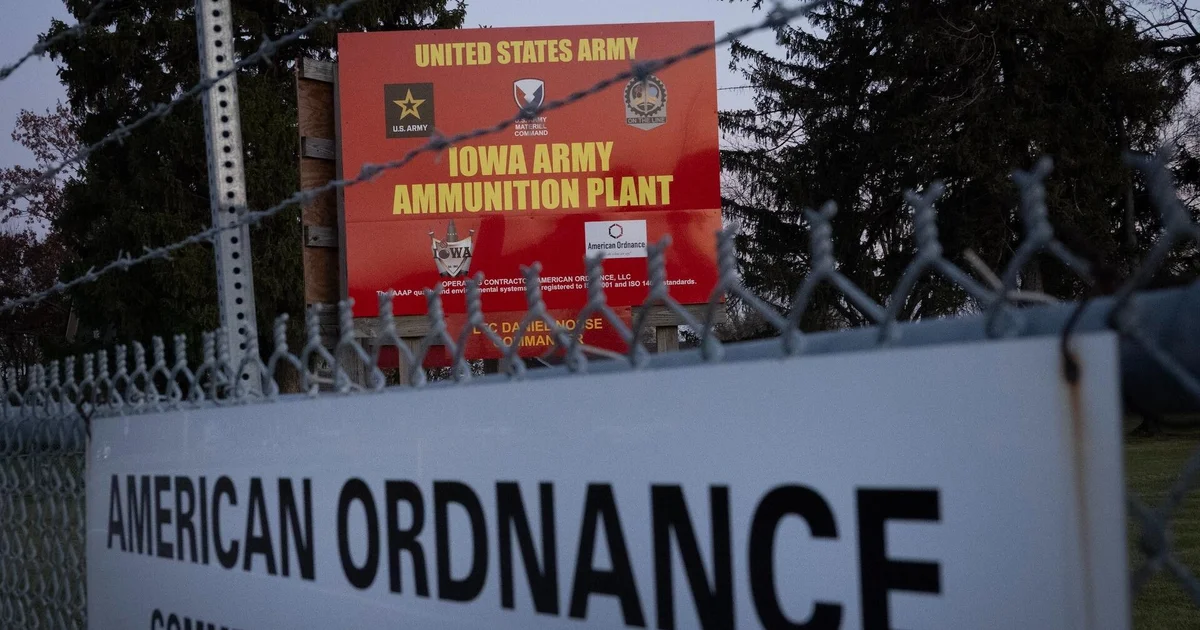
A US appeals court has suspended the Army’s planned detonation of several tons of unstable lead azide at a munitions plant in Iowa, following an outcry over fears that toxic lead particles could spread across parts of Iowa and Illinois.
The emergency order from the 8th US Circuit Court of Appeals came after environmental groups filed a lawsuit. Two controlled explosions had been scheduled at the Iowa Army Ammunition Plant in Middletown, a rural community of about 360 people.
The Army had initially planned the detonations for Friday before postponing them until Monday. The court intervened before the revised schedule could go ahead.
Why the Army planned the lead azide detonation
The Army said it discovered in March that 68 drums of lead azide stored in bunkers at the plant had begun to undergo “recrystallisation”. The chemical is a highly sensitive initiating explosive that can be set off by sparks, flames, friction or even tiny punctures.
Officials said recrystallisation creates a risk of spontaneous explosion, while cold weather could make the material even more unstable. They also said moving the drums would not be safe.
After assessing four possible methods of neutralising the chemical, the Army concluded that a controlled explosion presented the lowest immediate risk to people in and around the site.
“It was determined that a controlled detonation was the option that posed the lowest risk to the public in the immediate and surrounding area,” Acting Secretary of the Army Adam Telle said.
The Army said agencies including the Department of Health and Human Services and the Environmental Protection Agency had been involved in planning the operation since March.
Concerns over lead contamination
Residents and environmental campaigners have raised concerns that the explosion could send lead particles into the air and leave contamination on the ground. Lead can enter the body through dust, fumes, contaminated food or water, and can damage the brain and nervous system.
Children under six are considered particularly vulnerable because their bodies and brains are still developing. Residents have also expressed fears that lead could enter groundwater and remain in the environment for years.
David Cwiertny, a University of Iowa professor, said the lead could either remain airborne or settle on the ground. He said airborne material was expected to dissipate relatively quickly as it moved with the wind.
Middletown resident Sean Byers, whose home is opposite the plant, said he was concerned about a nearby playground used by local children. “It’s going to linger probably for decades,” he said. “It’s going to affect everyone.”
Critics said residents were informed about the proposed detonation only days before it was due to take place. Iowa Gov.-elect Rob Sand said: “The safety of Iowans now and in the future should be the government’s top concern. An unacceptable lack of communication and clarity has made Iowans understandably concerned and angry about this situation.”
Measures planned to limit the risk
The Army said the drums would be detonated inside concrete, earth-covered magazines surrounded by sand-filled barriers. Experts would saturate the soil above the magazines with water, while misters would operate before and during the blast.
Residents in the immediate area would be required to leave temporarily. Officials warned that the explosion would cause noise, ground vibrations and a dust plume containing some lead, and said windows could potentially be broken and replaced by the ammunition plant.
The Army said its mitigation measures meant lead levels in the air after the detonation would remain below the threshold at which the EPA requires protective action. The appeals court’s order has paused the operation while the legal challenge proceeds.
