


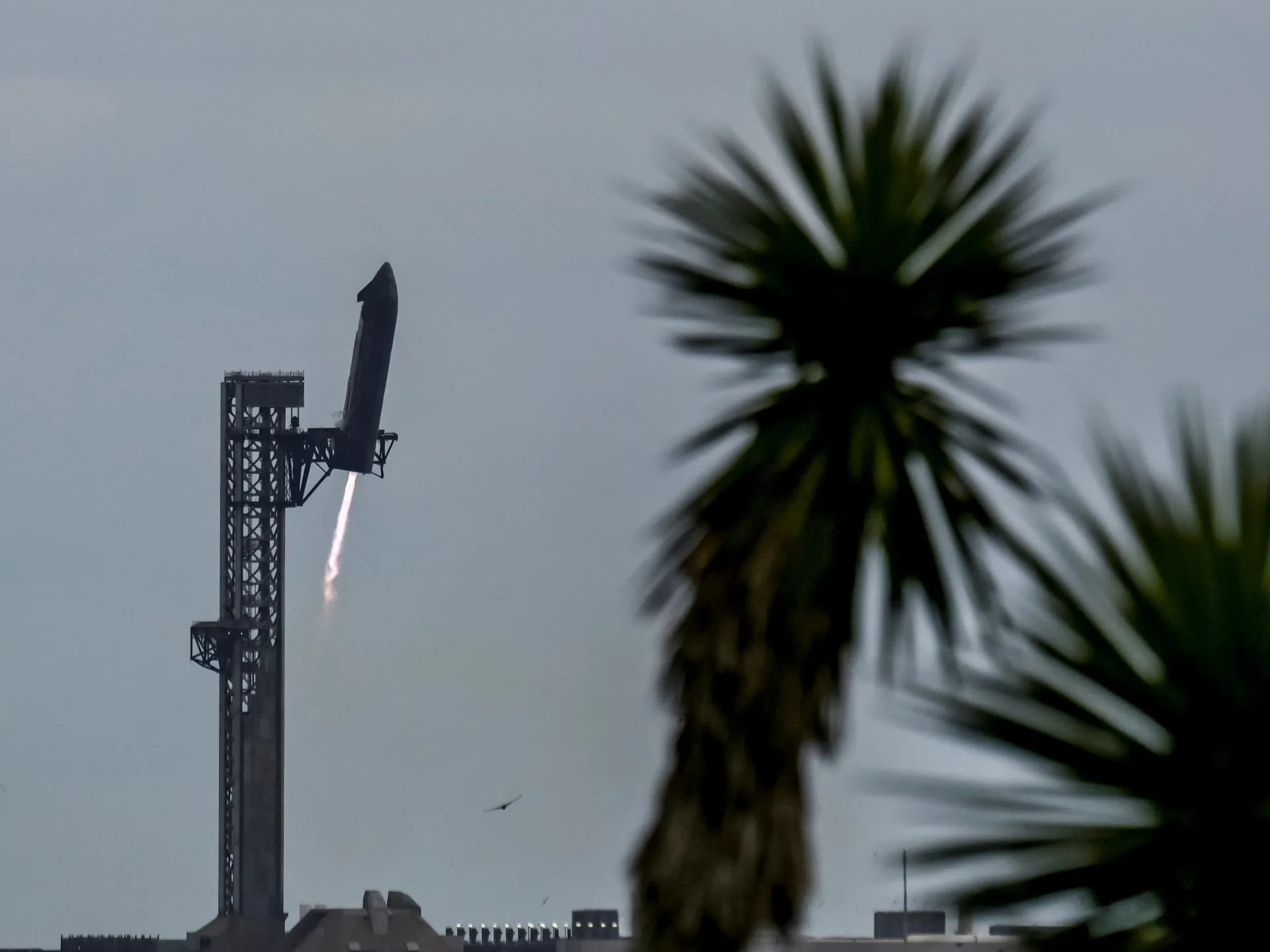
SpaceX’s Starship has completed the first mid-air capture of a spacecraft’s upper stage, returning to its Texas launch site between the mechanical arms of the company’s launch tower.
The 124-metre rocket emerged from cloud after orbiting Earth 14 times during a 22.5-hour flight. It turned upright before descending towards the arms above Launch Pad 2 at Starbase.
Known as “Mechazilla”, the tower used its two large arms to catch the vehicle while its engines were still firing. Starship then secured itself to the tower and shut down its engines, prompting cheers from onlookers.
The achievement was hailed by aerospace engineers as a significant step towards making mega-rockets fully reusable. SpaceX mission commentator Dan Huot described it as “the missing link, the holy grail of spaceflight”.
“We caught a Starship and now everything changes,” he said.
SpaceX founder and chief executive Elon Musk congratulated the team, while Nasa administrator Jared Isaacman said the landing was “almost magic”. Nasa is paying billions of dollars for Starship to carry astronauts to the Moon later this decade.
Why the Starship capture was so difficult
Returning spacecraft must overcome gravity and unpredictable atmospheric conditions. Several crewed spacecraft have been destroyed during re-entry, including the Soviet Union’s Soyuz 1, in which cosmonaut Vladimir Komarov died in 1967, and Nasa’s space shuttle Columbia, which broke apart and killed all seven astronauts aboard.
SpaceX has previously caught the boosters that propel its rockets after they separate from the main vehicle. Since October 2024, those boosters have been successfully caught three times.
The main spacecraft, however, had never before been captured in mid-air. Engineers said Starship’s heat shield and other key systems appeared to have performed well after the latest flight.
“Ship 42 looks great!” Musk wrote, alongside photographs and video from the launch tower.
What the Starship landing means for reusable rockets
SpaceX has built its position in the aerospace industry around reusable rocket technology and rapid engineering development. Its Falcon 9 rocket has launched 700 times since 2010, although only its first stage is reused, with the second stage discarded into the sea.
Starship is intended to take that approach further by making both the booster and upper stage reusable, with minimal refurbishment between flights. A vehicle that can be rapidly prepared and flown again could increase launch frequency while reducing the cost of reaching space.
Niharika Patel, technical programme manager at Loft Orbital, said the capture required precise positioning, protection from the intense heat of re-entry and tightly controlled autonomous manoeuvres.
She said full reusability could support the deployment of large satellite constellations, the construction of space infrastructure and longer-term human exploration of the Moon and Mars.
