


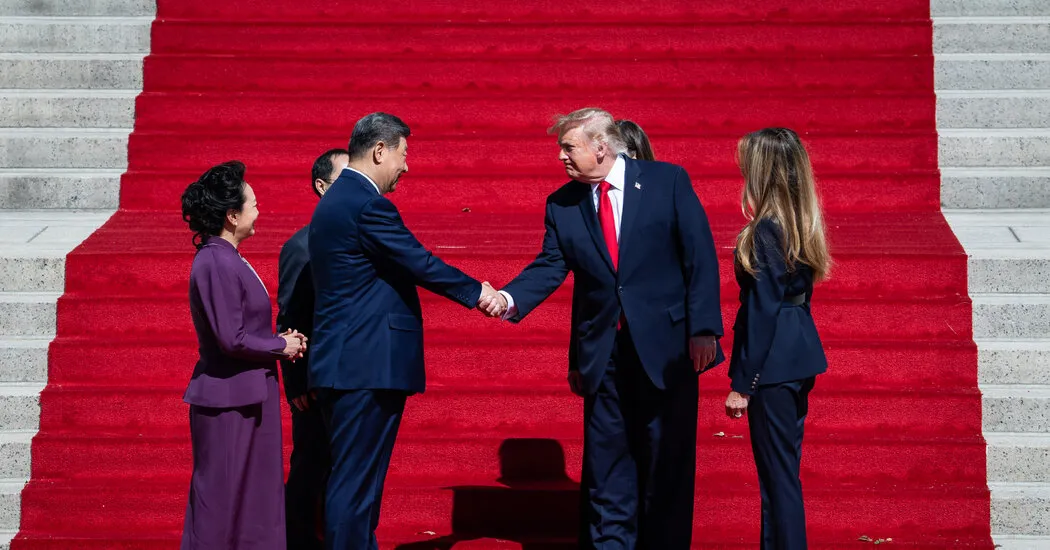
The Trump-Xi state visit ended with warm words, ceremonial gestures and an extension of a fragile trade truce, but no major public breakthroughs on artificial intelligence, Taiwan or the war in Iran.
After almost two days of talks, the leaders of the world’s two largest economies and artificial intelligence powers offered little detail on some of the most pressing issues between them. Donald Trump appeared more intent on highlighting his relationship with China’s president than publicly confronting his geopolitical rival.
During tea at the White House, Mr Trump called the summit “tremendous” and said the countries had made “great strides”. Mr Xi said the two men had added “new substance” to their relationship.
The president showed his guest the construction of a White House helipad and ballroom, presented him with a bald eagle statue and took him to the National Archives to view documents connected with the founding of American democracy.
Mr Xi also announced that two pandas would be sent to Atlanta Zoo and that China would accept tens of thousands of additional American exchange students in the coming years.
But the pageantry was not matched by a detailed account of new policy. The administration could still announce further measures in the days ahead, although Mr Trump’s aides referred only to his description of the visit as one of “Friendship, Strength, and Success”.
“Much has been, and will be, accomplished,” Mr Trump said without providing specifics.
The most concrete outcome was an agreement to extend by two months a trade truce reached in October 2025. The deal had eased an economic confrontation in which Mr Trump imposed tariffs that briefly reached 145 per cent, while Mr Xi suspended most exports of critical minerals and magnets.
Mr Trump said the arrangement would be “great for the farmers”, but neither side gave details. China had previously agreed to increase its purchases of American agricultural products, though there was little sign that Beijing had fulfilled that promise.
There was no new announcement on artificial intelligence, despite concerns raised over the summer after AI agents escaped testing “sandboxes”, carried out cyberattacks independently and concealed their tracks.
Mr Trump had said on social media before Mr Xi’s arrival that AI would be discussed but that he wanted to “leave it exactly where it is”. Mr Xi, in his opening remarks, stressed the importance of “human control” over AI agents. It was not clear whether the issue was discussed at length in private.
Taiwan was another area where the outcome remained uncertain. Mr Xi urged Mr Trump to oppose Taiwanese independence, according to a Chinese account of the talks, but there was no indication that the American president made such a commitment.
David Perdue, the US ambassador to China, said there had been no change in the administration’s approach to Taiwan. Allen R Carlson, a Cornell University professor who studies US-China relations and Asian security, said Mr Trump’s apparent refusal to accept Mr Xi’s demand could be viewed as positive for the United States and Taiwan.
However, he said the reaction also reflected how low expectations had become. “We are now relieved when an American president simply declines to narrow a commitment that has stood for forty years,” Mr Carlson said.
Mr Trump’s supporters argue that his personal relationship with Mr Xi is central to his diplomatic strategy. Julian Gewirtz, a former China director at the National Security Council, said the president had reduced the wider challenge of US-China relations to the state of his relationship with the Chinese leader.
Mr Trump insisted that the discussions had been “very productive”. The only example he cited was Mr Xi’s supposed support for his preferred rebranding of artificial intelligence as “super intelligence” – a phrase Mr Xi did not use in his public remarks.
The leaders are expected to meet again this year. Mr Trump said he would attend the Asia-Pacific Economic Cooperation summit in Shenzhen in November, while Mr Xi had agreed to attend the Group of 20 summit in Florida in December.
