


The Gaza peace plan has delivered just four of the 26 points assessed by five international aid organisations, which said its failure to secure humanitarian access and protect civilians had left Palestinians facing worsening conditions.
The Danish Refugee Council, Norwegian Refugee Council, Oxfam, Refugees International and Save the Children published their scorecard one year after the UN Security Council endorsed the Trump administration’s 20-point plan to end the conflict.
The assessment awarded no points for humanitarian access and just one for civilian protection. It was released as Israeli forces began a new ground offensive in central Gaza, moving tanks west of the so-called Yellow Line and issuing fresh evacuation orders.
The organisations said those actions breached the terms of the plan, which prohibits territorial occupation and requires Israeli forces to withdraw from Gaza.
Figures from the UN humanitarian office indicate that Israeli control has expanded from 58% of Gaza at the start of the ceasefire 13 months ago to 65% today. Israel has said it controls 70% of the territory, according to a UN official who addressed the Security Council in June.
Palestinians are not permitted to cross the Yellow Line. The UN humanitarian office estimated last month that about 2.1 million people had been confined to 128 sq km, equivalent to roughly 16,000 people per sq km.
More recent mapping by the US news organisation NPR put the remaining area at 109 sq km, with a population density of nearly 19,300 people per sq km.
Ramy Abdu, founder and chairman of the Euro-Mediterranean Human Rights Monitor, accused Israel of the unlawful acquisition of territory by force. The claims have not been independently assessed in the material available.
At least 1,650 Palestinians have been killed and 5,975 wounded since the ceasefire was declared in October last year, aid agencies said.
Shaun Hughes, the World Food Programme’s country director for Palestine, said the situation did not feel like a ceasefire for people in Gaza.
“When you’re in Gaza, it does not feel like a ceasefire. Israeli military control across nearly 70 per cent of Gaza means that people have almost no space to grow their own food. Fishing in the sea is prohibited and also life-threatening. Unemployment is over 80 per cent, so without humanitarian assistance, people have little or no alternate means of survival,” he said.
Humanitarian access falls short
The peace plan stipulated that at least 600 UN-coordinated aid lorries should enter Gaza each day. In September, however, an average of only 49 such lorries entered daily.
Just 2% of those convoys carried medical supplies, contributing to shortages and deaths from illnesses described as treatable by the aid organisations.
Commercial deliveries have increasingly been prioritised, although many of the goods are too expensive for Gaza’s impoverished population. During the week beginning October 12, 315 commercial lorries entered Gaza: 223 carried food, 51 carried non-essential items, 12 carried hygiene or shelter materials and one carried medical supplies.
Israel has cited restrictions on “dual use” goods, which cover products that could have both civilian and military applications.
Lilu Thapa, executive director for the Middle East, Asia and Europe at the Danish Refugee Council, said the expansion of the Yellow Line amounted to deliberate displacement.
“Palestinians in Gaza are being confined as the ‘Yellow Line’ expands. This is displacement by design, and a ceasefire that allows it is a ceasefire in name only,” she said.
Jan Egeland, chief executive of the Norwegian Refugee Council, said the suffering of Gaza’s population was the result of political decisions rather than an unavoidable consequence of the conflict.
Oxfam America president Abby Maxman similarly described conditions as the direct result of policy choices made in Israel, the US and at the UN.
Gaza shelter crisis worsens
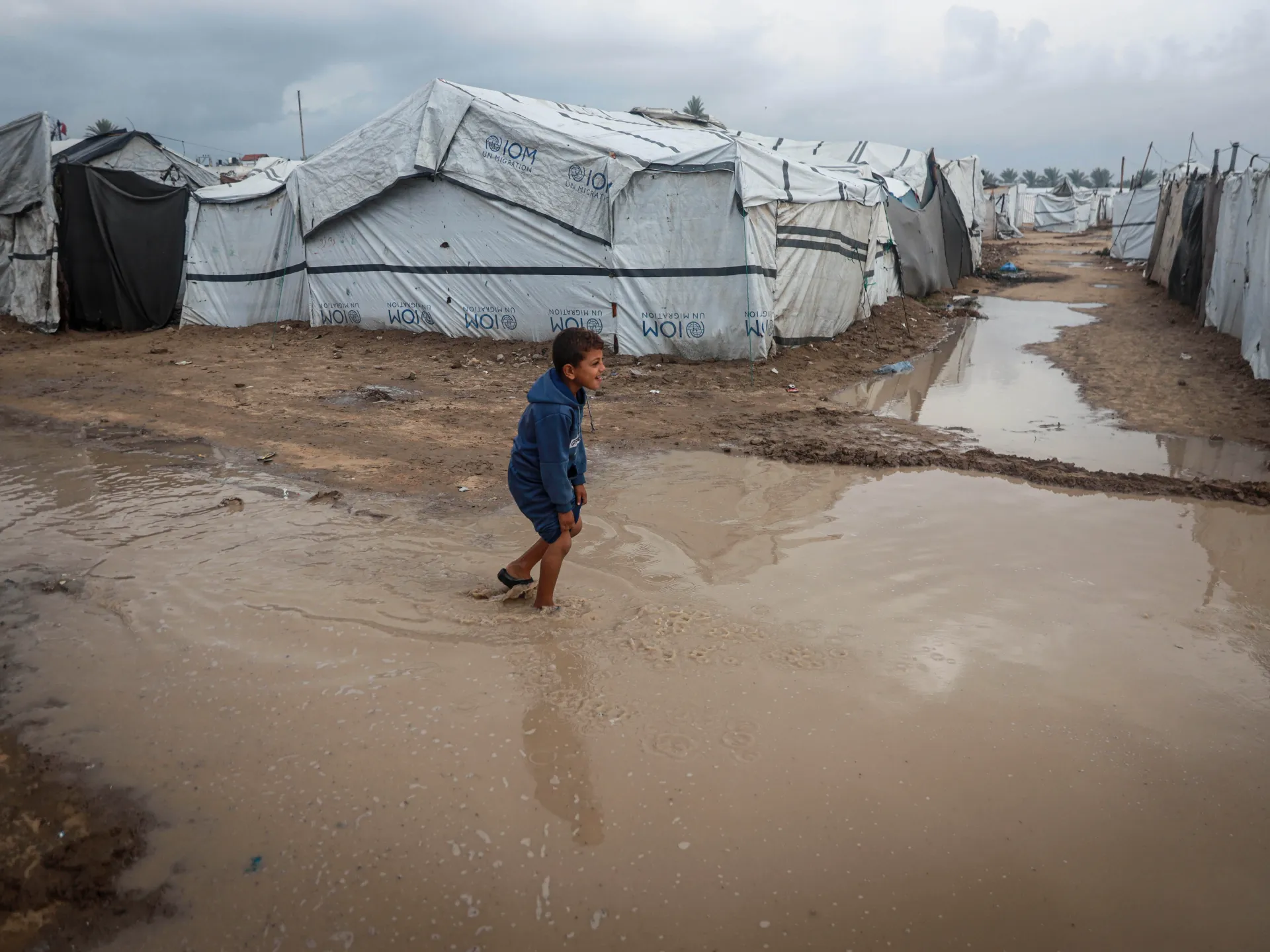
Gaza is entering its fourth winter of displacement, with nearly 1.4 million Palestinians living in makeshift shelters. Reconstruction has not begun, despite donors pledging about $18bn through the Board of Peace.
A winter storm recently flooded more than 70,000 tents in a single day. An infant and five other displaced people died, according to the aid organisations.
Stocks of tents and blankets inside Gaza are said to be almost exhausted, while more than 150,000 tents and 500,000 blankets remain outside the territory awaiting permission to enter.
Inger Ashing, chief executive of Save the Children International, said Gaza’s children were facing worse conditions than they had been promised after the ceasefire.
“One year ago, the world was promised that Gaza’s children would finally see safety, relief and a chance to rebuild their lives. Instead, they are colder, hungrier, more traumatised and more at risk than they were before,” she said.
The collapse of medical evacuations has also caused a growing backlog. Gaza’s health ministry said 2,027 patients had died while waiting to be transferred and that 21,000 remained on waiting lists.
Board of Peace criticised over implementation
The Board of Peace and the International Stabilisation Force, established under the US-backed diplomatic framework, have come under criticism from human rights experts and Palestinian civil society representatives.
Mr Abdu said the Board had been created without meaningful Palestinian representation and had undermined the Palestinian people’s right to self-determination. He accused it of providing political cover for Israel’s occupation and alleged crimes.
Mohsen Abu Ramadan, a member of the Palestinian NGOs Network, said the Board had failed the international community and continued to provide cover for atrocities.
The coalition called for international action, including enforcement of International Criminal Court arrest warrants for Israeli Prime Minister Benjamin Netanyahu and other officials, the continuation of genocide proceedings at the International Court of Justice, and the use of universal jurisdiction in national courts.
It also called for regional arms embargoes on Israel and a public UN Security Council briefing on the Board of Peace’s record.
Jeremy Konyndyk, president of Refugees International, said the US and other Security Council members should use their influence to ensure the plan’s obligations were fulfilled.
The Board of Peace did not directly address allegations concerning territorial expansion or restrictions on aid deliveries. Its communications chief, Brad Klapper, provided the Board’s latest official report when approached for a response.
The report acknowledged that implementation had been limited, but attributed delays in several areas to decisions still required from the Israeli government.
It said the absence of Israeli decisions on the training, deployment and return of civilian police was preventing the full implementation of the plan. It also said the entry of the National Committee for the Administration of Gaza and the International Stabilisation Force remained blocked pending those decisions.
The report noted that Hamas and other Palestinian factions had accepted a 15-point roadmap on July 30 to surrender their weapons and transfer authority to a transitional administration. However, it said mechanisms for putting the agreement into effect remained paralysed.
“A ceasefire that delivers nothing visible cannot be sustained indefinitely. The people of Gaza have paid the highest price for this war and should not be asked to pay again for delay,” the Board said.
