


Five men arrested after a major security operation near RAF Fairford have been released on bail, prompting analysts to question claims from Washington that the incident was linked to a serious terrorist plot.
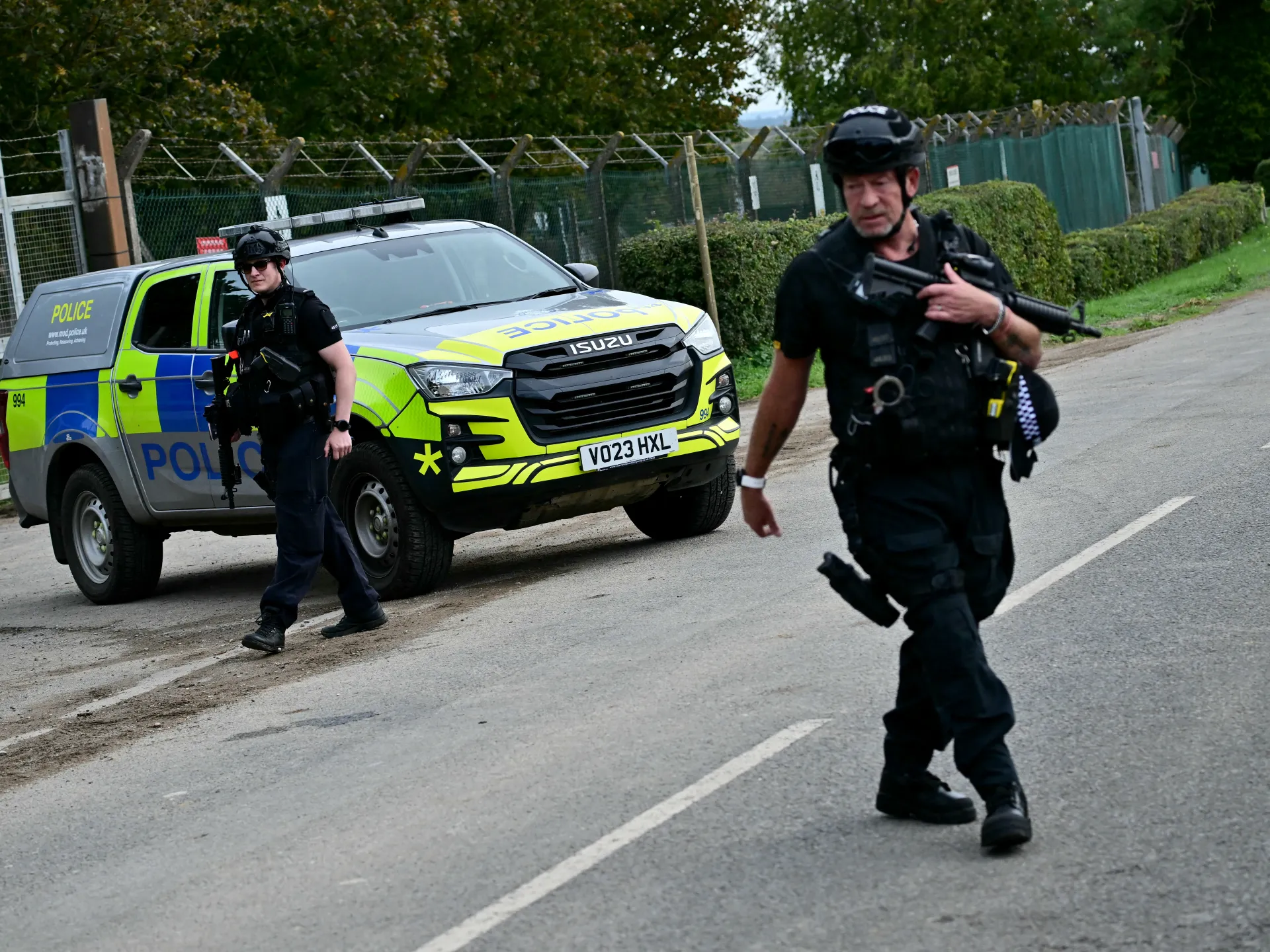
The men, all British nationals from London and in their 20s, were detained after three white vans blocked a driveway in a Gloucestershire village in the early hours of Sunday. Armed officers arrived within 15 minutes, while 85 homes were evacuated and a bomb disposal robot was sent between the vehicles.
The arrests were made on suspicion of explosives and terrorism offences. The operation triggered the declaration of a major incident at RAF Fairford, a base used by United States bombers to strike Iran.
US President Donald Trump said the suspects had been under observation “for a long time” before they were arrested. But the five men were released on bail on Monday, leaving Mr Trump saying he was surprised.
US Secretary of State Marco Rubio said the incident “clearly involves the hands of a foreign actor”, although he did not identify one. He pointed to Iran’s open threats to attack American interests around the world.
British Prime Minister Andy Burnham urged the public not to speculate, while Iran’s embassy in London “categorically rejects” any connection to the events. It said claims linking Tehran to the incident would fuel “Iranophobia propaganda in the UK”.
Analysts question the terrorism claims
Chris Phillips, a former head of the UK’s National Counter Terrorism Security Office, said the decision to release the men suggested that investigators had not found evidence of a major attack being prepared.
“If there had been any trace of explosives found in the vans, or any thoughts that these men were actually terrorists, they would not have been released,” he said.
Under the Terrorism Act 2000, police can hold terrorism suspects for up to 14 days without charge. Mr Phillips said officers who believed they had detained genuine attackers would have used that time to examine the men’s records, contacts and communications.
Afzal Ashraf, a visiting fellow in international relations and security at Loughborough University and a former senior Royal Air Force officer, also said the release was significant.
“If there had been any explosives, big or small, in those vans, then there is no way on Earth that the police would have released these individuals on bail,” he said.
Police have not said whether explosives were found. Assistant Commissioner Laurence Taylor stressed that the suspects “absolutely remain under investigation” and said detectives were considering every possible explanation.
Fuel theft or foreign involvement?
One of the vans carried the name “Fuel 2You”, although no evidence was found that it was a legitimate company. Mr Ashraf said many homes in the area appeared to rely on heating oil stored in garden tanks rather than mains gas.
With fuel prices rising during the conflict with Iran, he suggested the vans could have been connected to an attempt to steal heating oil. He described that as an alternative and “probably more plausible explanation”, while stressing that it was not certain.
“There’s absolutely nothing else at all, at the moment, suggesting that there is a link to any foreign government,” Mr Ashraf said.
Mr Phillips said the suspects’ proximity to RAF Fairford could simply have been a coincidence. “I’m absolutely certain there is intelligence that there are people in the UK that would love to attack,” he said. “But I’m not sure these guys are the ones.”
Anthony Glees, emeritus professor of security and intelligence studies at the University of Buckingham, took a different view. He said the use of three vans suggested that the operation had involved planning and expense.
He described the men as “useful idiots” who may have been hired by a foreign state, not to carry out an attack but to stage an incident intended to embarrass the British Government.
Claims of a foreign-backed operation
British authorities have not ruled out foreign involvement. Mr Taylor said investigators were examining the possibility of activity by proxies or individuals working for a foreign state, either knowingly or unknowingly.
Mr Phillips said foreign governments could recruit people through the dark web by offering money for a job, with the person carrying it out several stages removed from those who commissioned it.
Mr Glees said Iran was “in pole position” as a possible explanation, but argued that Tehran would have little to gain from a genuine attack on RAF Fairford. Such an assault on British soil could have drawn the UK more deeply into the conflict, he said.
He instead characterised the incident as “a frightener” designed to embarrass Britain and potentially make Mr Trump believe that the UK could not be relied upon.
Mr Ashraf was sceptical that Iran would take such a risk, arguing that an attack endangering British or American civilians would undermine its wider message that the war was unpopular. If Tehran had wanted to attack the base, he said, it would probably have assembled “a slightly more capable team”.
Questions over Washington’s account
Mr Ashraf said the strength of the claims from the Trump administration could reflect a desire to control the political narrative surrounding the conflict with Iran.
He suggested that Mr Trump may have been briefed about several groups being monitored by US authorities and that the information had subsequently been conflated with the five men arrested near Fairford.
“Nobody’s going to tell the president he’s got it wrong,” he said.
Reform UK leader Nigel Farage, a long-standing ally of Mr Trump, said the Fairford incident supported his position on Iran and the Islamic Revolutionary Guard Corps. He had linked the case to Iranian agents arriving in small boats, before police confirmed that all five suspects were British nationals from London.
Mr Ashraf said the initial claims could continue to shape public perceptions even if the investigation ultimately established that the incident was criminal rather than terrorist in nature.
