


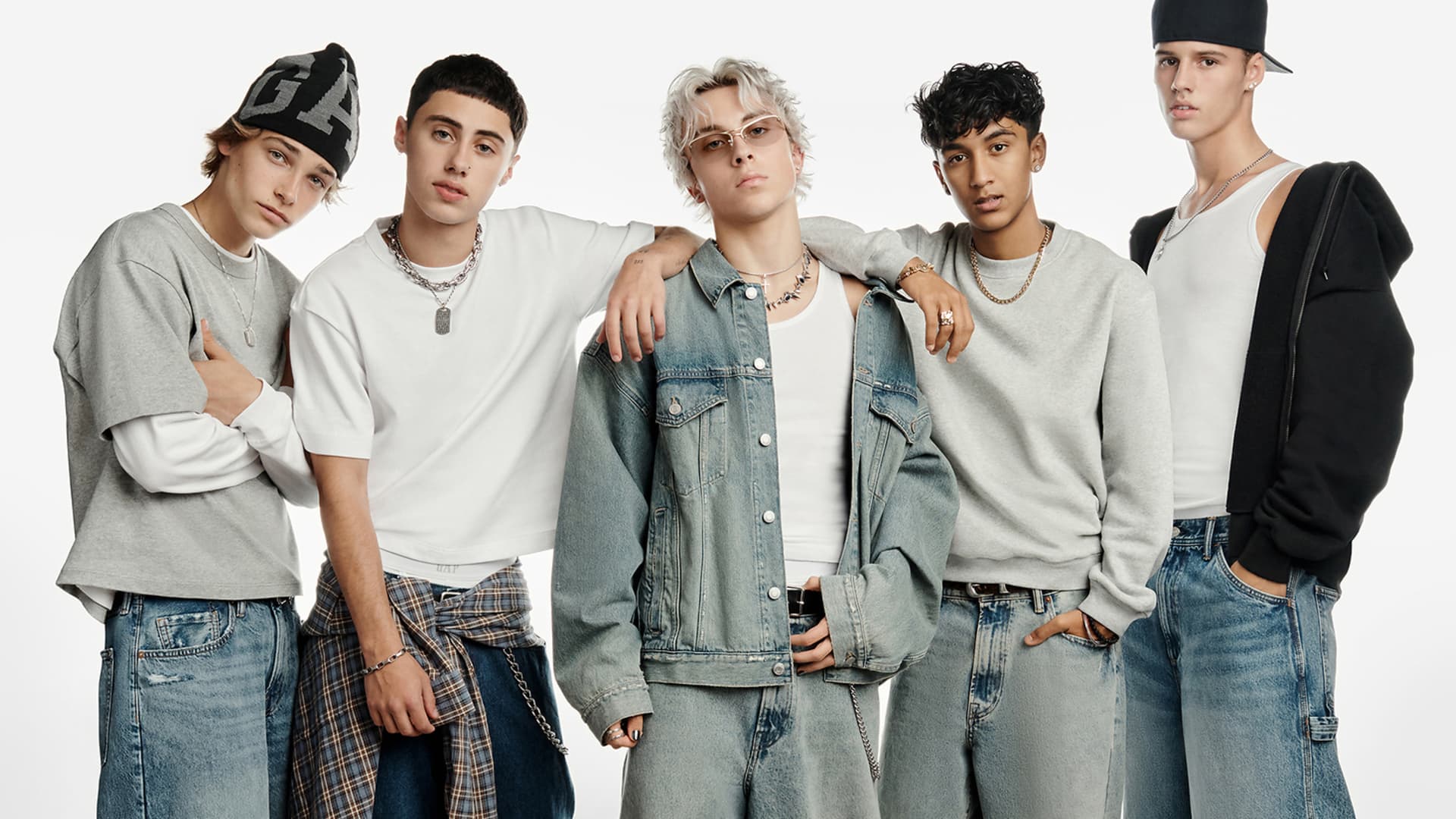
Retailers are investing more heavily in entertainment and live experiences as they seek to build stronger relationships with consumers, with Gap Inc launching its first “fashiontainment” partnership with emerging boy band Just Your Type.
The legacy retailer created a chief entertainment officer role earlier this year and appointed Pam Kaufman, a former Paramount executive, to lead its entertainment, content and licensing platform.
Gap has since expanded its campaigns through music partnerships, following the success of advertisements featuring girl group Katseye last year. The company says the approach is designed to combine fashion with entertainment and bring its brands closer to popular culture.
“Beloved brands have value beyond the products they sell. Consumers identify with them, trust them and want to be part of their world,” Kaufman said.
“The key is authenticity: Every extension has to reflect what the brand stands for and give its fans a meaningful new way to experience it.”
Retailers turn to entertainment and experiences
Gap’s chief executive, Richard Dickson, said the company wanted to place its brands at the centre of cultural conversations rather than focus solely on the products available in its shops.
“Brands are stories, and we are the storytellers,” he said at the Goldman Sachs Global Consumer and Retail conference in September. “I think you could see that come to life when you look at some of the work that we’ve done, putting our brands in the center of culture and cultural conversation.”
The move reflects a broader shift among retailers towards content, community and in-store experiences. Bryan Eshelman, who leads the retail practice at consultancy AlixPartners, said the role of shopping had changed since the Covid pandemic.
“It has gone from shopping as a fulfillment task to shopping, in many instances, more as an entertainment form,” he said.
Retailers are using physical experiences and exclusive media content to encourage engagement, while trying to create a stronger sense of community and belonging around their brands.
“Community, at the end of the day, is one of the key ways to drive loyalty, so I think retailers of all types are trying to tap into some sense of community, some sense of lifestyle, some sense of belonging that’s beyond the product that they offer,” Eshelman said.
The connection between commerce and entertainment is not new. Procter & Gamble helped to popularise the term “soap opera” in the 1930s, and businesses have long used media campaigns to attract customers.
However, the growth of social media, content creation and short-form video has increased demand for fresh and original material, according to experts.
Intellectual property drives the competition for attention
Alex Michael, senior managing director at investment firm LionTree, said intellectual property had become increasingly valuable as consumers faced a greater volume of marketing.
“The hardest thing to find and to get is audience these days,” he said. “IP, in that sense, is the most valuable thing out there, and only becoming more valuable because it’s attached to audience.”
Content linked to intellectual property can now be distributed through video, audio, short-form and long-form formats, as well as live events. Michael said brands needed to engage consumers earlier in their decision-making journey in order to win trust.
The overlap between retail and entertainment has also been reflected in the backgrounds of senior executives. Kaufman moved to Gap from Paramount, while Dickson previously served as president and chief operating officer of Mattel. Ynon Kreiz, co-chief executive of Skydance, has also held senior roles at Mattel.
“The gray areas have never been more pronounced as to what is classically defined as retail or media or entertainment or live events,” Michael said.
“People who have cross-sector expertise are increasingly more valuable because you can’t be defined by a single vertical, especially as things change so quickly.”
Sean Akaks, chief executive of agency SonderCo, said the changing studio landscape could create opportunities for brands and independent creators to develop their own material outside traditional entertainment companies.
He said creators and brands could eventually work together on intellectual property that they owned jointly, using creators’ existing platforms to reach consumers directly.
Experiential retail aims to turn visits into events
Retailers are also bringing entertainment into their shops. Dick’s Sporting Goods, for example, offers interactive activities and simulators in some stores, adding an experiential element to the traditional shopping trip.
Data from AlixPartners indicates that companies including Coach and Ralph Lauren, which have invested in experiential retail, recorded year-on-year increases of close to 10% in consumers’ average basket size.
Jeff Goldstein, co-lead of AlixPartners’ media and entertainment practice, said digital content could help drive people into stores, where an immersive experience could encourage further engagement and spending.
“The idea that retailers would potentially invest in some distributed electronic content to help drive traffic, and then when you get there, it’s experiential — it really goes into the kinds of flywheels that entertainment companies are also trying to build and grow,” he said.
But experts warned that entertainment cannot replace the fundamentals of retail. Eshelman said companies still needed to offer products that customers wanted, at prices that represented value, with reliable availability.
“The basics of having great product in stock at a transparent price that feels like value is not swept away by animatronics,” he said. “The fundamentals are still there, and if you’re going to have a good retail proposition, you need to have that balance. You can’t mask bad product at a bad price with no inventory with glitz and glamour.”
