


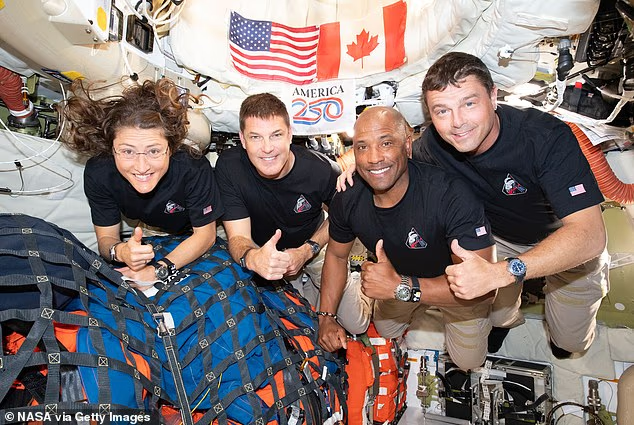
The commander of Artemis II has revealed that he feared he and his three fellow astronauts would be lost in space when their spacecraft travelled beyond the distance planned for its lunar flyby.
Reid Wiseman said he watched the mission’s distance reading climb past the maximum 219,667 nautical miles that mission control in Houston had given the crew. Instead of beginning to fall as expected, it reached 219,668 and then 219,669 nautical miles.
“That was the moment that I felt real fear because I thought we had just gone too far,” Wiseman, 50, told the Starmus Festival in Tenerife. “We’re never going to come home, and so I was very scared.”
After a further tense wait, the number began to drop, confirming that the spacecraft was heading back towards Earth. The Artemis II crew ultimately reached 219,669 nautical miles from Earth – 252,756 miles – setting a new record for the furthest distance travelled by humans and surpassing the mark set by Apollo 13 in 1970.
Wiseman said the crew had been watching the odometer closely as they passed over the far side of the Moon. “I thought, ‘Great, this is the farthest we will be from Earth, and the next number I will see will be 219,666, we’ll be going home’, but about three minutes later, I saw 219,668. It went up. I was like, ‘Huh, that’s weird’.”
Mission specialist Jeremy Hansen said the astronauts had discussed the possibility of not returning two days before launch. He said they had reached an acceptance of the risks involved, rather than relying on bravado.
“By launch the crew was at peace, not because we’re brave, it’s not bravado, it’s because we had an acceptance of whatever came, we would do the best, or our time would end,” said Hansen, of the Canadian Space Agency.
Wiseman, pilot Victor Glover, and mission specialists Christina Koch and Hansen launched from Kennedy Space Centre in Cape Canaveral, Florida, on April 1, 2026. The crew splashed down in the Pacific off San Diego at 5.07pm local time on April 10, completing a journey of 700,237 miles.
The return involved deceleration forces four times stronger than gravity during a 13-minute descent through Earth’s atmosphere. The Orion crew capsule separated from its service module 34 minutes before splashdown, with drogue parachutes deploying at 22,000ft before the main parachutes opened a minute later.
Strong ocean currents delayed the astronauts’ recovery by more than an hour. They eventually boarded a dinghy before being lifted by helicopter to the USS John P. Murtha.
Speaking after the mission, Wiseman also described the emotional effect of seeing Earth reduced to a tiny point in the darkness of space. He said he wanted to see his children and friends again, sit on grass and eat fresh salad, describing the feeling as “Earthsickness” rather than homesickness.
All four astronauts were presented with Stephen Hawking medals for science communication at the Starmus Festival, founded by Queen guitarist Sir Brian May.
