


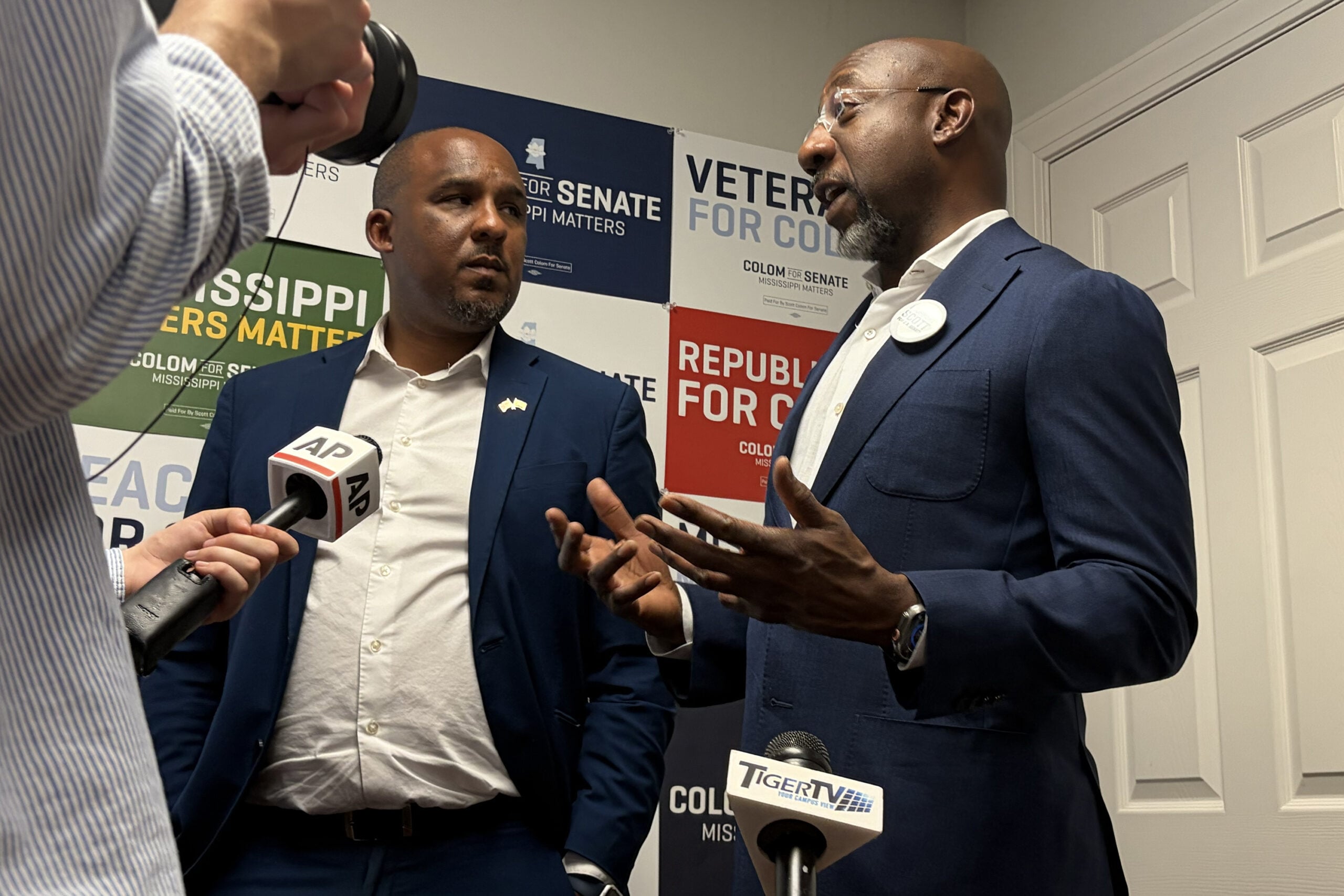
Raphael Warnock is putting money, political influence and donor contacts behind Scott Colom’s attempt to unseat Republican senator Cindy Hyde-Smith in Mississippi, arguing that Democrats are underestimating the South.
The Georgia senator has raised more than $500,000 directly for Colom’s campaign and has used four fundraisers to encourage leading Democratic donors to support the contest, according to a person familiar with his efforts.
Colom, a local prosecutor, is considered within striking distance of Hyde-Smith despite Mississippi’s deep-red political history. Republicans control every lever of state government, while Donald Trump won the state by 24 points in 2024.
At a Democratic donor breakfast in April, Warnock said the party was “sleeping on” the Mississippi race, according to a recording of the event.
“I’m going to ask you to resist the Democratic tendency to ignore the South,” he told attendees. “And for our own sake, for the sake of us having a possibility of winning over time, I think we can win in Mississippi if the conditions are just right.”
Warnock’s Southern strategy
Warnock has described his approach as a “new kind of Southern strategy”, invoking the Republican strategy associated with Richard Nixon in the late 1960s.
He has travelled through Mississippi, the Carolinas and his home state of Georgia to support candidates and promote greater Democratic investment in the region, particularly among Black voters.
Mississippi has a Black population of more than 35 per cent, but the state has not elected a Democrat to the Senate since 1982. Strong Democratic candidates have reached about 45 per cent of the vote in recent years without winning statewide.
Warnock has drawn comparisons with the Democratic victories in Georgia in 2020, when he, Jon Ossoff and Joe Biden all won. He argues that similar breakthroughs will be harder to achieve if the party does not build its organisation and invest in Black voters now.
“It is in the interest of the party to invest in the base and have the base understand that the party understands that these are loyal Democratic voters, and Black voters want what other voters want,” Warnock said. “They want the same kind of prosperity and opportunity that all families want.”
Colom said the party’s failure to prioritise Mississippi was tantamount to ignoring Black voters. “Yeah, of course, 100 percent,” he said.
Democratic resources are already stretched across an expanded Senate map, with funding directed towards more expensive races in states including Iowa, Alaska and Maine. Warnock’s contribution represents about 15 per cent of the $3.5 million Colom has raised during the campaign.
Colom’s campaign raised $1.3 million over the summer, compared with just over $640,000 for Hyde-Smith. However, the sums remain modest beside the tens of millions being spent in other contests.
American Bridge, a Democrat-aligned political action committee, has put more than $2 million into the race. A single donor is also expected to divide $7 million of personal funds between Colom’s campaign and other contests.
Several senior Democrats have backed Colom, with Kamala Harris and Pete Buttigieg planning visits to Mississippi. Senate Majority Leader Chuck Schumer and Kirsten Gillibrand, chair of the Democratic Senatorial Campaign Committee, have each hosted fundraisers, while Lisa Blunt Rochester has campaigned with him.
However, Democratic campaign groups have said they are limited in how much they can spend, while describing Colom as a strong candidate and saying they are monitoring the race closely.
Hyde-Smith’s campaign has maintained its confidence. Jake Monssen, her campaign manager, said the campaign had expected Colom to have substantial resources and was carrying out its own strategy accordingly.
A possible path to 2028
Warnock’s intervention could raise his profile as he considers whether to seek the presidency. Asked about his ambitions, he said he was “trying to think and pray about the highest and best use of my skills”.
He added: “I’ve been at crossroads many times, and in the moment, I’ve always known what to do.”
Andrew Heaton, a Georgia Democratic strategist who has worked on Warnock’s Senate campaigns, said the senator’s regional work would remain significant regardless of whether he ran in 2028.
“The ’28 chatter is something he will listen to, but I don’t think it’s something that’s part of a checklist he’s marching towards,” he said. “Regardless of what happens on that front, ’28 is going to be a very busy year because — especially if he decides not to run — I think there’s no question he’s planning on running for the Senate again.”
Warnock has acknowledged that Democratic investment in Mississippi remains limited. “We’re playing enough here to force the other side to compete in Mississippi, and that is an improvement, but it’s not enough,” he said.
Colom has made a similar appeal, arguing that Mississippi has long been competitive but has not received the attention or funding required to turn that potential into a win.
The contrast was evident when Warnock travelled to North Carolina, where Democrat Roy Cooper has attracted substantial national support and is leading Republican Michael Whatley in fundraising and polling. Democrats have spent years building their position there, beginning with investment after Barack Obama’s 2008 victory and increasing their efforts after Republican lawmakers redrew the state’s congressional maps in 2013.
