


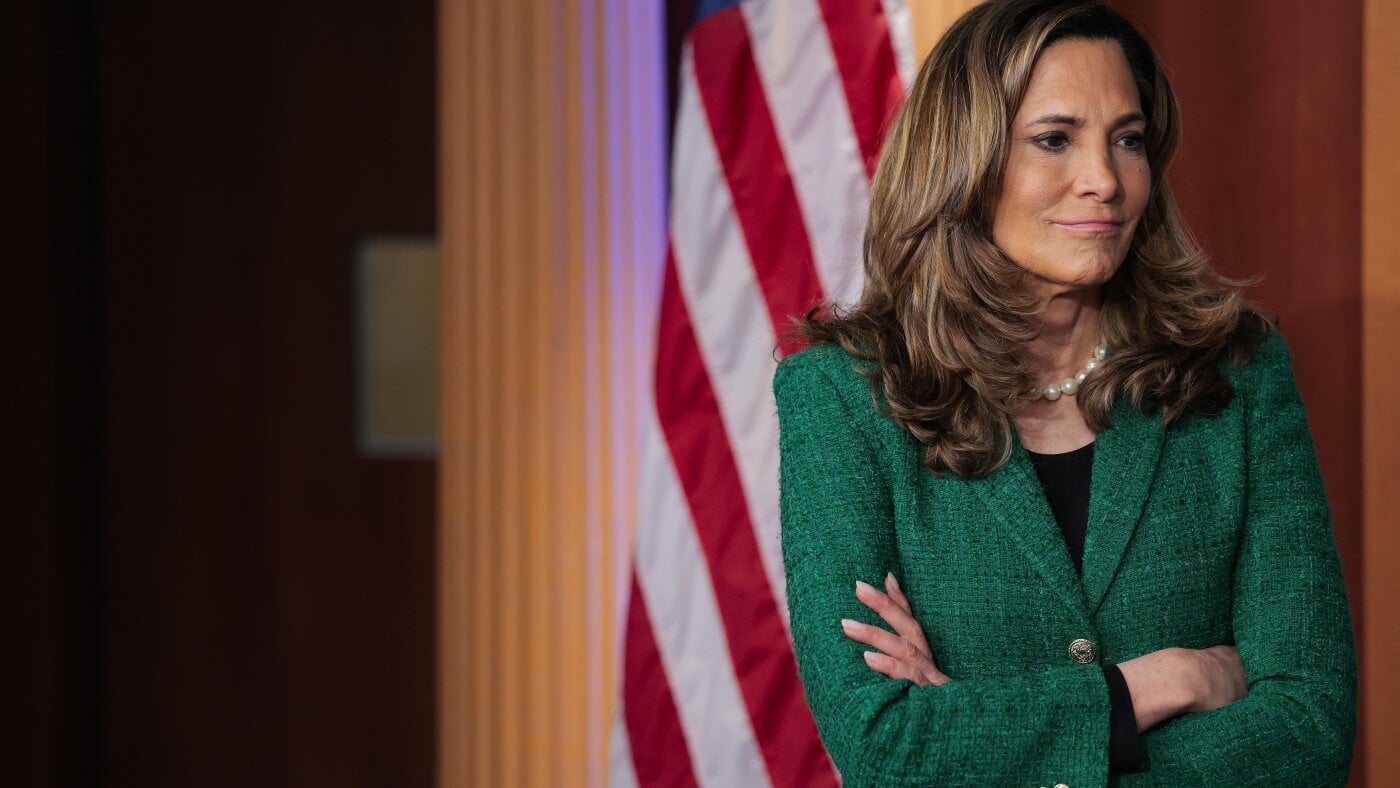
Donald Trump’s immigration policies are threatening Republican support among Latino voters in Miami, according to María Elvira Salazar, the Cuban-American congresswoman who has warned the president that he has “gone too far”.
Salazar, a Republican representing Florida’s heavily Latino 27th Congressional District, delivered the warning in a television advert filmed outside the White House. She said Hispanics who helped Mr Trump win the presidency in 2024 now felt betrayed.
“The same Hispanics who helped you get to the White House in 2024 feel betrayed today,” she said.
The dispute reflects a growing political divide in Miami-Dade County, where immigration enforcement and the cost of living are competing with the Republican message on socialism that once resonated strongly with Cuban-American voters.
At Máximo Gómez Park in Little Havana, also known as Domino Park, voters recently argued over who was responsible for rising living costs. Alejandro Torres, a Republican, blamed Joe Biden, while Ricardo Carracedo, who intends to vote Democrat in the midterm elections, blamed Mr Trump.
The political consequences could extend beyond Florida. In 2024, Mr Trump reduced the Democrats’ advantage among Latino voters nationally to three percentage points, compared with 25 points four years earlier, according to the Pew Research Centre.
Cuban Americans, the largest Latino group in Salazar’s district, have generally supported Mr Trump. But some voters now say friends and relatives have been affected by the administration’s deportation programme.
Mr Trump responded to Salazar’s advert by sharing a post on Truth Social in which another user described her as a “back stabber”. Salazar said she did not regard the remarks as an attack and later spoke to the president.
“I told him, ‘You know, what I’m telling you is what my people are feeling,’” she said. “This is Democracy where we tell the boss, ‘hey, this is what’s happening in my neck of the woods.’ And that’s exactly what I did.”
A recent Equis Research survey found that Hispanic and Latino registered voters would favour a Democratic congressional candidate over a Republican by 57 per cent to 31 per cent if an election were held at the time of the survey.
Salazar has previously opposed some tougher immigration measures. For several years, she has promoted legislation known as the Dignity Act, which would prevent the deportation of immigrants regarded as essential to sectors including hospitality, construction and farming.
Her position has not persuaded all voters. Carracedo said he planned to vote for Democrats, arguing that Salazar’s opposition to deportations had come too late after she had supported Mr Trump and funding for Immigration and Customs Enforcement.
“I’m not going to vote for her, because at the last hour she’s defending Hispanics,” he said in Spanish.
Eduardo Gamarra, a politics professor at Florida International University, said economic difficulties had become the district’s most important issue, followed by deportations. He said some Miami businesses had lost both workers and customers as a result of immigration enforcement.
Democrats seek an opening in Miami
Salazar’s Democratic challenger, Eliott Rodriguez, is also a former broadcast journalist with Cuban roots. He has pledged to overhaul the immigration judge system and restore federal food assistance after cuts that have affected constituents.
Mr Rodriguez acknowledged that Democrats had largely withdrawn from Florida and faced significant ground to recover. “One of the biggest mistakes that Democrats have made in Florida is to think that Florida is unwinnable. But I beg to differ,” he said.
Polling in the district has moved towards the Democrats in recent weeks, although Republicans remain favoured. The non-partisan Cook Political Report rates the contest as “lean Republican”.
Mr Gamarra said the Republican Party would need to depend on its campaign organisation and turnout operation, rather than its policy platform, to retain the seat.
“They’re not going to win on the issues … They’re going to win on turnout,” he said. “The enthusiasm is on the Democrat side. But Republicans have a machinery.”
