


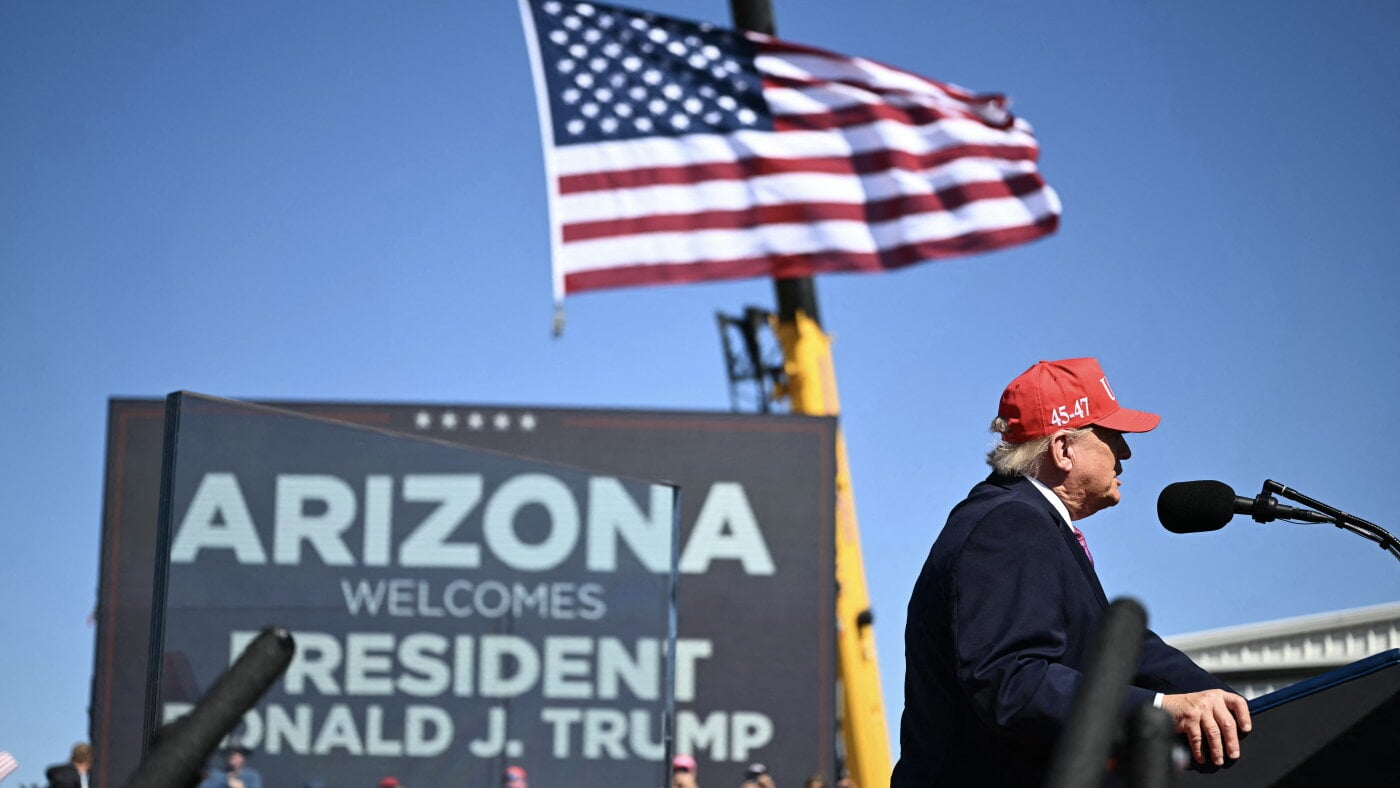
Donald Trump’s midterm campaign blitz has taken him mainly to Republican strongholds rather than the swing states and districts he promised to target, as the party faces unexpectedly competitive races across traditionally safe territory.
The president told Republican candidates at a White House dinner in September that he would visit “every one of those 35 places” represented by those attending. The White House has not clarified which locations he meant, but Trump has since campaigned with fewer than a third of the candidates.
His itinerary has instead included Ohio, Texas, Oklahoma and Tennessee, as well as Arizona, Montana and Alaska. Many of the states have previously backed him decisively, but Republicans are seeking to maximise turnout in races that have become less secure.
Trump has presented the visits as both an effort to support candidates and an expression of gratitude to voters. “So, I do it to thank them,” he said during stops in Arizona and Montana. “I also do it because we have some great people there that are running and I want to make sure they win.”
He has also acknowledged the difficulty Republicans face in midterm elections, when he is not personally on the ballot. His October schedule is intended to encourage supporters to vote as though he were standing for office himself.
Earlier this week, Trump flew for eight hours to Alaska to campaign for Republican senator Dan S Sullivan and representative Nick Begich. Both face races that are considered uncomfortably close in a state Trump won by 13 points in 2024.
“This is worth the 8 hours in a plane,” Trump told the crowd. “And don’t forget I’ve got 8 hours going back. Give me credit for that.” He made two further stops on the return journey and spent the night at his hotel in Las Vegas.
The Republican National Committee has also announced that Trump will campaign in Kansas on Monday, where a Senate race is rated a toss-up. The prospect of a competitive contest there would have been difficult to anticipate even a month ago.
Joe Gruters, the RNC chairman, said the president’s presence was designed to energise Republican voters. “It’s turnout, turnout, turnout. How do you get the base to show up? You put the president on the ballot. You put him out there,” he said.
Trump’s message has remained largely consistent at each stop, focusing on his previous election victories, his One Big Beautiful Bill and lower petrol prices before the war with Iran. He has also promoted the idea of a 5,000-dollar dividend for every American adult if Republicans win control of both chambers of Congress, although elected Republicans have resisted the proposal.
On Tuesday, Trump is due to campaign in Greenville, North Carolina, for Michael Whatley, his chosen Republican Senate candidate. Republican campaign committees have already cancelled advertising reservations intended to support Whatley, indicating that they believe the race is moving beyond reach.
A congressional district in eastern North Carolina has also become unexpectedly competitive after being redrawn to favour Republicans as part of Trump’s mid-decade redistricting effort. The Cook Political Report now rates the seat as a toss-up.
Anderson Clayton, chair of the North Carolina Democratic Party, said Trump’s late intervention would fail to revive Republican support. “He’s trying to drum up any amount of support that he can at the last minute,” she said. “But I don’t think that North Carolinians are going to fall for it again.”
