


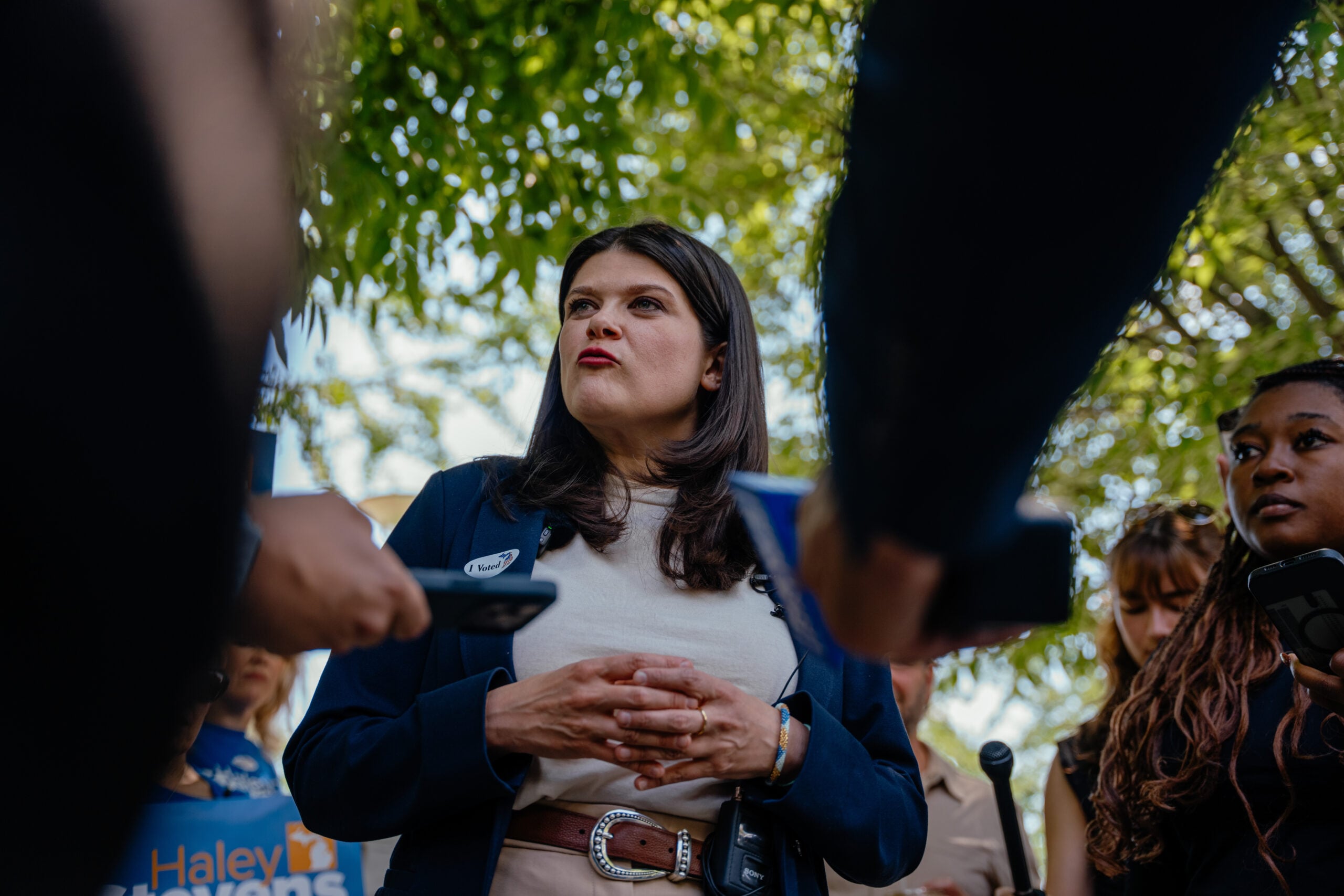
Haley Stevens has endorsed Abdul El-Sayed in Michigan’s Senate race but has largely stayed away from his campaign, raising concerns among Democrats that the coalition she built during the primary has not rallied behind her former rival.
Stevens quickly backed El-Sayed after losing the August 4 Democratic primary, but has since done little publicly to help him take on Republican former representative Mike Rogers. Some of her former supporters and donors continue to withhold their backing, while others have openly supported Rogers.
Asked whether she was encouraging her former donors to support El-Sayed, Stevens said her role was to “be part of the coordinated campaign, support where I can”, including helping in Michigan House races.
Pressed on whether she would personally urge donors to back El-Sayed, she replied: “That’s Elissa’s thing,” referring to Senator Elissa Slotkin, who has been fundraising for the Democratic nominee.
“I didn’t win a Senate primary,” Stevens added. “It’s not like a salty grapes deal or anything.”
Stevens said she had checked in with El-Sayed’s team but had not recently met the candidate because she had been travelling. She suggested that his campaign was assembling a different electoral coalition from the one that supported her.
“There’s changing dynamics, and there’s a new coalition that Abdul has built, and some people are a die-hard part of it, and some people are not,” Stevens said. “We’re seeing some constituent community pain coming out.”
She said Rogers was making particularly strong efforts to win over Black voters. “Rogers is working the Black community harder and more successfully than we have ever seen a Republican do or at least that I can remember — ever,” Stevens said.
She also acknowledged El-Sayed’s efforts to broaden his support, saying he had been visiting Michigan’s Upper Peninsula and filling venues in rural areas. El-Sayed performed strongly in the primary among young voters, Arab-American communities and parts of rural Michigan and is seeking to expand that base in the general election.
Democratic coalition remains divided
Debbie Rosenman, chair of the Birmingham-Bloomfield Area Democratic Party Club and an El-Sayed supporter, said Stevens had been “absent” from the campaign trail. She said she was “very concerned” that Stevens’s coalition was not coming together behind the nominee.
“I feel that that could change with more of her public support,” Rosenman said.
El-Sayed’s campaign said the two teams remained in close contact and pointed to several former Stevens staff members who joined his operation after the primary.
“The Abdul campaign is grateful for Congresswoman Stevens’ immediate and sustained support,” Roxie Richner, an El-Sayed campaign spokesperson, said.
El-Sayed has sought to repair relationships with Black and Jewish leaders, securing endorsements and campaigning with prominent Democrats from both communities, including former president Barack Obama, former vice-president Kamala Harris and Slotkin.
His campaign said he had made more than two dozen visits to Black churches and taken part in more than 100 events and meetings with Black leaders. He has also appointed a liaison to the Jewish community and apologised for a remark following a synagogue attack in West Bloomfield in the spring which he said had “hurt people hurt people”.
“I take very seriously that I’m going to represent a large community of Jewish Michiganders, and I want them to know that I’m committed to their safety and their well being, even if there are points in foreign policy on which we might disagree,” El-Sayed said.
Some Stevens supporters have not been persuaded. David Kramer, her primary campaign chair and a vice-chair of the Michigan Democratic Jewish Caucus, is now working with Nonnegotiable Michigan, a group of Jewish leaders withholding support from El-Sayed unless he changes his approach to Israel.
Kramer said he was not using his donor network for the general election and estimated that more than seven figures had been left unraised for El-Sayed as a result.
Brian Hermelin, a Democratic donor who supported Stevens and leads the Jewish Federation of Detroit, co-hosted a fundraiser for Rogers shortly after the primary which raised about $200,000.
Rogers’s campaign has sought to exploit the divisions by launching a “Democrats for Mike Rogers” group and courting Black and Jewish voters. Bobby Schostak, the former Michigan Republican chair and Rogers’s finance chair, said the campaign had raised roughly $3 million to $4 million since the primary from non-traditional Republican donors, including Democrats.
“The Democratic Party is still divided,” said Mary Waters, a Black Detroit city councillor who has met both candidates and remains undecided. “People are still so torn about what it is that they want to do.”
Joe Tate, a Black state representative from Detroit who backed Stevens, said there was lingering apprehension about El-Sayed. However, he said Stevens’s endorsement had helped persuade him to support the candidate and predicted that most Democratic voters would ultimately remain with their party.
El-Sayed raised nearly $33 million between July and September, including money raised before the primary, compared with almost $10 million for Rogers. He has also been outspending his Republican opponent on television.
Slotkin has been among the Democrats working to win over sceptical donors. She hosted an El-Sayed fundraiser in Washington in late September, telling attendees that although she did not agree with him on everything, they agreed on the important task of providing “a check and balance on this president”.
“And they donated,” Slotkin said.
