


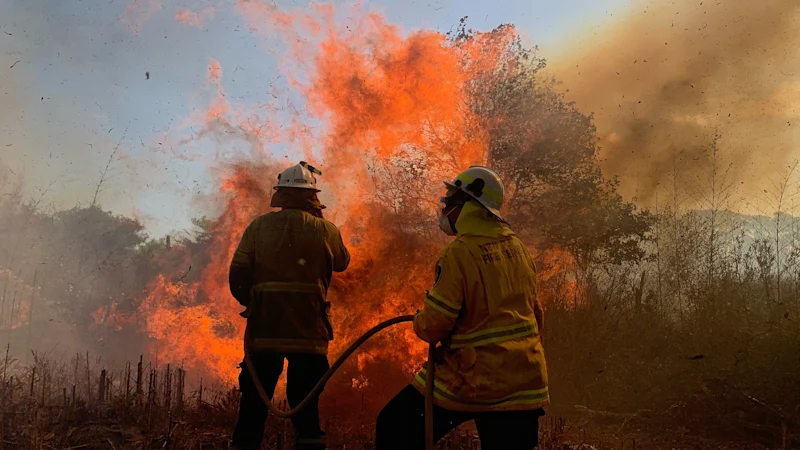
Queensland bushfire smoke is affecting urban air quality more frequently and severely than previously understood, with pollution travelling hundreds or even thousands of kilometres and increasing public health risks, a Queensland University of Technology-led study has found.
Researchers examined air quality records from 22 urban monitoring sites across the state between 2008 and 2023. They found smoke from bushfires could raise fine particle pollution, known as PM2.5, by up to 160.5 per cent during a fire event.
Ozone concentrations rose by as much as 33.2 per cent during the fire-active season, which runs from July to December. Between 2018 and 2023, the number of hours affected by bushfires during that period was about three times higher than between 2008 and 2017.
Lead researcher Dr Zijun Li said climate change and heatwave conditions were contributing to more frequent and intense fires, while longer burning periods were increasing pollution levels.
“Bushfire smoke is not only a problem for communities located near fires,” Dr Li said. “Our research shows emissions can travel hundreds or even thousands of kilometres and significantly affect air quality in urban areas far from the source.”
PM2.5 particles emitted by fires are small enough to enter deep into the lungs and bloodstream and have been linked to respiratory and cardiovascular health impacts.
The research also found bushfire emissions can interact with pollution already present in cities, particularly nitrogen oxides released by vehicles and industry, to increase ozone levels.
“This means bushfire smoke can worsen air quality even when the fires are a long way from the city,” Dr Li said.
Gold Coast University Hospital doctor Yian Zhao, who has had asthma since early childhood, said he could feel changes in air quality when smoke was present.
Zhao moved to Australia from China at the age of 11 because of concerns about air quality and grew up in Adelaide. He said smoke and allergies were his main asthma triggers and that he would sometimes take additional inhalers when smoke was in the air.
“I look at it from both sides, as a doctor and a patient myself,” he said. “For me, it gets a little bit harder to breathe whenever there’s smoke in the air.”
Zhao said a rise in bushfires would also place additional pressure on the public health system, where resources were finite.
