


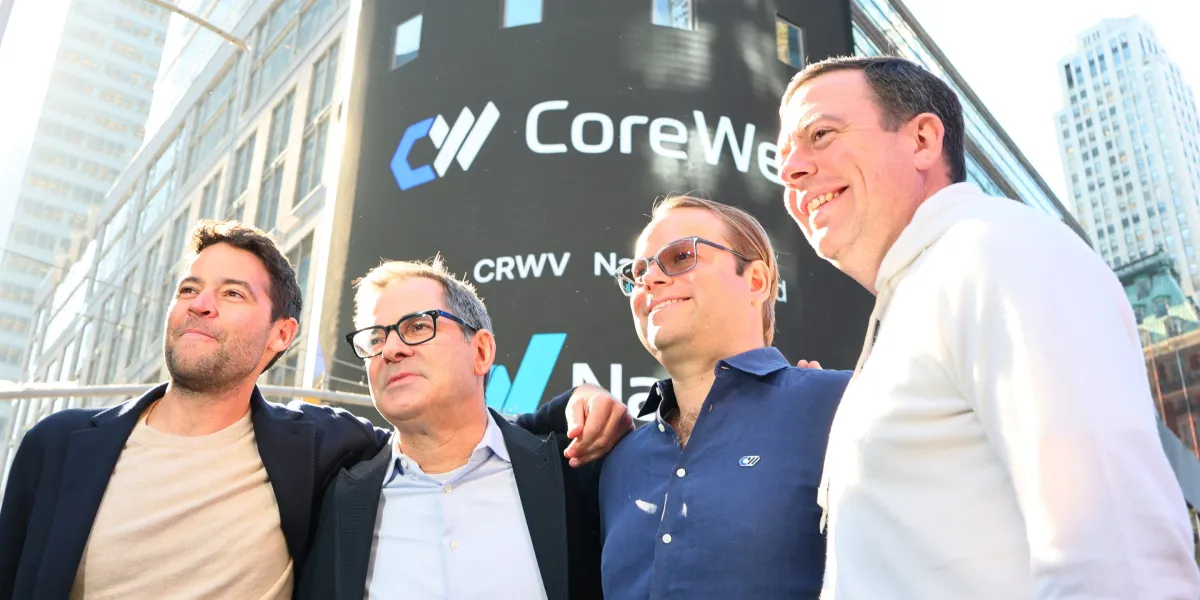
CoreWeave’s shares have fallen sharply after concerns over the AI infrastructure company’s debt intensified, but one investor has argued that its large financial obligations are supported by long-term contracts with major customers.
The company’s shares dropped 15.46 per cent on Wednesday and fell a further 5.62 per cent in after-hours trading after venture capitalist Chamath Palihapitiya highlighted a rise in the yield on its bonds to 15 per cent. The move suggested investors were demanding a substantial premium to hold CoreWeave’s debt.
“Is the AI buildout creating a private credit bubble?” Palihapitiya asked in a post on X.
The concern came as CoreWeave co-founder and finance lead Brannin McBee said the company wanted to raise more money from insurance companies. He described the sector’s access to capital as “unlimited”, adding: “Like, that’s all the money in the world that sits in the insurance tranche.”
CoreWeave reported operating lease liabilities of $16.3 billion and total debt of $35.6 billion in its second-quarter results. It generated $4.6 billion in revenue during the quarter but recorded a net loss of $1.4 billion after operating expenses exceeded sales.
CoreWeave debt backed by ‘take-or-pay’ contracts
Evan Schlossman, principal at Neostellar Capital Corp, said the company’s debt should be viewed alongside $103.7 billion in remaining performance obligations. About 41 per cent of that contracted income is due to be paid to CoreWeave by 2028, according to its second-quarter disclosure.
Remaining performance obligations are agreements for services that have not yet been delivered but for which payment is expected in future. Schlossman said CoreWeave’s contracts were non-cancellable, effectively making them “take-or-pay” agreements under which customers must pay even if they do not use the full service.
CoreWeave’s biggest customers include Microsoft and OpenAI. Its three largest customers, including one that has not been named, accounted for 72 per cent of its second-quarter revenue.
Schlossman said the strength of those customers’ balance sheets helped explain why lenders were prepared to provide financing despite the company’s losses and substantial commitments. He said CoreWeave had customers with a “tier-one balance sheet” supporting its borrowing.
CoreWeave said 98 per cent of its revenue came from committed, take-or-pay contracts. “We are confident in our backlog, which more than supports all of our debt obligations,” the company said, adding that most of its financing was structured so that customer cash flows repaid the related debt while generating additional free cash flow.
Schlossman said Microsoft was unlikely to become unable to pay and that the terms of its agreement appeared to give it limited routes to withdraw, including circumstances in which CoreWeave could not deliver its services because of a force majeure event.
He also argued that CoreWeave’s capacity could potentially be sold to other customers if OpenAI were to disappear, because demand for computing power was greater than when the contracts were signed.
However, he acknowledged that smaller companies in the AI ecosystem could face greater risks, particularly those backed by venture capital and reliant on customers that were themselves young, venture-backed businesses. “If there is something that goes wrong, I think you’re going to see that it’s going to matter significantly who owes you money, as it does in most businesses,” he said.
Not all analysts are persuaded that CoreWeave’s contracted income removes the danger. Francine McKenna, an accountant and investigative journalist, said Microsoft might not honour its commitments if demand for computing power weakened.
“If CoreWeave is counting on Microsoft to honor its contracts and bail them out of extreme debt and losses I have a bridge in Brooklyn I’d like to sell them,” she said. “Microsoft is ruthless and will eat CoreWeave for lunch and throw bones to its dogs if it makes sense for them.”
Microsoft declined to comment.
