


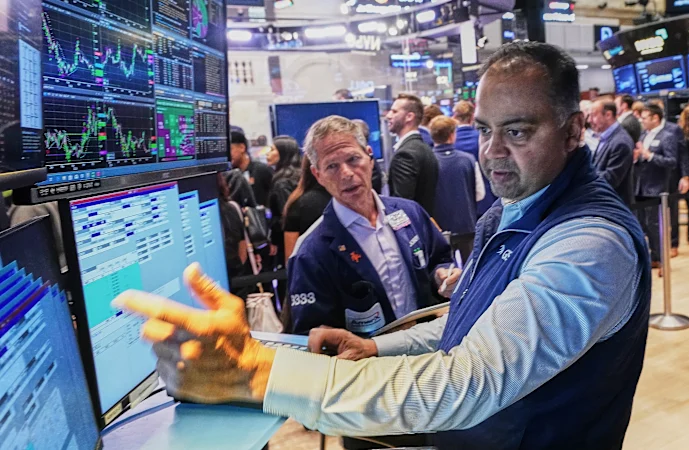
Wall Street fell sharply despite a strong first appearance for Anthropic, sending a fresh warning to investors in artificial intelligence shares and putting Australia’s market on course for further losses.
The S&P 500 dropped 1.1 per cent in early afternoon trading after initially rising 1.3 per cent. It was heading towards a sixth consecutive decline, which would be its longest losing run in two and a half years.
The Dow Jones Industrial Average was down 766 points, or 1.5 per cent, while the Nasdaq composite fell 1 per cent. About 85 per cent of companies in the S&P 500 were lower.
Futures pointed to an opening fall of 89 points, or 1 per cent, for the ASX. Australia’s benchmark index had already lost 1 per cent in the previous session, its sixth straight day of declines, while the Australian dollar weakened to US66.74 cents.
Anthropic debut fails to steady AI shares
Anthropic, the company behind the Claude chatbot, priced its initial public offering at US$83 a share, above its earlier expected range of US$70 to US$78. Its shares rose above US$115 soon after trading began on the Nasdaq, before giving back some of those gains to trade at US$98.56, up 18.7 per cent.
The debut briefly lifted other companies linked to the artificial intelligence boom. Investors had been looking for signs that demand for the technology remained strong after concerns that valuations had risen too far.
Those gains quickly faded. Micron Technology, which has benefited from increased demand for computer memory used in AI systems, moved from a 7.8 per cent rise to a 0.5 per cent fall.
CoreWeave, which buys AI chips and rents access to them through the cloud, swung from a 10.5 per cent gain to a 3.1 per cent decline. Nvidia also surrendered an early 4.7 per cent advance and fell 1 per cent.
Investors have questioned whether AI will generate enough profit and productivity to justify the heavy spending on data centres. Concerns about high interest rates, possible regulation following Democratic victories in the US midterm elections and the reported resignation of Nvidia chief executive Jensen Huang have added to the pressure on the sector.
There were some brighter spots. Palo Alto Networks rose 5.6 per cent after reporting quarterly profit and revenue above analysts’ expectations and agreeing to buy Applied Compute in an all-share deal valued at US$4.5 billion.
Everpure gained 10.2 per cent after saying revenue had increased 51 per cent from a year earlier, partly because of products linked to AI. Its quarterly profit also exceeded expectations.
Elsewhere, Williams-Sonoma fell 13.9 per cent after revenue came in just below forecasts. Walmart declined 1.3 per cent despite reporting quarterly profit and revenue slightly ahead of analysts’ expectations.
US Treasury yields were broadly steady after figures showed a small rise in weekly applications for unemployment benefits and weaker-than-expected manufacturing growth in the mid-Atlantic region. The yield on the 10-year Treasury edged down to 5.06 per cent from 5.07 per cent.
Asian markets were mixed. Japan’s Nikkei 225 rose 0.7 per cent, helped by a 4.6 per cent rise in SoftBank Group, while South Korea’s Kospi gained 1.4 per cent as AI-linked shares advanced. European markets were weaker, with Germany’s Dax down 1.1 per cent.
